Frankfurt Book Fair, 2026
A report by Nico Weidenfeld
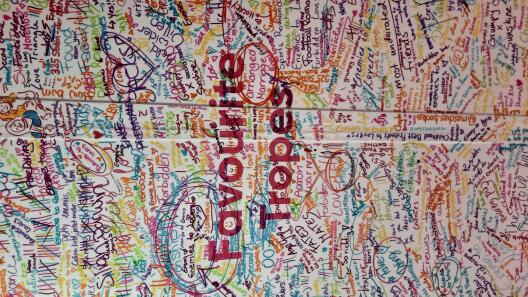
For the 5th year in a row, students from the MA BAPS and MA NTS traveled to Frankfurt to represent Book Studies at the Frankfurt Book Fair, the world’s largest trade fair for books. Leaving on a sunny Wednesday morning, the students arrived by train and were soon swept up by a world of publishers, booksellers, news outlets, and more. After greeting Professor Norrick-Rühl, the students set up the booth, creating a cozy, creative, and welcoming atmosphere in the exhibition hall. Colorful posters on the booth’s walls displayed some of the department’s focuses, such as scholarly activism and feminist book history, while clotheslines above the booth presented samples of marbled paper from previous book studio events. On the table, visitors could pick up bookmarks, book studies themed bingo and mad libs, as well as peruse a collection of zines. Next to the booth, a posterboard allowed fair-goers to cast their vote on a range of important questions: What’s your favorite comfort novel? Who’s the best book boyfriend? And who’s the best female protagonist?
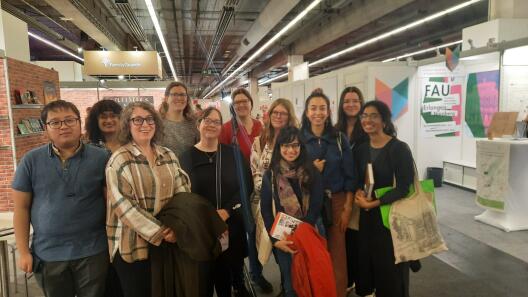
The Book Studies stand at the fair was part of the larger “Studium Rund ums Buch” program. Hosted by Frankfurt Media Campus, it brings together students of book studies and publishing from universities across Germany. This let prospective students and their parents peruse and compare programs, and gave the students the opportunity to meet each other. Similar to the team from Münster, the other universities had their own strategies for attracting visitors to their stalls, and all the students were happy to exchange freebies–like stickers with the slogan “Hot girls read,” or postcards with a map of publishing houses–with one another. One university even brought a printing press and allowed visitors to try their hand at printing a coaster.
Once a day, a student representative from each of the universities would share the stage and answer questions about the similarities and differences between all the programs, giving the public a glimpse into the academic lives of book studies and publishing studies students. Münster’s Book Studies program stood out from the others in a few ways: for one, it is the only book or publishing studies program in Germany that is conducted entirely in English. Additionally, the flexibility of Book Studies at Münster, as well the breadth of the experiences that the students here gain, came up repeatedly as one of the program’s highlights. Similarly to the pre-professional publishing programs, students of Book Studies in Münster have opportunities to gain their own publishing experience through the student-run journal Satura or through mandatory internships; they gain skills, like working with large data sets, that are important in academic and non-academic contexts alike. However, in addition to these more traditional offerings, students in Münster get hands-on experience with printmaking, book binding, and paper arts at the Book Studio, have access to a zine library, get strong academic support for studying non-commercial and independent publishing modalities, and have frequent opportunities to engage in social activism and public outreach through the Banned Books Network.
In addition to the daily student panel, the “Studium Rund ums Buch” stage hosted other events from the Book Studies team. Dr. Laura Dietz, an Associated Fellow of the Book Studies department and a lecturer at University College London, gave a talk on bibliotherapy. Her recent work looks at wellness-related reasons for preferring various book formats–for example, insomnia sufferers may enjoy listening to audiobooks at night–and how this relates to current reading for well-being schemas and policy. Prof. Schultermandl, Dr. Jennifer Gouck, and BAPS graduate Aline Franzus presented the work of Banned Books Network Münster. This talk introduced listeners to the specifics of book bans in a US-American context, highlighting that bans often come from well-funded lobby groups (as opposed to parents), and that books which explore topics such as race, gender, and sexuality are most frequently targeted in bans. Franzus’ portion of the event allowed her to share about her work as the founder of Silent Book Club Münster and to emphasize the radical, community-building potential of collective reading practices. Both the bibliotherapy talk and the book banning talk were hosted by student moderators from the Book Studies department, and both events were fascinating and critically relevant.
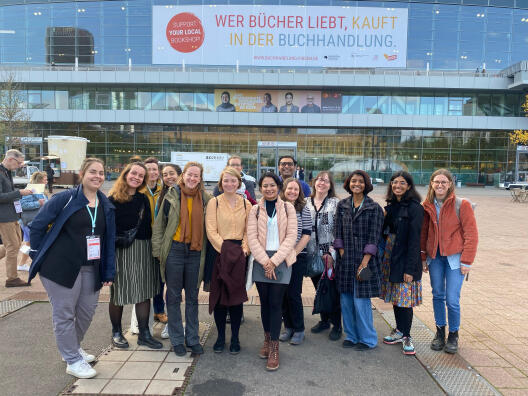
When students were not taking a shift at the Book Studies booth, they were free to explore the rest of the fair, which filled five massive, multi-story exhibition halls. The fair was roughly organized thematically, though the hall where the universities were seemed to be an anomaly in this regard, housing booths from newspapers, independent publishers, large publishers, German states, tea brands, and even an escape room themed around the works of German crime-thriller novelist, Sebastian Fitzek. Other halls mostly grouped fair exhibitors based on their language and continent of origin. Countries hosted booths to represent the publishing market of their nation, offering visitors a taste of a region’s cultural exports and literary tradition. Translation rights were being bought and sold, contracts were being signed, and the fair offered colleagues from different parts of the globe a place to all connect.
Each year, the fair highlights a specific country as the guest of honor, and for 2026, this was Czechia. The Book Studies students explored the nation’s special exhibition, which was themed around the motto “A country on the coast,” despite the fact that Czechia is land-locked. This quote instead refers to Shakepeare’s decision to portray Bohemia as a seaside location in A Winter’s Tale, and was reinterpreted during the fair as a metaphor for the Czech literary sphere’s relationship with global literature. Much like a port can be a cultural crossroads, the Czech literary tradition was presented as a site of historical and continuous cross-linguistic and intercultural exchange. A particular focus of Czechia’s guest of honor program was to promote the publication of Czech literature abroad and its translation into widely-spoken languages. Programming accompanying the nation’s guest of honor status at the fair will continue in Frankfurt through the end of 2026.
While most people at the fair were on a tight schedule, fitting a year’s worth of appointments into the span of a few days, the students all found people at Frankfurt Book Fair who were open, eager to talk, excited about new projects, and glad to offer advice to someone new to the publishing world. The students in attendance all had different interests: some were planning a career in education and wanted to connect with picture book publishers, others wanted to connect with publishers working in specific linguistic markets (like Turkish or Russian), while others were most excited about meeting independent, activist publishers. In these conversations, students got to meet authors, make connections, hear about upcoming events, and learn a little bit more about the daily work that publishing entails. At the end of the day, back at the hostel, the students shared their recaps of the day’s encounters and adventures with one another. While everyone’s days had been full of fun and excitement, no two days were ever exactly alike.
Friday, Saturday, and Sunday at the fair were open to the public, and on these days, exhibitors focused more on offering events for visitors than on doing business with each other. Famous authors came to speak–at one point, right across from the Book Studies booth, Colson Whitehead was interviewed by the Süddeutsche Zeitung, drawing quite the crowd. At events with comics publishers, some visitors arrived in cosplay, eager to get new and limited-edition merchandise. Lines for signed editions from authors grew long, wrapping around the perimeters of the exhibition halls, and live musical performances in the courtyard contributed to a festive (if at times hectic) atmosphere.
The size and the fame of the Frankfurt Book Fair also seemed to create an ecosystem around it. Some particularly strategic zine festival organizers decided to host an event at the same time as the book fair, walking distance from the main convention center, and to advertise the festival on the book fair’s website. Between one student’s visit around the zine festival’s opening time, and another’s late afternoon visit, the festival had become as crowded as the fair itself, and some of the artists had completely sold out of work. Other groups used the crowds drawn by the fair as an opportunity to advertise products near the festival’s entrance or to stage protests, a reminder of the inherently political nature of literature and publishing.
All in all, the Book Studies excursion to the Frankfurt Book Fair was an exciting, social, exhausting, fun, and horizon-opening whirlwind. It gave students the opportunity to meet publishers, to make friends, to channel their creativity into an interactive fair booth, to talk with prospective Book Studies students, and to collect lots and lots of pieces of paper: stickers, posters, publisher catalogues, and yes–even books.
We look forward to seeing everyone in Frankfurt again in 2027! Until then, keep reading!