

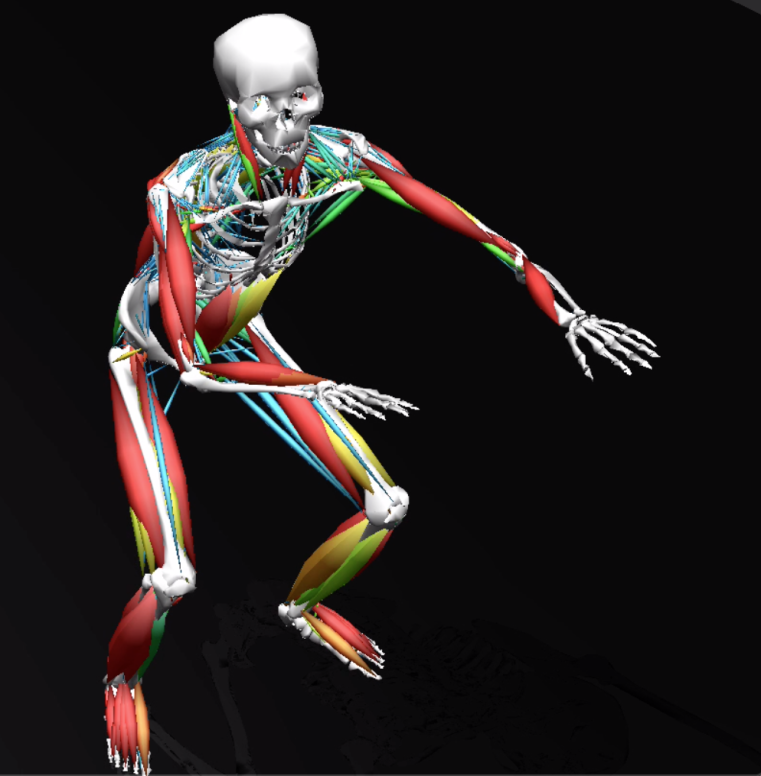
Myonardo works on the comprehension of the relationship between motor control and the biomechanical requirements of the human body. To obtain this, experimental methods and the computational muscle-skeletal model Myonardo are combined. Myonardo is based on human physiology and aims to provide foundational knowledge of human motion which can also be applied to individual usage for detailed analyses. Therefore, an application is possible for every human in any kind of circumstance. The information acquired may also be used to intensify the understanding of musculoskeletal pain. First and foremost, we put forward the idea to combine internal forward and inverse models into one unified neural circuit that controls and predicts movement in a parallel fashion. Further current research is done on developing a 3D human model with bones, muscles, reflexes, and motor control units.
During research kinetic and kinematic measures, electromyography, modelling in MATLAB and Simulink and state of the art neuronal networks are used. As a result, motion tracking and mixed dynamics analyses with Myonardo enable a detailed evaluation of the data. Current research topics are the concept of self-stability, analysis of spinal control and various research areas involving the Myonardo. Ongoing cooperative work exists with the Vrije Universiteit Amsterdam, Karl-Franzens University Graz and the Friedrich-Schiller-Universität Jena.