

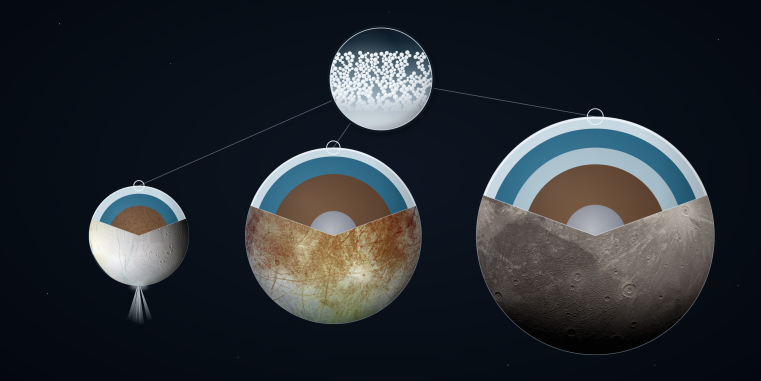
Icy moons are satellites of the outer planets whose surfaces consist predominantly of water ice. They include the large moons of Jupiter and Saturn, such as Europa, Ganymede, Callisto, Enceladus, and Titan. Beneath their icy crusts, many of these moons are thought to harbor subsurface liquid-water oceans. On smaller moons such as Enceladus and Europa, these oceans are likely in direct contact with the underlying rocky interior. On larger moons such as Ganymede, Callisto, and Titan, however, the ocean is thought to be sandwiched between layers of ice: an outer shell of ordinary low-pressure ice above and high-pressure ice phases below, which separate the ocean from the rocky core. These subsurface oceans are considered among the most promising environments in the search for conditions that could support life beyond Earth.
The surfaces of icy moons are shaped by low temperatures, radiation, and geological activity. On Enceladus, for example, jets of water vapor and ice particles erupt from fractures in the south polar region, carrying material from the underlying ocean into space. Such activity makes icy moons key targets for current and future space missions.
At the Institut für Planetologie, we investigate the surfaces of icy moons to better understand their thermophysical and mechanical properties. To this end, we use our thermophysical model MoCSI as well as laboratory experiments, including measurements of the compression behavior of granular ice. In addition, our one-dimensional thermal evolution model allows us to simulate the long-term evolution of an icy moon from its (metallic) core to its surface. In further laboratory experiments, we investigate potential sample acquisition mechanisms relevant to ESA's proposed L4 mission to Enceladus.
Through this work, we contribute to a better understanding of icy moons and provide the scientific foundations needed to interpret data from current and upcoming missions such as JUICE, Europa Clipper, ESA's proposed L4 mission, and NASA's Dragonfly mission to Saturn's moon Titan.