

Research Foci
Formation of solids in the early solar system
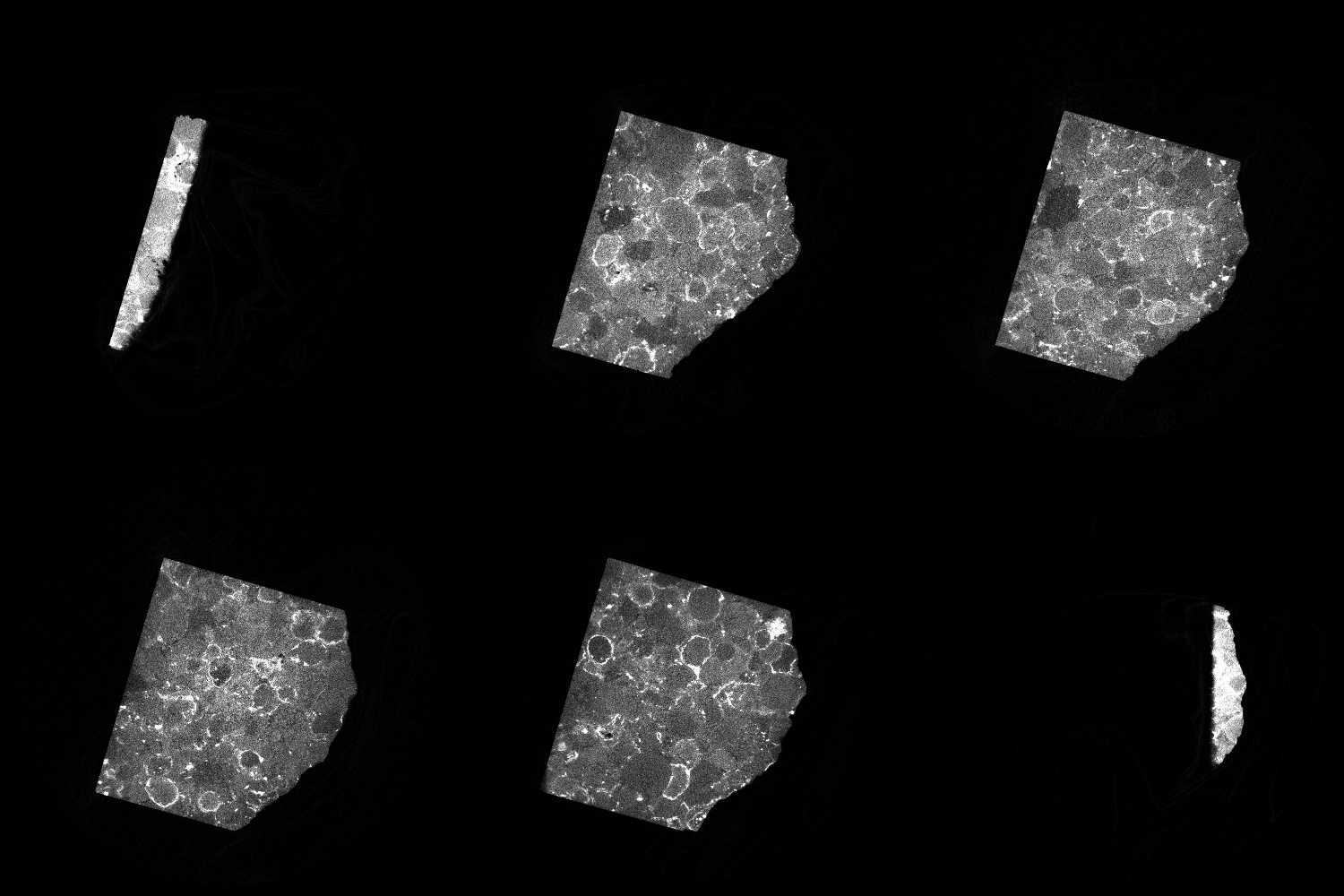
The collapse of a part of an interstellar molecular cloud marks the beginning of our solar system. The size of the dust grains contained in this gas cloud was on the order of nanometers to micrometers. From the collapsing cloud a protoplanetary accretion disk formed around a central protostar, our early sun. Later on, the planets and asteroids formed within this disk from parts of the gas; and dust mixture. The process of the transition from micrometer-sized grains to millimeter; to meter-sized bodies is not well understood yet. Fortunately, a large variety of these early solids can be found in the asteroidal rocks, which fall to us on Earth as chondritic meteorites and are available for scientific study in order to clarify this question.
Accretionary structures in primitive meteorites
Extraterrestrial breccias
Nuclear tracks by cosmic radiation in meteoritic minerals
CV
Academic Education
- PhD in Planetology, Institut für Planetologie, WWU Münster "Petrographic and michochemical investigations on the history of accretion and evolution of chondritic parent bodies using the example of CM chondrites".
- PhD study, Institut für Planetologie, WWU Münster
- Diploma in Mineralogy, Institut für Mineralogie, WWU Münster "Texture and composition of lithic clasts in polymict achondritic breccias"
- Intermediate diploma in Mineralogy, Institut für Mineralogie, WWU Münster
- Study of Mineralogy, Institut für Mineralogie, WWU Münster
Positions
- Research scientist, Institut für Planetologie, WWU Münster
- Branch manager (private companies in the field of waste management and environmental remediation), Hamm, Münster
- Chief curator for the rock, mineral, and meteorite collections at the Museum für Naturkunde, Humboldt-Universität Berlin
- Research Scientist, Institut für Planetologie, WWU Münster
- Research Scientist (part time work), Institut für Planetologie, WWU Münster
External Functions
Projects
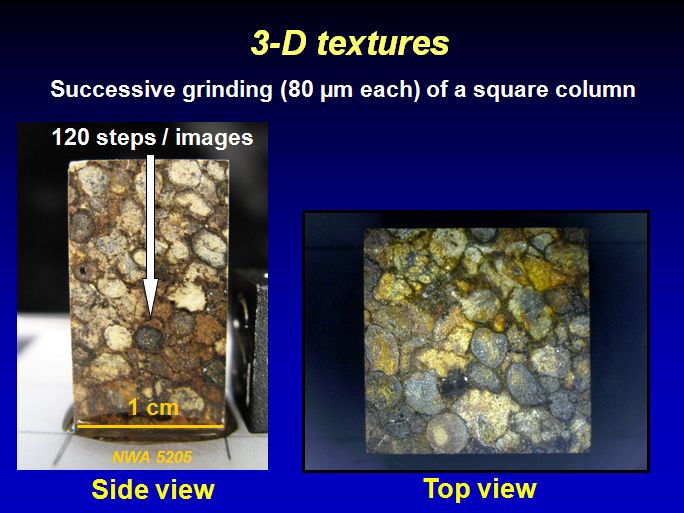
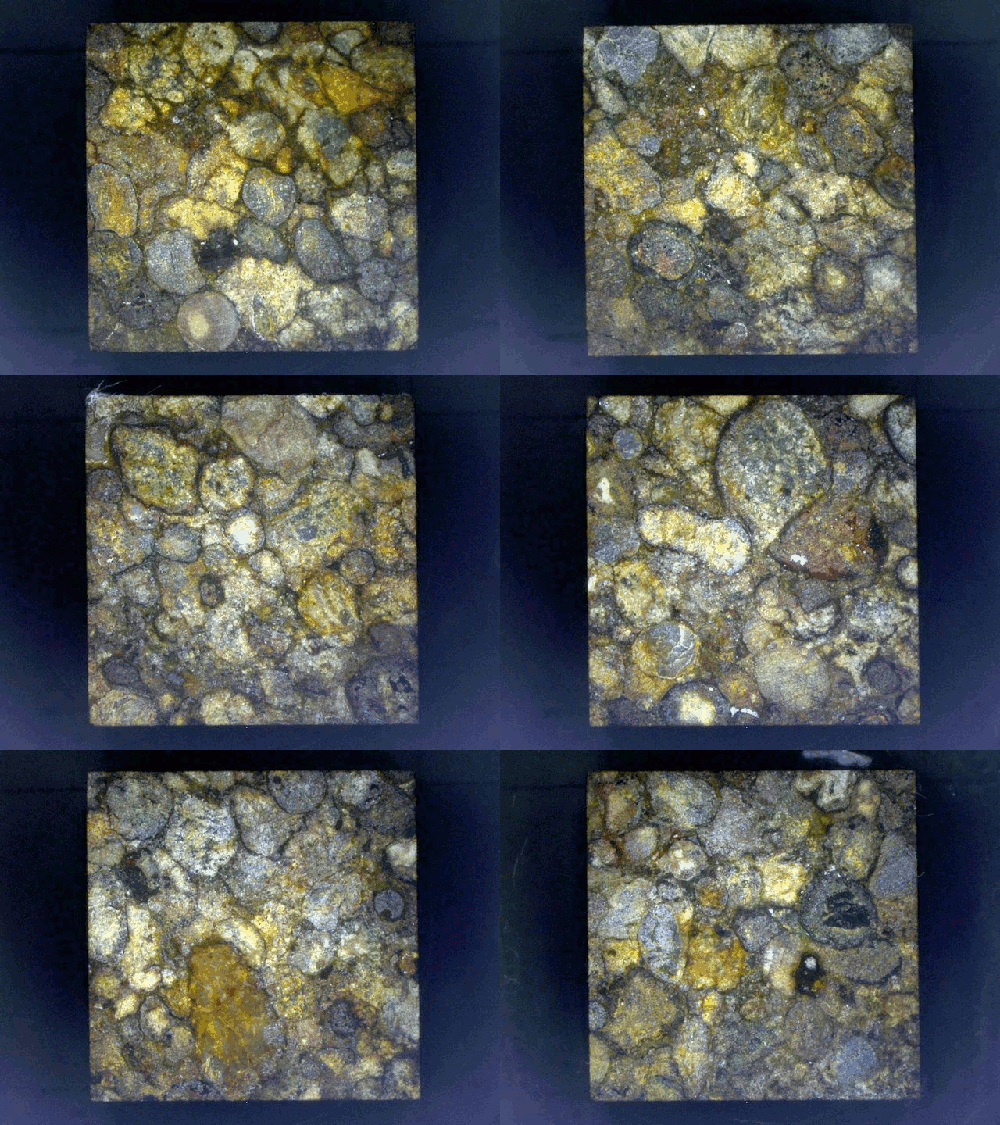
- True (3D) chondrule size distributions: Basic data for the reconstruction of chondrule formation and asteroid accretion ()
Individual Granted Project: DFG - Sachbeihilfe/Einzelförderung | Project Number: ME 1115/10-1 - SPP 1385 - Subproject: High-temperature chondrule accretion in primitive chondrites and its relevance for theories of chondrule formation and planetary accretion (3rd funding period) ()
Subproject in DFG-Joint Project Hosted outside University of Münster: DFG - Schwerpunktprogramm | Project Number: ME 1115/8-3 - SPP 1385 - Subproject: High-temperature condrule accretion in primitive chondrites and its relevance for theories of chondrule formation and planetary accretion (2nd funding period) ()
Subproject in DFG-Joint Project Hosted outside University of Münster: DFG - Schwerpunktprogramm | Project Number: ME 1115/8-2 - SPP 1385 - WP: High-temperature chondrule accretion in primitive chondrites and its relevance for theories of chondrule formation and planetary accretion (1st funding period) ()
Subproject in DFG-Joint Project Hosted outside University of Münster: DFG - Schwerpunktprogramm | Project Number: ME 1115/8-1
Publications
- Metzler, K, Hezel, DC, Barosch, J, Wölfer, E, Schneider, JM, Hellmann, JL, Berndt, J, Stracke, A, Gattacceca, J, Greenwood, RC, Franchi, IA, Burkhardt, C, and Kleine, T. . “The Loongana (CL) group of carbonaceous chondrites.” Geochimica et Cosmochimica Acta 304: 1–31. doi: 10.1016/j.gca.2021.04.007.
- Hellmann, JL, Kruijer, TS, Metzler, K, Patzek, M, Pack, A, Berndt, J, and Kleine, T. . “Hf-W chronology of a macrochondrule from the L5/6 chondrite Northwest Africa 8192.” Meteoritics and Planetary Science 55 (10): 2241–2255. doi: 10.1111/maps.13571.
- Heck, PR, Herd, C, Grossman, JN, Badjukov, D, Bouvier, A, Bullock, E, Chennaoui‐Aoudjehane, H, Debaille, V, Dunn, TL, Ebel, DS, Ferrière, L, Garvie, L, Gattacceca, J, Gounelle, M, Herd, R, Ireland, T, Jacquet, E, Macke, RJ, McCoy, T, McCubbin, FM, Mikouchi, T, Metzler, K, Roskosz, M, Smith, C, Wadhwa, M, Welzenbach‐Fries, L., Yada, T, Yamaguchi, A, Zeigler, RA, and Zolensky, M. . “Best practices for the use of meteorite names in publications.” Meteoritics & Planetary Science 54 (7): 1397–1400. doi: 10.1111/maps.13291.
- Leitner, J, Metzler, K., Vollmer, C, Floss, C, Haenecour, P, Kodolanyi, J, Harries, D, and Hoppe, P. . “The presolar grain inventory of fine-grained chondrule rims in the Mighei-type (CM) chondrites.” Meteoritics & Planetary Science 54. doi: 10.1111/maps.13412.
- Metzler, K, Hezel, DC, and Nellesen, J. . “Various size-sorting processes for millimeter-sized particles in the Sun´s protoplanetary disk? Evidence from chondrules in ordinary chondrites.” The Astrophysical Journal 887 (2). doi: 10.3847/1538-4357/ab58d0.
- Stöffler, D, and Hamann C, Metzler K. . “Addendum to ‘Stöffler, D., Hamann, C., and Metzler, K., Shock metamorphism of planetary silicate rocks and sediments: Proposal for an updated classification system. Meteoritics & Planetary Science 53, 5–49, 2018’.” Meteoritics & Planetary Science 54 (4): 946–949. doi: 10.1111/maps.13246.
- Gattacceca, J, Bouvier, A, Grossman, J, Metzler, K, and Uehara, M. . “The Meteoritical Bulletin, No. 106.” Meteoritics & Planetary Science 54 (2): 469–471. doi: 10.1111/maps.13215.
- Hellmann, JL, Kruijer, TS, Van, Orman J A, Metzler, K, and Kleine, T. . “Hf-W chronology of ordinary chondrites.” Geochimica et Cosmochimica Acta 258: 290–309. doi: 10.1016/j.gca.2019.05.040.
- Metzler, K. . “From 2D to 3D chondrule size data: Some empirical ground truths.” Meteoritics & Planetary Science 53 (7): 1489–1499. doi: 10.1111/maps.13091.
- Stöffler, D., Hamann, C., and and, Metzler K. . “Shock metamorphism of planetary silicate rocks and sediments: Proposal for an updated classification system.” Meteoritics & Planetary Science 53: 5–49. doi: 10.1111/maps.12912.
- Friend, P, Hezel, DC, Barrat, J-A, Zipfel, J, Palme, H, and Metzler, K. . “Composition, petrology, and chondrule‐matrix complementarity of the recently discovered Jbilet Winselwan CM2 chondrite.” Meteoritics & Planetary Science 53 (12): 2470–2491. doi: 10.1111/maps.13139.
- Gerber, S., Burkhardt, C., Budde, G., Metzler, K., and Kleine, T. . “Mixing and Transport of Dust in the Early Solar Nebula as Inferred from Titanium Isotope Variations among Chondrules.” Astrophysical Journal Letters 841 (1). doi: 10.3847/2041-8213/aa72a2.
- Bischoff, A., Wurm, G., Chaussidon, M., Horstmann, M., Metzler, K., Weyrauch, M., and Weinauer, J. . “The Allende multicompound chondrule (ACC)-Chondrule formation in a local super-dense region of the early solar system.” Meteoritics and Planetary Science 52 (null): 906–924. doi: 10.1111/maps.12833.
- Riebe, M.E. I., Huber, L., Metzler, K., Busemann, H., Luginbuehl, S.M., Meier, M.M. M., Maden, C., and and, Wieler R. . “Cosmogenic He and Ne in chondrules from clastic matrix and a lithic clast of Murchison: No pre-irradiation by the early sun.” Geochimica et Cosmochimica Acta 213: 618–634. doi: 10.1016/j.gca.2017.06.035.
- Roth, A.S. G., Metzler, K., Baumgartner, L.P., Hofmann, B.A., and and, Leya I. . “Protracted storage of CR chondrules in a region of the disk transparent to galactic cosmic rays.” Meteoritics & Planetary Science 52: 2166–2177. doi: 10.1111/maps.12923.
- Roth, A.S. G., Trappitsch, R., Metzler, K., Hofmann, B.A., and and, Leya I. . “Neon produced by solar cosmic rays in ordinary chondrites.” Meteoritics & Planetary Science 52: 1155–1172. doi: 10.1111/maps.12868.
- Budde, G., Kleine, T., Kruijer, T.S., Burkhardt, C., and Metzler, K. . “Tungsten isotopic constraints on the age and origin of chondrules.” Proceedings of the National Academy of Sciences of the United States of America 113: 2886–2891. doi: 10.1073/pnas.1524980113.
- Roth, A.S. G., Metzler, K., Baumgartner, L.P., and Leya, I. . “Cosmic-ray exposure ages of chondrules.” Meteoritics & Planetary Sciences 51: 1256–1267. doi: 10.1111/maps.12658.
- Metzler, K., and Pack, A. . “Chemistry and oxygen isotopic composition of cluster chondrite clasts and their components in LL3 chondrites.” Meteoritics & Planetary Sciences 51 (2): 276–302. doi: 10.1111/maps.12592.
- Metzler, K. . “Ultrarapid chondrite formation by hot chondrule accretion? Evidence from unequilibrated ordinary chondrites.” Meteoritics and Planetary Science 47 (12): 2193–2217. doi: 10.1111/maps.12009.
- Roszjar, J, Metzler, K, Bischoff, A, Barrat, JA, Geisler, T, Greenwood, RC, Franchi, IA, and Klemme, S. . “Thermal history of Northwest Africa 5073-A coarse-grained Stannern-trend eucrite containing cm-sized pyroxenes and large zircon grains.” Meteoritics and Planetary Science 46 (11): 1754–1773. doi: 10.1111/j.1945-5100.2011.01265.x.
- Welten, K, Caffee, MW, Franke, L, Jull, AJT, LeClerc, MD, Metzler, K, and Ott, U. . “The L3-6 chondritic regolith breccia Northwest Africa (NWA) 869: (II) Noble gases and cosmogenic radionuclides.” Meteoritics and Planetary Science 46 (7): 970–988. doi: 10.1111/j.1945-5100.2011.01204.x.
- Metzler, K, Bischoff, A, Greenwood, RC, Palme, H, Gellissen, M, Hopp, J, Franchi, IA, and Trieloff, M. . “The L3-6 chondritic regolith breccia Northwest Africa (NWA) 869: (I) Petrology, chemistry, oxygen isotopes, and Ar-Ar age determinations.” Meteoritics and Planetary Science 46 (5): 652–680. doi: 10.1111/j.1945-5100.2011.01181.x.
- Bischoff, A, Scott, ER D, Metzler, K, and Goodrich, CA. . “Nature and Origins of meteoritic breccias.” in Meteorites and the Early Solar System II, edited by DS Lauretta and HY Jr McSween. Tucson AZ, USA: University of Arizona Press.
- Metzler, K. . “Formation of accretionary dust mantles in the solar nebula: Evidence from preirradiated olivines in CM chondrites.” Meteoritics and Planetary Science 39 (8): 1307–1319. doi: 10.1111/j.1945-5100.2004.tb00948.x.
- Blum, J, Wurm, G, Kempf, S, Poppe, T, Klahr, H, Kozasa, T, Rott, M, Henning, T, Dorschner, J, Schräpler, R, Keller, HU, Markiewicz, WJ, Mann, I, Gustafson, BA S, Giovane, F, Neuhaus, D, Fechtig, H, Grün, E, Feuerbacher, B, Kochan, H, Ratke, L, El, Goresy A, Morfill, G, Weidenschilling, SJ, Schwehm, G, Metzler, K, and Ip, W-H. . “Growth and form of planetary seedlings: Results from a microgravity aggregation experiment.” Physical Review Letters 85 (12): 2426–2429.
- Nakamura, T, Nagao, K, Metzler, K, and Takaoka, N. . “Heterogeneous distribution of solar and cosmogenic noble gases in CM chondrites and implications for the formation of CM parent bodies.” Geochimica et Cosmochimica Acta 63 (2): 257–273. doi: 10.1016/S0016-7037(98)00278-6.
- Metzler, K. . “Cosmic Vagabonds as Stony Witnesses - How did our Solar System form?” German Research - Reports of the DFG 1/97: 27–29.
Research Article (Book Contribution)
- Metzler, K, and Bischoff, A. . “Constraints on chondrite agglomeration from fine-grained chondrule rims.” in Chondrules and the Protoplanetary Disk, edited by RH Hewins, RH Jones and ER D Scott. Cambridge: Cambridge University Press.
Non-Scientific Contribution (Journal)
- Metzler, K. . “Kosmische Vagabunden als steinerne Zeugen - Wie entstand unser Sonnensystem?” Forschung - Mitteilungen der DFG 3/96: 19–21.
- M, ETZLER K, B, OBEKD, P, ALMEH, S, PETTEL B, and S, TOFFLER D. . “THERMAL AND IMPACT METAMORPHISM ON THE HED PARENT ASTEROID.” Planetary and Space Science 43 (3-4): 499–525. doi: 10.1016/0032-0633(94)00219-H.
- K, UNZJ, T, RIELOFF M, B, OBEKD, M, ETZLER K, S, TOFFLER D, and J, ESSBER GER EK. . “THE COLLISIONAL HISTORY OF THE HED PARENT BODY INFERRED FROM AR-40-AR-39 AGES OF EUCRITES.” Planetary and Space Science 43 (3-4): 527–543. doi: 10.1016/0032-0633(94)00137-G.
- M, ETZLER K, B, ISCHOFF A, and S, TOFFLER D. . “ACCRETIONARY DUST MANTLES IN CM CHONDRITES - EVIDENCE FOR SOLAR NEBULA PROCESSES.” Geochimica et Cosmochimica Acta 56 (7): 2873–2897. doi: 10.1016/0016-7037(92)90365-P.