



Mr. Dr. Niklas Vollmar (AG Salinga)
finished his doctorate!
Congratulation!
Forschung in den Naturwissenschaften ist heute Teamarbeit: Forschende bringen ihre unterschiedlichen Expertisen oft über Fächergrenzen hinweg zusammen, um komplexe Fragen zu bearbeiten. Dabei reicht es meist nicht aus, lediglich etablierte Messverfahren und Analysen anzuwenden. Entscheidend ist vielmehr, neue Experimente, Methoden und Analysewege zu entwickeln. Der Austausch mit Kolleginnen und Kollegen ist dafür wichtig, weil er neue Perspektiven und innovative Ansätze für die eigene Forschung eröffnet.
Mit dem Studierendenlabor "OpenLab" wird ein physischer und sozialer Raum geschaffen, in dem interessierte Studierende eigene experimentelle Projekte planen, realisieren und weiterentwickeln können. Durch die intensive Beschäftigung mit den eingesetzten Geräten (insbesondere den selbst gebauten) werden diese tiefergehend verstanden und nebenbei Berührungsängste und Unsicherheiten abgebaut.
Im Raum 631 (im 6. Stock des IG1) in der Wilhelm-Klemm-Straße 10 stehen diverse Messinstrumente, optische Geräte und Komponenten, sowie Werkbank, 3D-Drucker und Elektronikarbeitsplatz bereit, um wissenschaftliche Neugier, Kreativität und den Austausch zwischen Studierenden unterschiedlicher Fachsemester und Disziplinen zu fördern.
In regelmäßigen Treffen können sich Studierende über das gemeinsame Vorgehen und aktuelle Probleme austauschen. Nach Einweisung in die jeweils notwendige Laborausstattung soll das “OpenLab" den Studierenden jedoch gerade auch außerhalb dieser Treffen für das eigenständige Arbeiten zur Verfügung stehen. Während in diesen Öffnungszeiten vor allem Raum für freies Arbeiten, kreative Problemlösungen und forschendes Lernen im Vordergrund stehen soll, können Studierende sich bei Problemen und Fragen auch an teilnehmende WissenschaftlerInnen sowie Studierende aus höheren Semestern wenden, und so von deren Erfahrung profitieren. Ziel ist es das "OpenLab" dauerhaft zu etablieren, um Generationen von Studierenden einen Raum zur Verwirklichung ihrer eigenen experimentellen Projektideen zu bieten.
Weitere Informationen sind auf der Webseite openlab.uni-muenster.de zu finden.
Interessierte Studierende sind eingeladen, am 7. Mai 2026 (Donnerstag) um 17:00 Uhr (s.t.) im Seminarraum 620 (im 6. Stock des IG1) in der Wilhelm-Klemm-Straße 10 mehr über die Möglichkeiten des “OpenLab” zu erfahren und sich über erste Ideen auszutauschen.

For modern data storage and new computing concepts, so-called memristive materials are of great interest because they can store information without a continuous supply of energy and because even small changes in their atomic structure lead to pronounced changes in electrical resistance. This makes it possible to create very dense networks of memory cells in which computational operations can take place directly within memory. In this way, the time- and energy-intensive transfer of data between processor and data storage can be avoided. However, this high sensitivity, which makes these materials attractive for applications, also has a downside. In a nanoscopic volume of germanium telluride, a particularly versatile material for memristive and ferroelectric applications, even slight atomic rearrangements lead to significant intrinsic noise, i.e. spontaneous changes in resistance. Using this noise, doctoral student Sebastian Walfort and Prof Martin Salinga’s team at the Institute of Materials Physics were able to derive thermodynamic quantities and map the energy landscape that governs the material’s behaviour.
You could find the complete article here.
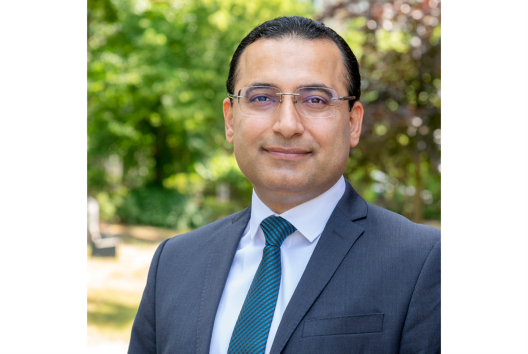
Prof. Darvishi Kamachali of the Federal Institute for Materials Research and Testing (BAM), Department of Materials Engineering, and the Institute of Materials Physics at the University of Münster, has been awarded a Consolidator Grant from the European Research Council (ERC), one of Europe’s most prestigious funding schemes for excellent researchers. The decision highlights the scientific significance of his work in the field of materials modelling. The project “AMASE” on the behaviour and evolution of advanced high-performance materials receives funding of €2 million and is funded over five years.
Within the framework of “Assessing Microstructure Phase Maps (AMASE)” Prof. Darvishi Kamachali will develop new methods for the consistent calculation of the thermodynamics and kinetics of material defects. AMASE pursues an ambitious yet precisely-defined goal: to predict how defects in real materials rearrange, interact with and stabilize each other, and how their “landscape” influences the performance limits, service life, and safe application of advanced materials.
“Being able to predict such defects drastically shortens development times in materials research, particularly for demanding applications in the automotive, battery, and aerospace industries,” says Prof. Darvishi Kamachali, who in addition to his role at BAM also holds the Chair of Materials Modelling at the Institute of Materials Physics at the University of Münster. “In this way, AMASE drives a digitally accelerated innovation cycle for high-performance materials and enables safer, longer-lasting, and more reliable components for demanding applications.”
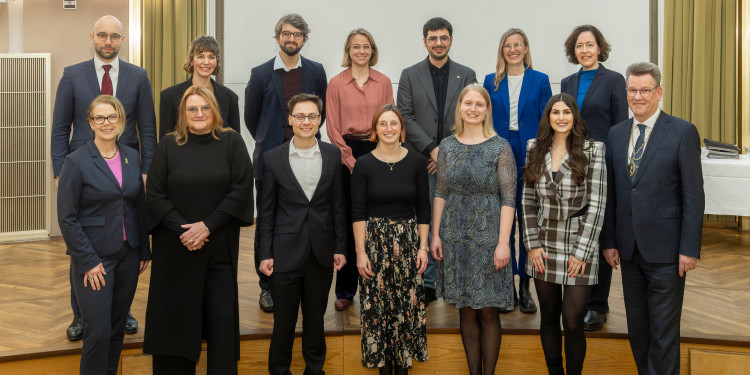
Das Rektorat der Universität Münster hat in einer Feierstunde in der Aula im Schloss 13 Nachwuchswissenschaftlerinnen und -wissenschaftler mit dem Dissertationspreis des Jahres 2025 ausgezeichnet. Neben der wissenschaftlichen Exzellenz müssen die Dissertationen dafür "ein hohes Maß an Originalität aufweisen und einen bedeutsamen Beitrag zur aktuellen Forschung leisten". Rektor Prof. Dr. Johannes Wessels und Prof. Dr. Maike Tietjens, Prorektorin für akademische Karriereentwicklung und Diversity, verliehen die Auszeichnungen. Sie sind mit jeweils 3.000 Euro dotiert, um die weitere Arbeit der Preisträgerinnen und Preisträger an der Universität Münster oder an einer anderen nationalen oder internationalen Hochschule zu fördern.
Wie Maike Tietjens sagte: „Wir sind stolz auf die herausragenden Leistungen unserer aufstrebenden Wissenschaftlerinnen und Wissenschaftler“. Dem können wir uns nur anschließen!
Herzlichen Glückwunsch, Nils Holle!
Link zur (vollständigen) News-Seite: https://www.uni-muenster.de/news/view.php?cmdid=15135

Our group member Nils Holle received the second prize for best talk at the EPCOS 2025 conference in Marseille. In his presentation titled “Effect of Peierls-like distortions on transport in amorphous phase change devices,” he presented new insights into electronic transport in phase change materials – materials that could play a key role in neuromorphic computing.
Using advanced computer simulations, the study shows how tiny atomic distortions in amorphous materials affect the flow of electrical current and contribute to resistance drift, a key challenge for future memory and computing devices.
Congratulations on this recognition!
Link to publication: https://doi.org/10.1038/s43246-025-00776-5