

Frequency conversion in disordered and ordered nonlinear photonic structures
“Disorder is the new order” could one say if we look what we need for easy but efficient broadband nonlinear frequency conversion of laser pulses. For efficient frequency doubling the fundamental and SHG waves have to fulfill the phase matching condition. Phase matching can be realized for instance by using the birefringence of the crystal. A more flexible approach is the periodic structuring of the Χ(2)-nonlinearity, which can be realized in ferroelectric crystals by periodically poling of the domains.
A two-dimensional structure of the Χ(2)-nonlinearity – a so called two-dimensional nonlinear photonic structure – represents an extension of the concept of quasi-phase matching leading to new phase matching conditions. In comparison with photonic lattices or photonic crystals these nonlinear structures posses a homogeneous refractive index but a modulated nonlinearity.
Due to their discrete nature periodic nonlinear photonic structures can only be used for an effective frequency conversion of discrete wavelengths. However, for frequency conversion of ultrashort laser pulses with a large spectral bandwidth nonlinear photonic structures with a broad bandwidth are desired. For this purpose the period of the alternating nonlinearity can be linearly increased (chirp) or one can use so called quasi gratings. A rather simple kind of structure is a random orientation of the nonlinearity. Domains are already randomly oriented when the ferroelectric crystal is unpoled.
We take advantage of this situation for our work on an effective and tunable frequency conversion of ultrashort laser pulses: we examine frequency conversion of ultrashort laser pulses in strontium barium niobate (SBN), where the order of the nonlinearity is specifically moulded.
We have demonstrated all kinds of parametric three-wave mixing processes: second harmonic generation, sum-frequency generation, and difference-frequency generation. Cascaded processes to generate the third and fourth harmonic are also possible. As the nonlinearity is modulated in two dimensions, the phase-matching process is non-collinear which leads to a spatial distribution of the higher harmonics. The frequency converted light is emitted either in a plane or on a cone (see figures). In the case of conical emission the nonlinear photonic structure acts like a super prism, which can be used for measuring the spectrum of the fundamental wave.
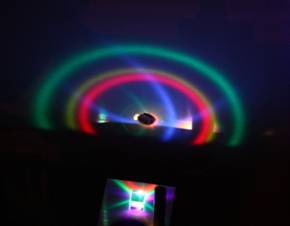
Conical sum-frequency generation in unpoled SBN
We can specifically influence the order of the nonlinearity by electrical poling. Additionally the crystal can be illuminated inhomogeneously during the poling process to produce a modulated domain structure. The degree of order of the nonlinearity is directly visible in the spatial distribution of the emitted SHG light. This kind of nonlinear spectroscopy can be used to reveal any kind of disorder in a nonlinear photonic structure. On the other hand, we can manipulate the order of the nonlinearity for an efficient broadband frequency conversion.

Planar SHG in unpoled SBN