

Photorefractive Crystals
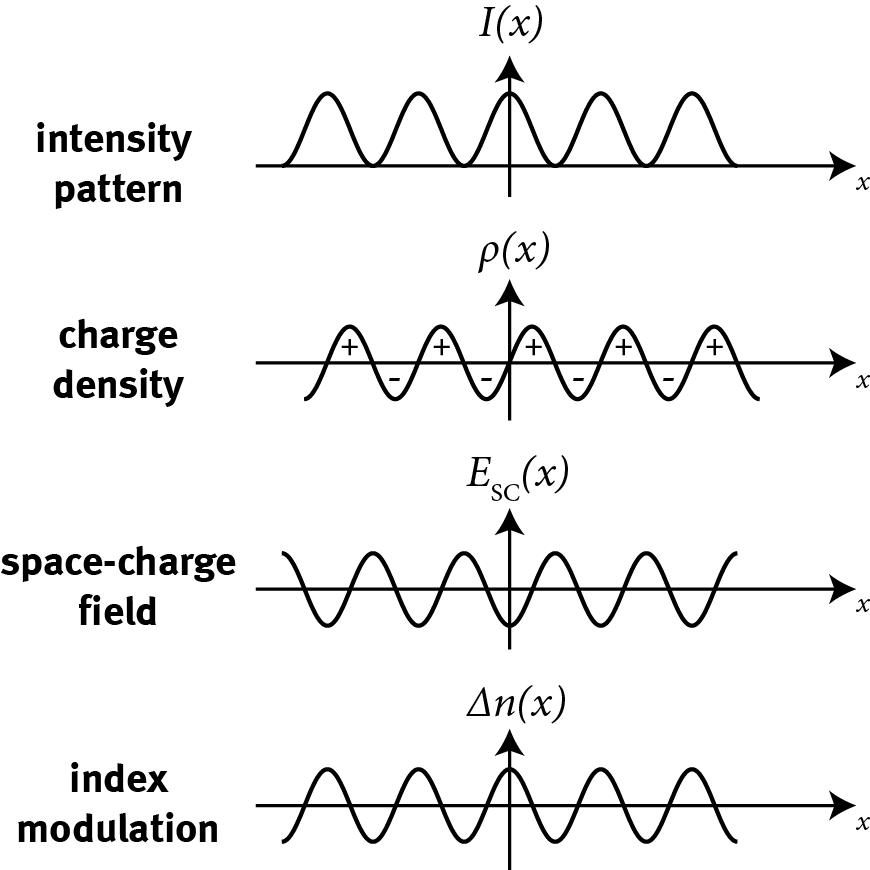 |
| fig. 1: photorefractive Effect, intensity distributiion I, charge density, space-charge-field E, refractive index change n |
Inorganic crystals offer light induced refractive index changes if they are electrooptic and photoconductive. They are commonly used as SAW frequency filter in e.g. mobile phones or in electrooptic modulators, but there are already some devices which use the photorefractive effect. An example are wavelength filters for telecommunications (DWDM: division wavelength demultiplexer). The photorefractive effect was discovered in 1966 by Ashkin et al.. Since then many other materials were discovered in which the photorefractive effect can be observed. At the "Institut für Angewandte Physik" Lithiumniobat (LN), Strontiumbariumniobate (SBN) and Bariumtitanate (BTO) and Bismuttellurit are used in different experiments.
Photorefractive Effect
The photorefractive effect was observed for the first time in 1966 by Ashkin et. al.. Since then a variety of inorganic materials exhibiting the photorefractive effect have been discovered. In the "Nonlinear Photonics Group", lithium niobate (LN), strontium barium titanate (SBN), barium titanate (BTO) and bismuth tellurite crystals are used in various different experiments. The photorefractive effect is based on excitation distribution and recombination of charge carriers (electrons or holes). A widely used model for the description of the charge transport processes was introduced in 1971 by Kukhtarev et. al.: A spatially modulated light pattern excitates charge carries into the conduction band. The carriers are redistributed by different transport processes and recombined at places with low light intensity (fig. 1). Thus, the resulting charge carrier density is spatially modulated and gives rise to an internal phase shifted electric space charge field. The following refractive index change is due to the Pockels effect.
Lithium niobate
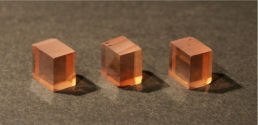 |
| fig. 2: iron-doped lithium niobate crystals |
Lithiumniobate (Fig. 2) is a commonly used material for experiments in the field of photorefractive and nonlinear optics. It posseses a single optical axis and has birefringend, piezoelectric and pyroelectric properties. Lithium niobate crystals can be grown with exellent optical quality and in large dimensions. The employed crystals were grown by the Czochralsky method at the "Research Laboratory for Crystal Physics and Optics" in Budapest. Lithium niobate is used in the field of holographic data storage and to some extend in the novelty filtering lab. Generally storage materials should for employment in data storage applications should offer the following properties: High optical quality, high sensitivity, a linear response and long time stability. The disadvantage of inorganic crystals like lithium niobate is a low sensitivity compared to organic photopolymer systems and the instability resp. the reversibility of the refractive index grating during long time read-out.
Bismuth tellurite
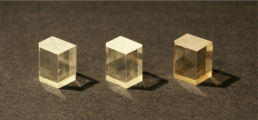 |
| fig. 3: undoped bismuth tellurite crystals |
Bismut tellurite (fig. 3) is a relative new material in which th photorefractive effect can be observed. In 1990 the first crystals with a sufficient optical quality for data storage experiments were grown. The crystals exhibit a pale yellow coloration and strong photochromic behaviour was observed. Bismut tellurite is ferroelectric at room temperature and and the photorefractivity is due to the photoconductivity of the material. At the beginning the achieved diffraction efficiencies were below one percent. For that reason there was no practical use for high capacity storage. Meanwhile diffraction efficiencies of more than 40% can be obtained and samples with different dopants were realized. Bismut tellurite crystals are of interest for data storage applications because of a long living photorefractive signal which was observable for more than five years. Even under permanent illumination a fraction of the refractive index grating resides in the crystal. Recent studies assume that a high mobility of oxygen ions gives rise to the buildup of an ionic grating that develops with the space charge field. This effect offers nonvolatile readout of holograms which makes further fixing techniques unnecessary because the relaxation of this grating is only due to thermal excitation.