

Thermal Stability of Graphite- and Silicon-based Anodes Investigated
While the thermal behavior of graphite anodes has already been extensively studied, research on silicon-based anodes has so far focused primarily on improving their electrochemical performance. A recent study by MEET Battery Research Center at the University of Münster and LG Energy Solution now systematically compares the thermal stability of electrodes containing exclusively graphite or silicon as the active material. The research focused on determining at what temperatures exothermic decomposition reactions begin and how intense these reactions are. Both the heat and gas evolution of the respective anode materials were analyzed.
Heat Generation More Pronounced in Silicon Anodes
The researchers found that silicon-based anodes generate significantly more heat than graphite-based anodes. In addition, the gases produced during the reactions contain a high proportion of hydrogen, which is a relevant safety concern. “Due to the increased heat generation, we reached the point of an uncontrollable, self-reinforcing chemical chain reaction, known as thermal runaway, much faster in cells with silicon-based anodes than in comparable cells with graphite anodes,” explains MEET scientist Lukas Schrief. “Our results suggest that the entire structure of the lithiated silicon particles is involved in the decomposition reactions. In graphite anodes, however, the graphite structure remains intact; here, the lithium ions are deintercalated from the graphitic host structure and react with the electrolyte.”
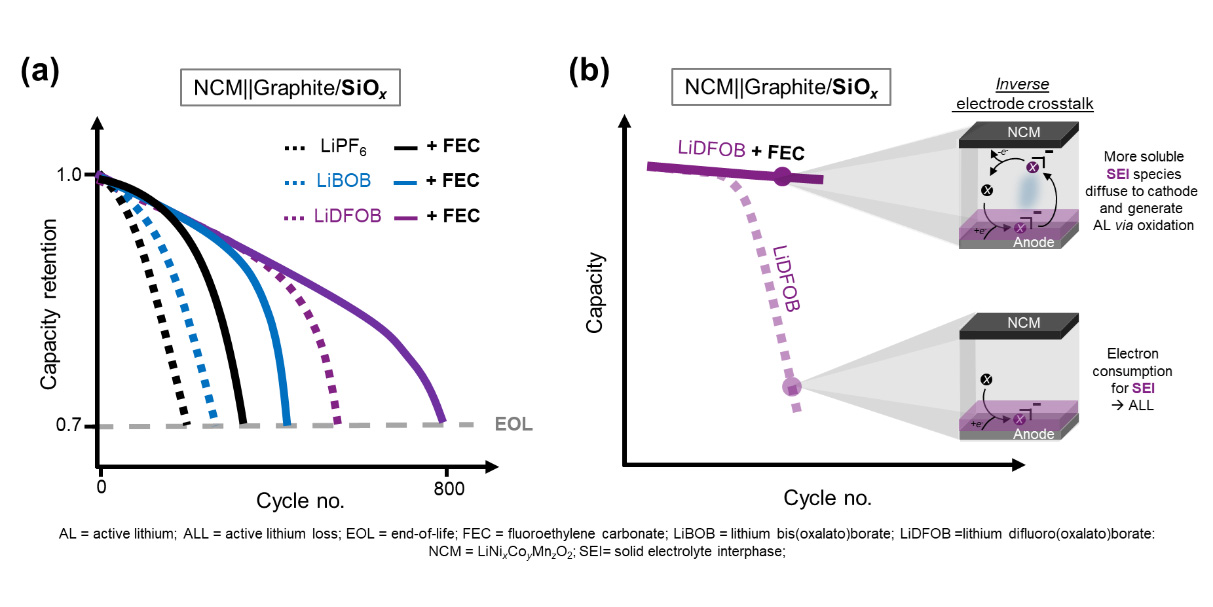
Due to its significantly higher specific capacity, silicon is considered a promising anode material for high-energy applications. At the same time, its thermal properties and the associated safety aspects have not yet been sufficiently studied. “With our research, we aim to gain a better understanding of the underlying reaction mechanisms. In the long term, these findings should contribute to the further development of silicon-based electrodes in a way that distinctly improves their thermal stability,” explains Dr Markus Börner, Head of MEET Research Division “Cell System”, describing the study’s objective.
Detailed Results Online Available
The entire study has been published by the authors Lukas Schrief, Dr Lukas Trojahn, Nick Fehlings, Dr Sascha Nowak and Dr Markus Börner, MEET Battery Research Center, as well as Junyeong Jang, LG Energy Solution, and Prof. Dr Martin Winter, MEET Battery Research Center and Helmholtz Institute Münster of Forschungszentrum Jülich, in the journal “EES Batteries“.