
MEET Battery Research Center Develops Innovative Modular Battery Production Line for Various Materials
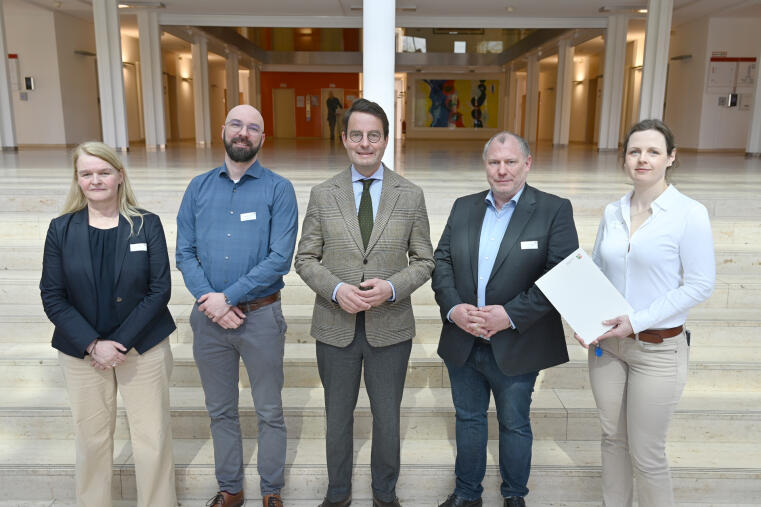
With the aim of developing a modular pilot line for automated battery cell production, the “REFlexBatt 2.0” project (expansion of battery pilot production to enhance traceability, evaluation, and flexibility for the future diversification of battery technology) has been launched at MEET Battery Research Center at the University of Münster. The innovative pilot line will enable the production of battery cells with different material and cell designs at an early stage of development using flexibly adaptable manufacturing processes. The industrial partner for the three-year project is Safion GmbH. It is being funded with approximately five million euros by the European Union and the State of North Rhine-Westphalia through the funding program “Forschungsinfrastrukturen.NRW”. The Münster Regional Council presented the grant notification to MEET Battery Research Center on April 9, 2026.
Flexibility for New Battery Technologies
“The market of battery technologies continues to diversify. New material systems based on, for example, sodium or potassium set different requirements on cell production. To achieve the necessary flexibility, we will develop a modular pilot line with short changeover times that can flexibly integrate innovative technologies,” says Dr Markus Börner, Head of the Research Division Cell System at MEET Battery Research Center. The core of the project is a pilot line in which contact components can be replaced when changing battery technologies and process steps can be adapted quickly. The modular design prevents cross-contamination. In the future, the pilot line will help to shorten innovation cycles and bring next-generation cell technologies into practical application more rapidly – a decisive step towards a more sustainable and high-performance energy storage.
The project also aims to develop a scalable approach that allows batteries with new and innovative cell chemistries to be assembled into multi-layer cells at an early stage of development using the new pilot line. Consequently, the individual process steps can then be scaled up faster to industrial scale. This will close the transfer gap between laboratory- and pilot-scale developments for existing and future battery systems. Regional President Andreas Bothe emphasizes: “Battery research in Münster covers a broad spectrum, ranging from basic and applied research to technology transfer. With this funding, we are strengthening the infrastructure required and making an important contribution to securing resource-efficient supply chains in North Rhine-Westphalia and the European Union.”
Continuous Traceability of Processes and Materials
In addition to the modularity and flexibility of the process steps, the team focuses on maximizing insights even when material availability is limited. Therefore, it is implementing a track-and-trace system. Each electrode is uniquely labeled throughout the entire process, from manufacturing to cell production and performance testing. This traceability, in combination with additional process parameters and analytical methods, enables precise identification of influencing factors while simultaneously strengthening the quality management.