

Optimized Porosity Boosts the Performance of Lithium Ion Batteries
Dry Processing is considered a promising approach to manufacture lithium ion batteries in a more sustainable and cost-effective manner, as it does not require organic solvents during electrode fabrication. While the influence of porosity, the proportion of voids in electrodes, has already been extensively studied for wet-processed electrodes, corresponding findings for dry-processed electrodes have been lacking until now. Researchers at MEET Battery Research Center at the University of Münster have now systematically investigated how different degrees of compaction affect the pore structure, electron and ion transport, as well as the long-term stability and performance of lithium iron phosphate-based electrodes (LFP).
Targeted Compaction for Improved Battery Performance
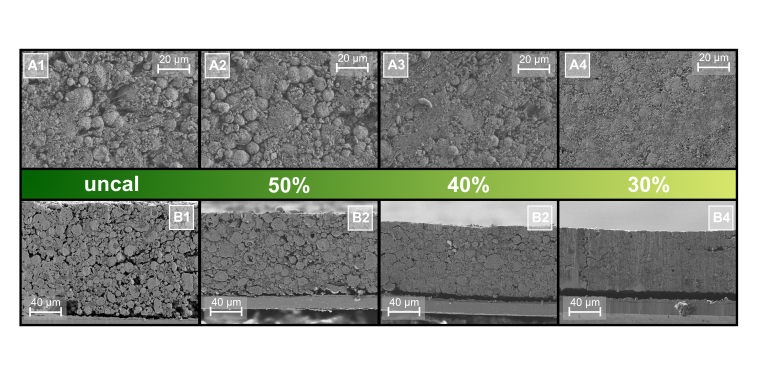
In their study, the research team was able to demonstrate that a porosity of around 40 percent offers the best balance between high energy density and efficient ion transport for the investigated electrodes. “While moderate compaction improves electron transport, excessive compaction hinders the movement of lithium ions through the electrode and leads to a loss of performance,” explains MEET scientist Simon Raffenberg.
The research team was also able to show that the properties of dry-processed electrodes can be specifically adjusted through so-called post-calendering, the calendering of already laminated electrodes. “Until now, this process has been used primarily for wet-processed electrodes. Its application in dry processing opens up new possibilities for optimizing dry battery electrode structures,” summarizes Dr Markus Börner, head of the research division “Cell System”. The research results illustrate that, in addition to granule production, the calendering process in particular is crucial for manufacturing high-performance dry battery electrodes that are also produced more sustainably.
Detailed Results Online Available
The entire study has been published by the authors Simon Raffenberg and Dr Markus Börner, MEET Battery Research Center, as well as Prof. Dr Martin Winter, MEET Battery Research Center and Helmholtz Institute Münster of Forschungszentrum Jülich, in “Journal of Power Sources”.