

Influence of Different Lithium Iron Phosphate Powders on Dry-processed Electrodes Deciphered
Dry-processing of battery electrodes offers promising advantages over conventional solvent-based manufacturing methods: Toxic solvents are eliminated, energy requirements are reduced, production costs are lowered, and processes are simplified. However, the method is sensitive to the properties of the materials used. It is therefore essential to closely examine the interaction between powder, binder, and mechanical stress. A team from MEET Battery Research Center at the University of Münster has addressed this challenge and analyzed five different lithium iron phosphate (LFP) powders. The research focused on the questions of how suitable the materials are for dry-processing based on their intrinsic properties and their influence on cell performance.
Materials Science Basis for Selecting Suitable LFP Powders
The researchers investigated the qualities of industrially relevant LFP powders at particle, granulate, and electrode level. They first identified particle size as a key factor. Very small particles make it harder for the polytetrafluoroethylene (PTFE) binder to fibrillate because they strongly cover the binder surface. Particle degradation during processing is critical. Unstable particles that break under heavy loads can accelerate material aging. A high specific surface area, in turn, strengthens the shear stability as the shear forces are better distributed, making the particles less prone to breakage. Electrochemical performance is particularly influenced by crystallite size. Medium sizes of 66 to 69 nanometers in particular showed a good specific discharge capacity. The research team also carried out quantitative rheological measurements of the PTFE-based granules for the first time to assess how they can be processed in a calender.
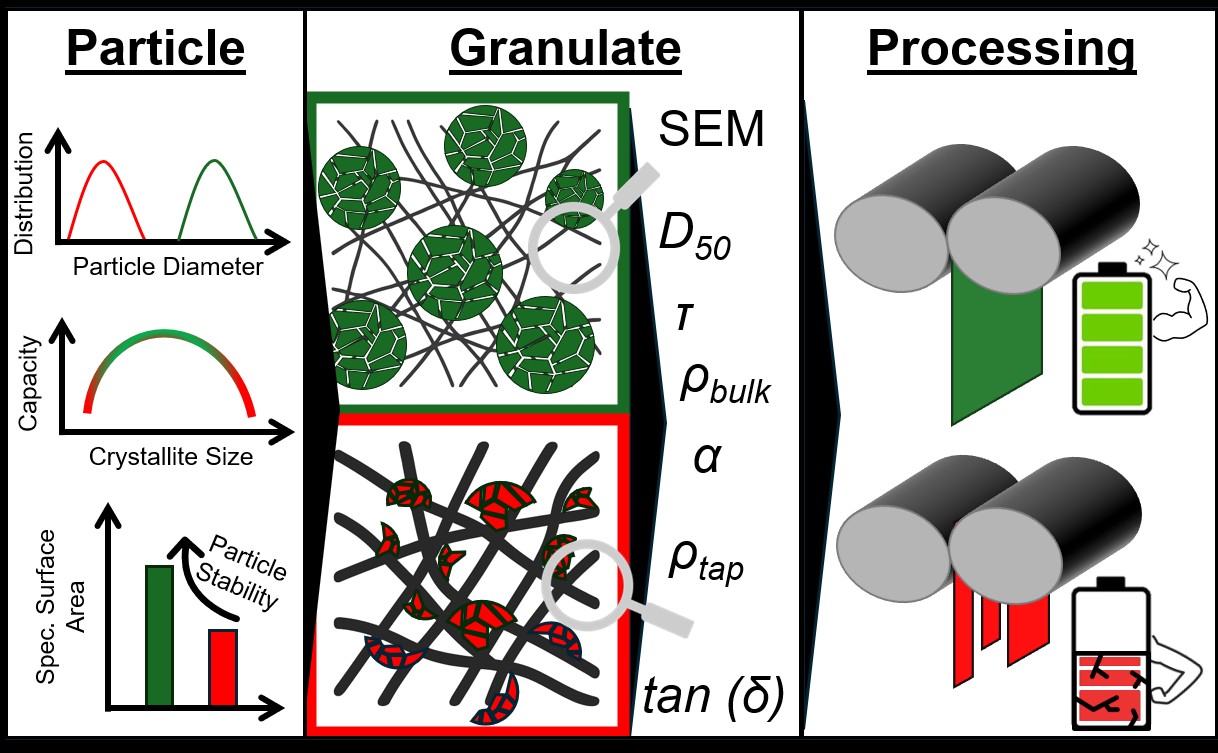
“With our differentiated material evaluation, we have not only shown that not every LFP powder is equally suitable for dry-processing electrode, but also which powder characteristics should be considered in the selection process,” says MEET scientist Simon Raffenberg. “In addition, the material parameters partly differ significantly from those of classic wet processes.” Dr Markus Börner, Head of the Research Division Cell System at MEET Battery Research Center, adds: “With our study, we have therefore created a materials science basis for developing LFP powders specifically for dry-processing.” This approach has now the potential to better scale dry-processing, specify active materials purposefully, increase electrochemical performance, and reduce production costs as well as environmental impacts in the long term.
Entire Study Available
The detailed results have been published by the authors Simon Raffenberg, Dr Uta Rodehorst, Dr Katrin Junghans and Dr Markus Börner, MEET Battery Research Center, as well as Prof. Dr Martin Winter, MEET Battery Research Center and Helmholtz Institute Münster of Forschungszentrum Jülich, in the “Journal of Energy Storage”. The study is part of the “ProLiT” research project (process and material development of lithium ion battery cathodes for large-scale dry coating). The LFP powders examined were provided by the industry partner IBU-tec advanced materials AG.