
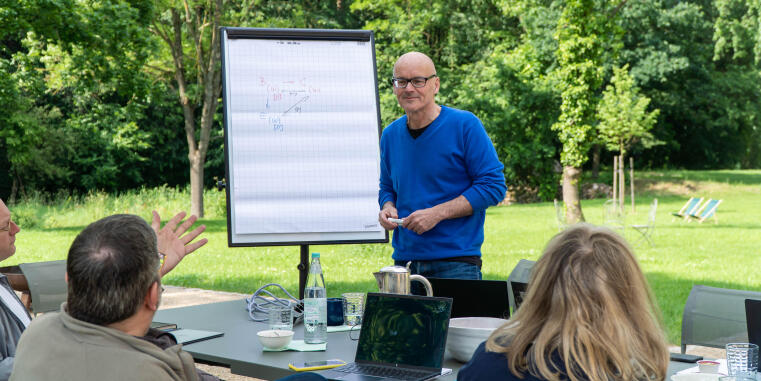
From 7 to 10 June 2024, the Research Retreat “Zugang zu kulturellen Gütern: (Rechtliche) Gründe für Zugangshindernisse — (rechtliche) Lösungsmöglichkeiten?” (“Access to cultural heritage: (Legal) reasons for barriers to access — (legal) solutions?”) took place in Gerswalde (Uckermark). The Research Retreat was organised in collaboration with the “Zentrum für Legistik” project of the Federal Ministry of Justice.
Scientific organisation: Prof. Dr. Reinold Schmücker (University of Münster, director of the Centre for Advanced Study “Access to Cultural Goods in Digital Change”)
Speakers:
- Matthias Schmid, Ministerialdirigent (Federal Ministry of Justice)
- PD Dr. Dr. Grischka Petri (FIZ Karlsruhe – Leibniz Institute for Information Infrastructure)/NFDI4Culture/Non-resident Permanent Fellow of the Centre for Advanced Study “Access to Cultural Goods in Digital Change”)
Digital media facilitate and expand access to significant collections of cultural heritage in a variety of ways and on an unprecedented scale. However, digital access infrastructures also give rise to new forms of barriers to access. Some access restrictions are well-founded and must be accepted. In other cases, the necessity and legitimacy of access restrictions appear less clear. In some circumstances, barriers to access arising from specific provisions of current law may even appear unnecessary and illegitimate. In such cases, the question arises as to whether it is possible to adjust the relevant provisions, which could help to enable or facilitate access to objects of cultural interest that have hitherto remained inaccessible, whilst taking into account any interests worthy of protection.
In cooperation with the “Zentrum für Legistik” project at the Federal Ministry of Justice, the Research Retreat analysed a series of access conflicts and barriers to access in various case scenarios, including in relation to works of digital media art and collections of cultural and historical significance. The analysis initially focused on the typically conflicting interests and claims of all parties involved, and subsequently with regard to the relevant provisions of applicable law pertaining to the respective conflict and the actions of the parties involved. In addition to the provisions of copyright law, criminal law, data protection law and claims based on personality rights—which directly give rise to claims for the restriction of access to certain objects, information or representations—the Research Retreat also examined procedural provisions, duties of care and other provisions of liability law were also examined; in some cases, these make the risk of granting access to – even if only potentially – copyright-protected material appear unacceptable to the responsible parties. Building on the analysis of the relevant case scenarios, various approaches were discussed that could help to reduce or avoid restrictions on access that appear to be avoidable. The event served as a forum for mutual consultation between, on the one hand, the Centre for Advanced Study and, on the other, the legislative experts involved in developing relevant draft legislation.