
Do Internet spying and electronic mass surveillance violate international law? Can whiteblowers allow leaked documents to be admitted to the International Court of Justice as evidence? How is the conflict between national security and freedoms convincingly resolved? The 57 dealt with these and other current issues of international law. Philip C. Jessup International Law Moot Court 2016, where the Faculty of Law of the University of Applied Sciences was again successfully represented.
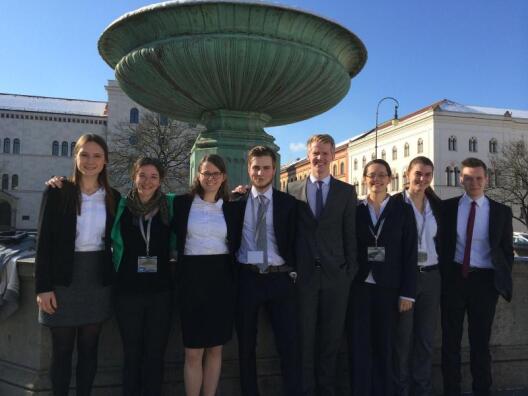
The highly motivated Münster team, consisting of Hannah Adamek, Nadja Homann, Lukas Kintrup, Clara Scharfenstein and Markus Schnetter, had worked for months with ambition and excellent team spirit in the demanding problem areas of the fictional fact. The students were supported by the supervisors Isabel Lischewski, Jana Lohmann and Thorsten Jakob from the Institute of Public Law, including international and European law as well as empirical legal research.
The national preliminary round of the Jessup Moot Court was hosted by the LMU Munich this year. From 24.02.2016 – 28.02.2016 a total of 21 German teams competed against each other in simulated oral negotiations. The Münster team met strong competition from Heidelberg University, Bucerius Law School, HU Berlin and the University of Freiburg in the assigned preliminary group, so that the preliminary round encounters were already becoming a real exchange of blows.
The participants were able to successfully withstand the drilling questions of the judges and thereby prove their fluent English and broad knowledge in international law. Charisma, strong nerves and quick-wittedness were also required, for example when one of the judges surprisingly opened the oral hearing in French (also official court language of the ICJ).
In the preliminary rounds, the Münster team defeated the University of Freiburg, but had to be defeated in close encounters with the University of Heidelberg, the Bucerius Law School and the HU Berlin. Overall, the Münster team thus won 15th place in the overall standings this year. The overall victory in 2016 and the “Award for the Best Oralist” went to Bucerius Law School. A participant of the HU Berlin was named the second best speaker. HU Berlin also received the prize for the best typeface.
In addition to the competition rounds, an extensive accompanying program was also offered at this year's Jessup. At the reception on Wednesday, the Announcement Dinner on Friday evening and the closing event on Saturday evening, the participants had the opportunity with other teams and high-profile guests, such as Mr. Prof. Dr. Dr. h.c. mult. Bruno Simma and Prof. Dr. Abdul Koroma, judge at the International Court of Justice (a.d.), or Ms. Prof. Dr. Dr. h.c. Angelika Nußberger, M.A., judge at the European Court of Human Rights, to enter into the conversation.
The actual stars of the event, however, were the students themselves. Because they impressively showed that they have grown together into a real team and their knowledge of international law goes so far beyond the regular studies in the area of focus that they can discuss freely and “on an equal footing” with the experts from practice. Despite the deprivation-rich months of the competition, all participants will take best memories of their time in the Jessup team and many valuable experiences on their further (professional) path.