ERC Consolidator Grant Project: Correcting Inequality through Law

Equality is one of the main political concerns of our time. Rising economic inequality is often cited as a major reason for the recent rise of political populism. But economic inequality is not the only problem. Inequalities based on gender, race or nationality are also major issues in the contemporary discussion. While most commentators discuss political solutions, the proposed research project analyses the contributions that courts can make to correct inequalities. Norms protecting equality form part of all major national and international human rights instruments. However, the meaning of equality is fundamentally contested. There is no agreement on what equality exactly means or entails. The question, therefore, is not whether legal equality guarantees can tolerate inequality, but to what extent they can do. Because of these conceptual difficulties, the application of equality and non-discrimination clauses is not a straightforward exercise, in which courts simply apply legal norms to a given set of facts. Instead, courts need to develop doctrinal instruments to give meaning to the concept of equality.

The research project “Correcting Inequality through Law”, which is funded by a Consolidator Grant of the European Research Council and runs from June 2019 to May 2024, analyses how apex courts conceptualize equality in constitutional and international human rights law. It will be based on a comparative study of the equality jurisprudence of 16 courts and jurisdictions (Canada, Colombia, France, Germany, India, New Zealand, Poland, South Africa, Spain, Taiwan, United Kingdom, United States, UN Human Rights Committee, ECtHR, IACtHR, AfrCHPR). It has three aims. Firstly, it intends to create a comparative map of equality jurisprudence, i.e. to describe and categorize the constitutional jurisprudence on equality: Which doctrinal choices do courts make and how do these choices inform the conception of equality? Secondly, it seeks to explain the doctrinal choices of the analyzed courts: Which factors influence courts to arrive at particular conceptions of equality? Thirdly, it has a normative goal and examines whether courts are better suited to correct certain kinds of inequalities than other kinds of inequalities.

This project has received funding from the European Research Council (ERC) under the European Union’s Horizon 2020 research and innovation programme (grant agreement No. [817652]).
The PSPP Decision of the Federal Constitutional Court: Analysis & Criticism

In its PSPP decision, the Federal Constitutional Court (BVerfG) found that the European Court of Justice (ECJ) had exceeded its competences when it failed to subject the purchase of European government bonds by the European Central Bank (ECB) to stricter control. The consequences of the ruling are potentially serious – both for the ECB’s capacity to act and for the recognition of the primacy of EU law by national courts. The chair is involved in the Europe-wide debate on PSPP with several contributions.

In particular, Niels Petersen and Konstantin Chatziathanasiou, on behalf of the Committee on Constitutional Affairs (AFCO) of the European Parliament (EP), have written a detailed study on the background and consequences of the PSPP decision. The study was given to the committee on 14. July 2021 presented. Already on the 3 In June 2021, the authors put the study up for discussion in the EP's "Democracy, Rule of Law and Fundamental Rights Monitoring Group."

Article:

Niels Petersen: The PSPP Decision of the German Federal Constitutional Court and Its Consequences for EU Monetary Policy and European Integration. Revue Trimestrielle de Droit Financier, 28–33 (2020).

Niels Petersen: Karlsruhe’s Lochner moment? – A Rational Choice Perspective on the German Federal Constitutional Court’s Relationship to the CJEU after the PSPP decision. 21 German Law Journal, 995–1005 (2020).

Niels Petersen, Konstantin Chatziathanasiou: Balancing competences? – Proportionality as an Instrument to Regulate the Exercise of Competences after the PSPP Judgment of the Federal Constitutional Court, 17 European Constitutional Law Review, 1–21 (2021).

Study for the European Parliament:

Niels Petersen, Konstantin Chatziathanasiou: Primacy's Twilight? On the Legal Consequences of the Ruling of the Federal Constitutional Court of 5 May 2020 for the Primacy of EU Law.

Hearings:

LIBE Democracy, Rule of Law and Fundamental Rights Monitoring Group, European Parliament: Primacy of EU law: discussion with recent experts on developments (Webstream), 3. June 2021.

AFCO Committee on Constitutional Affairs, European Parliament: Presentation of the Study “Primacy’s Twilight? On the Legal Consequences of the Ruling of the German Federal Constitutional Court of 5 May 2020 for the Primacy of EU Law” (Webstream), 14. July 2021.

Balkan Summer School

The Balkan Summer School has been bringing together teachers, doctoral students, and advanced students from the University of Münster and the University of Paris Nanterre as well as several universities from Balkan countries for several years.

The Balkan Summer School is funded by the Franco-German University of Applied Sciences as part of the funding project "Scientific Events for Young Scientists (Research Studios, Summer Schools)".

The Balkan Summer School is funded by the Franco-German Youth Office.


Photos

© Lehrstuhl für öffentliches Recht, Völker- und Europarecht sowie empirische Rechtsforschung
  • © Lehrstuhl für öffentliches Recht, Völker- und Europarecht sowie empirische Rechtsforschung
  • © Lehrstuhl für öffentliches Recht, Völker- und Europarecht sowie empirische Rechtsforschung
  • © Lehrstuhl für öffentliches Recht, Völker- und Europarecht sowie empirische Rechtsforschung
  • © Lehrstuhl für öffentliches Recht, Völker- und Europarecht sowie empirische Rechtsforschung
  • © Lehrstuhl für öffentliches Recht, Völker- und Europarecht sowie empirische Rechtsforschung
  • © Lehrstuhl für öffentliches Recht, Völker- und Europarecht sowie empirische Rechtsforschung
  • © Lehrstuhl für öffentliches Recht, Völker- und Europarecht sowie empirische Rechtsforschung
  • © Lehrstuhl für öffentliches Recht, Völker- und Europarecht sowie empirische Rechtsforschung
  • © Lehrstuhl für öffentliches Recht, Völker- und Europarecht sowie empirische Rechtsforschung
  • © Lehrstuhl für öffentliches Recht, Völker- und Europarecht sowie empirische Rechtsforschung
  • © Lehrstuhl für öffentliches Recht, Völker- und Europarecht sowie empirische Rechtsforschung
  • © Lehrstuhl für öffentliches Recht, Völker- und Europarecht sowie empirische Rechtsforschung
  • © Lehrstuhl für öffentliches Recht, Völker- und Europarecht sowie empirische Rechtsforschung
  • © Lehrstuhl für öffentliches Recht, Völker- und Europarecht sowie empirische Rechtsforschung
  • © Lehrstuhl für öffentliches Recht, Völker- und Europarecht sowie empirische Rechtsforschung
  • © Lehrstuhl für öffentliches Recht, Völker- und Europarecht sowie empirische Rechtsforschung
  • © Lehrstuhl für öffentliches Recht, Völker- und Europarecht sowie empirische Rechtsforschung
  • © Lehrstuhl für öffentliches Recht, Völker- und Europarecht sowie empirische Rechtsforschung
  • © Lehrstuhl für öffentliches Recht, Völker- und Europarecht sowie empirische Rechtsforschung

5. Summer University in the Balkans

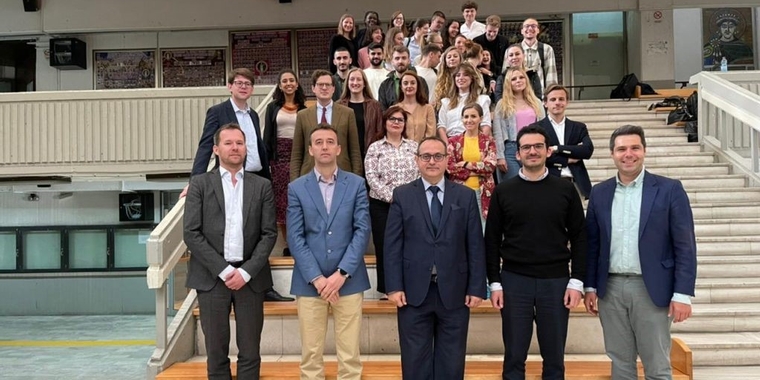
From 5.–6. May 2022 found on the Ss. Cyril and Methodius University in Skopje (North Macedonia) the second session of the "5. Summer University in the Balkans" instead. The Summer University is a joint initiative of the Universities of Münster and Paris-Nanterre. It is generously funded by the Franco-German University (DFH) and coordinated by the Chair of Petersen. The topic of the summer university was the crisis of the rule of law, which the countries of the West Balkans, but also the EU are currently challenging. Students, doctoral students and faculty members of the partner universities Münster, Paris-Nanterre, Prishtina, Skopje and Tirana discussed problem analyses and solutions in Skopje. They followed the previous session, which was held from 15-16. September 2021 had taken place in Tirana (Albania). In addition to the representatives of the partner universities, speakers from Mannheim, Munich and Passau also took part in the summer university. We would like to thank all those involved, and especially our sponsors and hosts!

STF & WWU Webinar Series in 2021/ 2022

The Faculty of Law of the University of Münster (formerly WWU) organizes the lecture series STF & WWU Webinar Series in cooperation with the Brazilian Supreme Court (STF) with the support of the Brazil Center in this winter semester 2021/ 2022. The lecture series brings together outstanding lawyers from Brazil and Germany and offers comparative legal insights into the fundamental rights interpretation and practice of the STF. It will take place on the occasion of the signing of the Partnership Agreement between the two institutions, to promote scientific cooperation and academic exchange between the Faculty of Law and the STF.

The 1. Webinar on "Covid-19 and its impact on fundamental rights" took place on 12. November 2021.

The 2. Webinar on "Constitutional Courts and Countermajoritarian Protection" took place on 11. March 2022.

The 3. Webinar on “Digital Constitutionalism and Democracy” took place on 03. June 2022.