


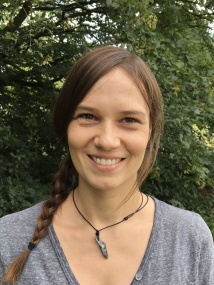
Research Foci
- Impact of land-use intensity and biodiversity decline on animal communities on a local and landscape scale
- Trophic and microbial interactions involving invertebrates & vertebrates
- Physiological condition of invertebrates
- Movement pattern of invertebrates
- Lady beetles, ground beetles, slugs, mice, voles, shrews & bats
CV
Academic Education
- Phd in Biodiversity and Ecology (Dr. rer. nat.), University of Göttingen, DE; Thesis: Plant diversity and landscape-scale effects on multitrophic interactions involving invertebrates
- MSc in Horticulture, University of Hannover, DE; MSc Arbeit: Wirkung des standardisierten Bitterholzprodukts Quassia-MD auf die Schwarze Bohnenblattlaus Aphis fabae
- BSc in Horticulture, University of Hannover, DE; BSc Arbeit: Auswirkungen von Bitterholzextrakten auf Wirtswahl und Entwicklung der Weißen Fliege Trialeurodes vaporariorum
Positions
- Postdoc, Molecular Evolution and Sociobiology Group, University of Münster, DE; Project: Changes in Small Mammal Trophic Interactions in response to land-use intensity and biodiversity (SMaTI)
- Postdoc, Animal Ecology and Multitrophic Interactions Group, University of Münster, DE; Project: Changes in Small Mammal Trophic Interactions in response to land-use intensity and biodiversity (SMaTI)
- Coordinator of the 49th annual meeting of the Ecological Society of Germany, Austria and Switzerland (GfÖ), Institute of Landscape Ecology, University of Münster, DE
- Research assistant, Animal Ecology and Multitrophic Interactions Group, University of Münster, DE
- Research assistant, Agroecology Group, University of Göttingen, DE
- Research scholar, Landscape Ecology of Insects Group, University of Wisconsin-Madison, USA
Projects
- Kaskadeneffekte des klimabedingten Waldumbaus auf Zoonoseerreger in Säugetieren - Nahrung und Mikrobiom – ANTIZOONS ()
Participation in Federally Funded Joint Project: Bundesministerium für Forschung, Technologie und Raumfahrt | Project Number: 01Kl2507A - SPP 1374 - Subproject: Changes in Small Mammal Trophic Interactions (SMaTI) in response to land-use intensity and biodiversity – SMaTI ()
Subproject in DFG-Joint Project Hosted outside University of Münster: DFG - Schwerpunktprogramm | Project Number: TI 1093/1-1
Research Articles (Journals)
- Tiede, J, Iuliano, B, and Gratton, C. . “Agriculturally intensified landscapes are associated with reduced body condition of lady beetles.” Landscape Ecology 37: 1921–1936. doi: 10.1007/s10980-022-01458-0.
- Tiede, J, Keller, A, and Eitzinger, B. . “SPECIAL ISSUE: DNA sequence-based biodiversity and interaction ecology.” Basic and Applied Ecology 56: 460–463. doi: 10.1016/j.baae.2021.06.008.
- Tiede, J, Diepenbruck, M, Gadau, J, Wemheuer, B, Daniel, R, and Scherber, C. . “Seasonal variation in the diet of the serotine bat (Eptesicus serotinus): A high-resolution analysis using DNA metabarcoding.” Basic and Applied Ecology 49: 1–12. doi: 10.1016/j.baae.2020.09.004.
- Grass, I, Loos, J, Baensch, S, Batáry, P, Librán-Embid, F, Ficiciyan, A, Klaus, F, Riechers, R, Rosa, J, Tiede, J, Udy, K, Westphal, C, Wurz, A, and Tscharntke, T. . “Land-sharing/-sparing connectivity landscapes for ecosystem services and biodiversity conservation.” People and Nature 1 (2). doi: 10.1002/pan3.21.
- Tiede, J, Scherber, C, Mutschler, J, McMahon, KD, and Gratton, C. . “Gut microbiomes of mobile predators vary with landscape context and species identity.” Ecology and Evolution http://dx.doi.org/10.1002/ece3.3390. doi: 10.1002/ece3.3390.
- Engel, J, Hertzog, L, Tiede, J, Wagg, C, Ebeling, A, Briesen, H, and Weisser, W. . “Pitfall trap sampling bias depends on body mass, temperature, and trap number: insights from an individual-based model.” Ecosphere 8 (4). doi: 10.1002/ecs2.1790.
- Tiede, J, Wemheuer, B, Traugott, M, Daniel, R, Tscharntke, T, Ebeling, A, and Scherber, C. . “Trophic and non-trophic interactions in a biodiversity experiment assessed by next-generation sequencing.” PloS one 11 (2). doi: 10.1371/journal.pone.0148781.