

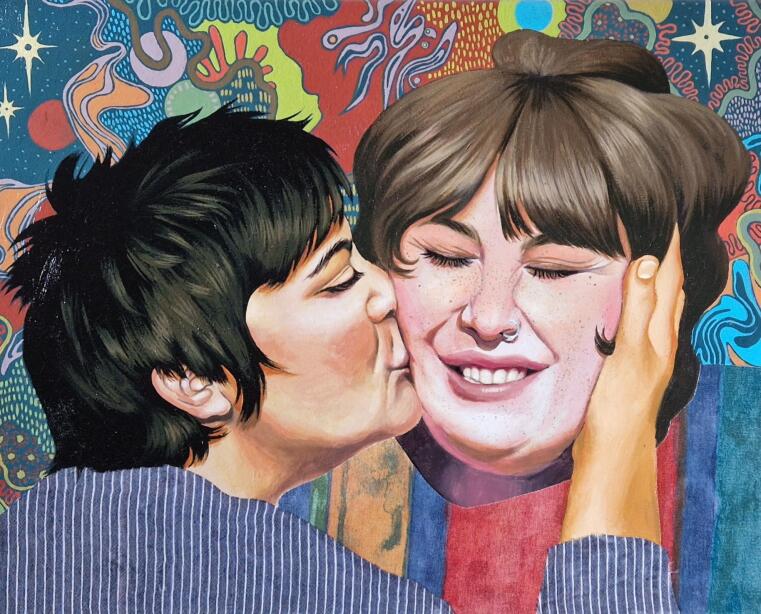
© Lisa Hannen

The Kiss Lab is a participatory art and encounter format that explores physical closeness, touch, and nonverbal communication as social and cultural practices. The event creates a temporary space where visitors become co-creators of a collective performance. The project is carried out in collaboration with the Institute of Ethnology, which oversees and coordinates the academic support and documentation. In a thoughtfully curated setting combining spatial installation, music, film, and performance, closeness is made tangible as a positively charged normality in public space. The project combines performance art, consense culture, sound art, and visual anthropology into a fleeting yet enduring work of art that permeates everyday social life through the bodies of the participants.

  • Join the Kiss Lab team!

    We are looking forsupport for our public relations and outreach teams, as well as students interested in producing a short anthropological film about the event. Your contribution to the project can take the form of an internship, media project, term paper, or thesis.

    If you would like to join the project, please contact annika.strauss[at]uni-muenster.de. The first team meeting will take place on May 13 at 6 p.m. in the B-consultation room at B-Side.

  • Project phases and dates

    From April to July the focus is on preparation, conceptualisation, and team‑building. In August and September the recruitment of participants and outreach to the public take place. The main event is held in November, followed by a post‑production phase from December through February 27. During this final phase the team and participants reflect on the work and organise a public film screening with a subsequent discussion.

    The first team meeting will take place May 13 2026, 6pm in the B-ratungsraum at B-Side.

  • Artistic and Scientific Concept

    The Kiss Lab sees itself as a contemporary development of participatory performance art in the tradition of happenings, Fluxus, and relational aesthetics, combined with a collaborative research approach. At its core lies the question: “How do we want to encounter one another physically today—mindfully, voluntarily, and consciously?” The project shifts intimacy from the exclusively private sphere into an artistically framed public context. This is not about provocation or crossing boundaries, but rather about normalization through mindfulness, slowing down, and conscious perception. The collaborative research framework and aesthetic slowing down simultaneously enable a conscious and critical reflection on the cultural and social norms that shape our experiences and needs for closeness and intimacy. Closeness, touch, and kissing become tangible as cultural practices—embedded in clear agreements, voluntariness, and a trauma-sensitive framework. Artistic value arises not through representation, but through experience; not through observation, but through participation.

  • Three aspects of the project: performance, collaboration, and research

    1. Performance by the participants (approx. 30–40 people)

    The performance lasts approximately three hours and takes place over the course of a day on a weekend. Participants are guided through a designed transition into the space, which is itself part of the performance. In guided yet open encounter formats, the process of approaching one another is slowed down, nonverbal communication becomes tangible, and bodily perception is deepened and reflected upon. Participants decide for themselves at all times regarding intensity, closeness, and participation. The goal is to recruit a group of participants that is heterogeneous in terms of age, gender, relationship status, and body types, among other factors. The processes and methods aim to enable interactions among participants that are not determined by conventional social paradigms such as attractiveness and gender. One focus is on the diverse experience and embodiment of kissing encounters, which invites participants to discover what is possible, what they enjoy, but also simply to let themselves be surprised by new sensual impressions. What are the individual and social brakes and accelerators that play a role here? Intimacy is not problematized, but taken seriously as a basic human need. The performance is created solely by the participants themselves. They are not an audience, but co-authors of the artwork.

    2. The team’s participatory production and collaborative research process

    Running parallel to the performance is an independent artistic research process led by the team, consisting of:

    • Artistic Direction (concept, space, process facilitation, and moderation)
    • Academic Support (social and cultural anthropology, concept of collaborative and artistic research process)
    • Assistance and Support Team
    • DJ / Sound Artist
    • Students of Visual Anthropology
    • Students of Social and Cultural Anthropology

    This team works together in a participatory and creative manner. Methods of engagement are tested collectively, feedback is incorporated into adjustments, and mindfulness and sensibility are continuously refined. The aim is the conscious creation of a mindful creative space for the participants’ process. The team meets in advance to develop and test the concept. Following the event, there is a working meeting to reflect on the artistic process. The assistance and support team strives to create a consensus-oriented, diversity-sensitive, and trauma-informed accountability space and manages public relations efforts both before and after the event. In this way, not only the performance but also the creative process itself becomes a space for artistic research.

    3. Academic Support and Framework

    The entire process is accompanied and filmed by a team of students in social and cultural anthropology. Another team of students is exploring intimacy, closeness, and the kiss as a sociocultural phenomenon and is creating accompanying materials for the event, such as a flyer and a blog post that reflects on and contextualizes the event from a social anthropological perspective. The event will also be accompanied by an interactive lecture in which an artist and a social scientist will contextualize and reflect on the event using scholarly insights and engage in conversation with an interested, non-academic audience.

  • Role of the Film Documentation

    The film team, consisting of students of visual anthropology, will document the project before, during, and after the performance. They are invited to follow the team’s production and research process, participate in team meetings and workshops, and work with the short application videos that potential participants submit in advance of the event, along with a statement explaining their motivation for participating. Following the event, individual team members and participants may be interviewed about their experiences. The film team will produce one or more social anthropological films that may address their own research questions or pursue specific areas of interest. We are particularly interested in films that follow the approach of sensory ethnography or are participatory in nature. The project will conclude with a follow-up session featuring a film screening and an exhibition on the sociocultural background of the kiss.

  • Space, Atmosphere, and Sound

    The space is designed as a temporary ritual and experiential space—a “Kiss Temple” that enables a different kind of normality. Elements of spatial installation and decoration interact with carefully curated lighting and sound design. There will be a transitional area for arriving and immersing oneself in the performance, as well as a quiet zone for participants who wish to step back in between. The space is deliberately free of intoxicating substances, characterized by slowing down rather than escalation, and oriented toward all the senses. Participants are asked to refrain from wearing perfume. A hygiene protocol is in place for the event. In this way, the project offers a counterpoint to dominant party cultures and opens up a space for conscious, embodied encounters.

  • Participation and Social Relevance

    The Kiss Lab responds to social tensions surrounding closeness and distance, loneliness and a lack of social contact, acceleration and sensory overload, and uncertainties in physical interaction. The project offers an artistic space for experience where participants can experiment with different forms of encounter. Here, participation means making one’s own decisions, taking responsibility for closeness, and embodying art rather than merely consuming it.

  • Collaboration and Integration

    The project is organized by the Institute of Ethnology and funded by the Robert Lemelson Foundation. With Matou La Rouge as artistic director and Annika Strauss as academic advisor, in cooperation with B-Side Kultur e.V. and lust:kunst as part of the B-Side venue:

    • Integration into the B-Side opens the project to a diverse audience
    • Anchoring in the contemporary art context
    • Academic contextualization and support
    • Enabling visibility beyond the performance.
  • Sustainability

    This is an embodied experience, a shared work of art, and a collaborative exploration of intimacy. Although this work of art is ephemeral and aware of its own transience, its impact remains in the participants’ bodily memory. Through scientific guidance and a collaborative research approach, it also facilitates a conscious reflection on and contextualization of the physical experiences and the sociocultural context in which intimacy occurs on a daily basis.

  • Note on Previous Experience

    An earlier version of this format has already been tested on a smaller scale. The insights gained from that experience are now being incorporated into a further developed version. As a performance artist, Matou La Rouge has already led and staged five different performances with participatory groups as part of Luft & Laune events. Annika Strauss and Matou La Rouge are both part of the lust:kunst team, which conceived and carried out the reflexive-artistic project “Sex on Stage” last year.