
Master of Science in Data Science at the University of Münster - Profile
The University of Münster is introducing a new interdisciplinary Master’s program in Data Science, scheduled to commence in the Winter Semester 2026/27. The program provides a specialized foundation in the methodology of Artificial Intelligence (AI) and Machine Learning (ML), with a strong focus on their application within the natural sciences.
Interdisciplinary Tracks and Specializations
The program is hosted at the Faculty of Mathematics and Computer Science. In close collaboration with four different faculties (Mathematics & Computer Science, Physics, Chemistry & Pharmacy, and Geosciences), the curriculum is uniquely designed to offer both rigorous methodological and technical depth and broad natural science expertise. This interdisciplinary structure allows students to tailor their studies to their individual interests, choosing between high-level specialization in AI methodology or the application of data-driven solutions within diverse scientific domains.
The program bridges the gap between theoretical AI research and domain-specific challenges. Depending on their background and interest, students specialize in one of the following areas:
The programme spans Mathematical and Computational Data Science, focusing on the theoretical, algorithmic, and numerical foundations of AI and machine learning, alongside its application in Physics, Chemistry, and Pharmaceutical Sciences, where data-driven methods support modeling, simulation, experimental analysis, and innovation in domain-specific research.
Mathematical and Computational Data Science
The Mathematical and Computational Data Science track provides an in-depth, methodologically rigorous education in the theoretical and algorithmic foundations of Data Science and Machine Learning. Designed for students with a strong background in mathematics, computer science, or related disciplines, this track emphasizes advanced statistical modeling, optimization, numerical methods, algorithmic design, and the formal analysis of learning systems. Students develop a deep understanding of the mathematical structures underlying modern AI, enabling them not only to apply existing methods but also to critically evaluate, adapt, and further develop machine learning algorithms. Through advanced coursework, research-oriented seminars, and a method-focused Master’s thesis, graduates are prepared for careers in high-level research and development in academia or industry, particularly in areas where robust, interpretable, and theoretically sound AI methods are essential.Data Science in Physics
The Physics Data Science track offers a comprehensive education in the application of data science methods to complex physical systems, combining theoretical insight with experimental and observational practice. Aimed at students with a strong background in physics, geophysics, or related disciplines, this track integrates advanced training in scientific computing, data-driven methods, and physics-informed machine learning. Students develop the ability to model, analyze, and interpret large and complex datasets arising from physical experiments, simulations, and Earth observation systems, while maintaining a strong connection to underlying physical principles. Emphasis is placed on bridging domain knowledge with modern AI techniques, enabling students not only to apply existing tools but also to design innovative, physically consistent models. Through specialized coursework, interdisciplinary projects, and a research-oriented Master thesis, graduates are well prepared for careers in scientific research, high-tech industry, and data-intensive fields where combining physical understanding with advanced analytics is crucial.
Data Science in Chemistry
Data Science and AI techniques play a rapidly increasing role in essentially all areas of chemistry, ranging from fundamental applications in quantum chemistry via machine-learning models for material simulations, property prediction, and synthesis planning, up to generative AI models for compound design or automated extraction of context-specific data from the literature. The Chemistry Data Science track is designed for students with a BSc degree in Chemistry who want to combine their strong background in Chemistry with rigorous training in data analysis and modeling, scientific programming, and machine learning for advanced chemical problems. Courses in Data Science, Mathematics, Computer Science, and advanced Chemistry subjects are the main pillars of this MSc track. They form the basis for an interdisciplinary Chemistry Data Science project and a research-oriented Master’s thesis, in which students apply modern data-driven methods to current research questions in chemistry. Trained in this way, graduates acquire a strong quantitative skill set combined with domain expertise in chemistry, providing an excellent basis for careers both in academia and in industry, where data-driven approaches and AI are increasingly essential for solving important problems in molecular and materials science.
Pharmaceutical Data Science
The ‘Pharmaceutical Data Science’ degree programme prepares students to apply modern methods of AI and data science within the pharmaceutical industry, particularly in drug discovery and development. The programme combines core competencies in statistics, machine learning, data management and software development with the pharmaceutical expertise required to understand and model real-world problems in drug discovery.
In addition to the necessary skills in AI and data science, students gain insights into key pharmaceutical fundamentals, including medicinal chemistry, the chemical properties of active substances, their development and optimisation, and their interactions with biological targets. The programme also teaches key approaches in computer-aided drug design, such as molecular modelling and molecular docking, enabling students to analyse drug-target interactions and support the identification and optimisation of promising drug candidates.
By integrating data science, AI, medicinal chemistry and computer-aided pharmaceutical research, this degree programme equips graduates with the knowledge and practical skills required to contribute to data-driven innovation in the pharmaceutical industry. Selected outstanding students will have the opportunity to undertake their Master’s thesis within the pharmaceutical industry.
An ideal programme for students who wish to use AI and data science to advance drug research and play a part in developing the medicines of the future.
Important: Sufficient knowledge of German is required for admission.
Curriculum Structure
To support this high level of specialization, the program utilizes a modular structure:
Foundation Phase: Specialized modules in Mathematics, Computer Science, and Natural Sciences ensure all students possess the necessary prerequisites for advanced AI studies.
Project-Based Learning: An interdisciplinary project in the third semester allows students to apply ML algorithms to real-world research problems in collaborative cross-faculty teams.
Research Thesis: The program culminates in a Master’s thesis where students independently solve a scientific problem using advanced data science and AI methodologies.
Key Facts
Degree: Master of Science (M.Sc.).
Duration: 4 Semesters (120 ECTS).
Language: English.
Admission: Requires a Bachelor’s degree in a relevant field (e.g., Mathematics, CS, Data Science, Physics, Chemistry, Chemical Siences) and English proficiency at the B2 level. For Pharmaceutical Data Sciences a sufficient knowledge of German is also required.
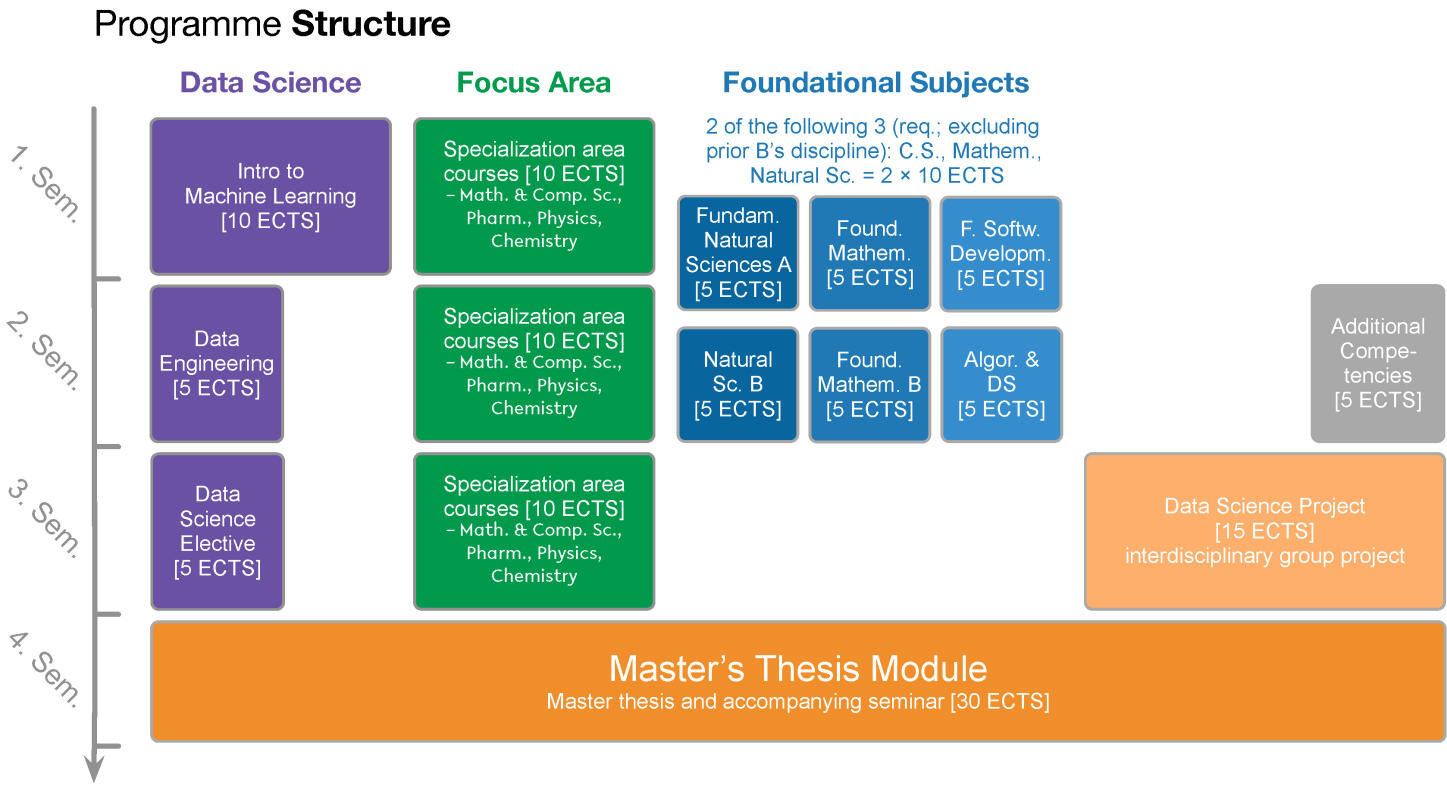
Learn more about the curriculum and course options in the program's Degree Regulations, which provide detailed descriptions of each module and its learning objectives.
The University of Münster: Combining Tradition and Innovation
With some 44,000 students, the University of Münster is one of the biggest and oldest universities in Germany and one of the foremost centers of German intellectual life. Officially founded in 1780, our roots go back to the convent of lay sisters Liebfrauen-Überwasser – an educational institution for women – founded in 1040, and the establishment of a Jesuit College in 1588. Due to the turmoil of the Thirty Year’s War and financial reasons, it took almost 200 years to transform the Jesuit College into an official university.
Today, besides a broad range of academic opportunities – from bachelor's programmes to in-service continuing education courses, the University of Münster offers a huge and varied amount of extracurricular activities and support for its students: Learn a new language at our Language Centre, take part in one of over 150 different sports at our University Sports, sing in a choir or join an orchestra, take part in a university group, act in a play – or sit back and enjoy the performances of other students: with our wide variety of cultural, international, political and religious student societies, initiatives, and sports groups, the University of Münster offers you countless opportunities to spend your free time and make new friends.
We value a close relationship between research and teaching, extensive advice and counselling services. Compared to many other German universities, our graduates have better chances of launching a career after their studies.
The City of Münster: Our vibrant, verdant Campus
In Germany, Münster is known as one of THE student cities. Since its official founding in 1780, the University of Münster has grown continuously. Our departments, central institutions and libraries are spread all over the city - well, the city of Münster somehow is our campus! Münster is a beautiful, green, safe and lively city of about 320.000 inhabitants in the north-western part of Germany, and the northern part of its federal state North-Rhine Westphalia. Münster has a vibrant cultural and nightlife scene - partly due to its over 70.000 students of one of the eight institutions of higher education. Many cafés, bars and cultural institutions in the city offer a wide range of discounts for students. Münster also hosts one of the most important art exhibitions worldwide - the sculpture project - every 10 years. What else? Well, Münster has won numerous awards for its high quality of live - and a bicycle is the best way to zoom around!