

How “green” is the production of new materials?
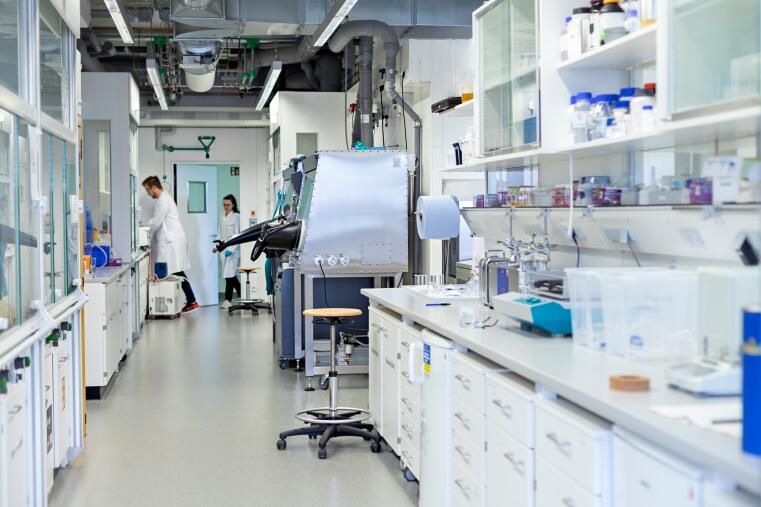
New materials are intended to make batteries more powerful and sustainable. Yet producing them can also have substantial environmental impacts. A team from the Universities of Cologne and Münster has developed a method to systematically assess these impacts early in the research process. The Institute of Business Chemistry at the University of Münster contributed to the study. The “Environmental Synthesis Radar” (ESR) identifies particularly problematic chemicals and production steps – and highlights opportunities for improvement. The study has been published in the journal Advanced Materials.
The approach is based on life cycle assessment. Rather than focusing solely on a material’s carbon footprint, for example, ESR considers 18 environmental impact categories, including climate change, resource use and potential harm to human health from pollutants. The team records the substances used, energy requirements and waste generated throughout the production chain, including the production of starting materials.
The method provides an overall indicator, an “environmental fingerprint” highlighting the most significant impacts, and an overview of the most critical process steps. It is designed for both laboratory procedures and industrial production.
The researchers tested the approach on two classes of materials for the positive electrode of rechargeable batteries: organic, carbon-based compounds and an established lithium nickel manganese cobalt oxide. For the same mass of material produced, the organic materials studied caused approximately five to seven times the environmental impact of the inorganic reference material, with both assessed at laboratory scale. Complex reaction sequences and environmentally harmful chemicals were major contributors.
The analysis also identified opportunities for improvement. For one organic reference compound, replacing a palladium-based catalyst with a copper-based alternative reduced the calculated environmental impact by around 83 per cent. This optimisation was assessed computationally, not tested experimentally. For the inorganic material, moving from laboratory-scale to industrial production roughly halved the environmental impact, primarily through more energy-efficient furnaces.
ESR does not, however, provide a definitive environmental assessment of complete batteries: use, service life and recycling fall outside the production assessment examined here. Instead, the method aims to help researchers develop more environmentally favourable production routes early on – while processes can still be readily changed.
Original publication:
Plein, L., Schommer, A., Dietrich, F., Gutsch, M., Klesper, H., Schuller, K., Jahnke, L., Leker, J. & Meerholz, K. (2026). How “green” is your functional material? Assessing environmental impacts of multi‐step synthetic protocols in material sciences at various technology levels. Advanced Materials, e74993. doi: 10.1002/adma.74993.