The University of Münster’s Brazil Centre visits USP to boost collaboration in research & innovation
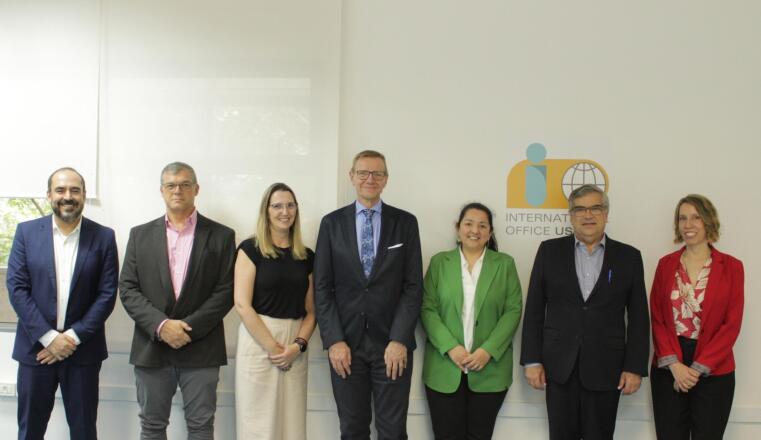
In early April, a delegation from the Brazil Centre, led by the Scientific Director, Prof. Dr.-Ing. Bernd Hellingrath, and the Acting Managing Director, Katy Cordeiro dos Santos, travelled to Brazil. The team, which also included Cíntia Toth, Director of the Brazil Centre’s Liaison Office in São Paulo, held a series of meetings and participated in events with the aim of strengthening partnerships and fostering collaboration.
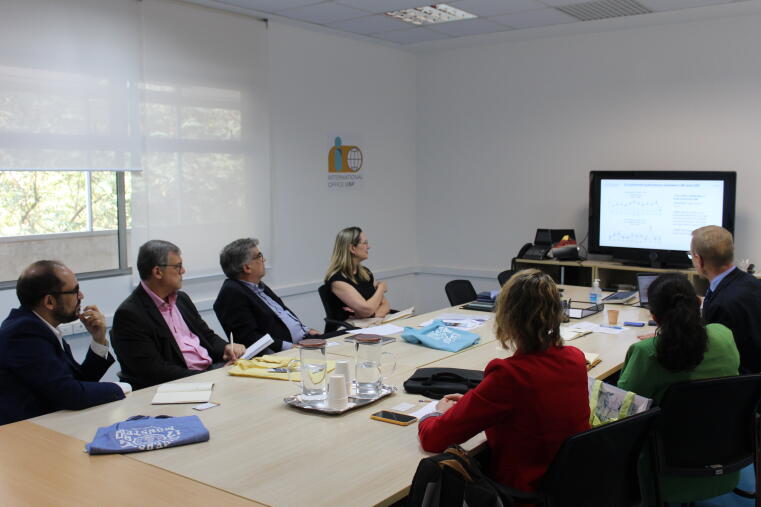
On 9 April, the delegation from Münster met with representatives from its strategic partner, the University of São Paulo (USP), one of the leading higher education institutions in Latin America and a long-standing partner of the University of Münster. USP is Münster's most active collaborator in Brazil. The meeting took place at the USP's Agency for National and International Academic Cooperation (AUCANI) and was attended by Prof. Carlos Eduardo Cerri, Deputy Vice-Chancellor for Research, Prof. Carlos Gilberto Carlotti Junior, Provost for International Cooperation, Prof. Dr. Juliana Leme, Associate Director for Academic Cooperation, and Prof. Dr. Paulo Henrique Braz-Silva, Associate Director for Academic Mobility.
The purpose of the meeting was to introduce the institutions under USP’s new leadership and to explore new collaboration opportunities, particularly in research and innovation. During the visit, various initiatives were discussed, with particular focus on the wider promotion of existing programmes and opportunities. One such programme is the Master SãmBio programme, a dual degree programme between the Faculty of Biology at the University of Münster and the Institute of Biomedical Sciences at USP, established in 2017. Another existing opportunity discussed was the Global Joint Supervision Agreement. Signed in 2022, this agreement enables joint supervision of doctoral candidades. The University of Münster currently hosts the largest number of individual joint supervision cases under this agreement. In addition, new avenues for collaboration were explored, including organising joint events to connect researchers in priority areas, as well as developing initiatives for academic exchange, both in person and online.
Related News (in Portuguese):
Aucani recebe delegação da Universität Münster (UNIMÜNSTER), da Alemanha.