


Project MUSGOS (2026-2028)
Modelling and UpScaling Greenhouse gas flux Observations with remote Sensing
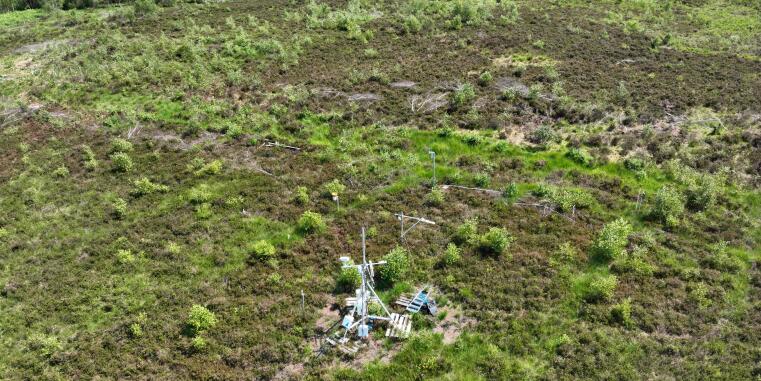
The project MUSGOS aims to investigate which landscape conditions contribute most to the greenhouse gas (GHG) exchange in a degraded peatland ecosystem in northwest Germany. An eddy covariance tower, installed at Amtsvenn-Hündlfelder Moor in September 2022, continuously measures GHG exchange between the ecosystem and the atmosphere across the area surrounding the tower. Drone surveys with high-resolution imaging and LiDAR sensors will be used to identify and map peatland vegetation types and structure, alongside high-resolution satellite imagery to track environmental changes over time. As rewetting has been underway at the site since 2025, groundwater depth measured by in-situ sensors will also be integrated. Together, these data will characterize peatland conditions and landscape heterogeneity. Using machine learning models, the project aims to understand how these landscape characteristics influence GHG uptake and release in a peatland undergoing rewetting.
The potential and reliability of upscaling the flux measurements to a broader area of the peatland will be assessed. This will help to estimate the contribution of the degraded peatland to GHG emissions and understand how landscape features influence this contribution. The ongoing rewetting will also allow the examination on whether these relationships remain consistent as landscape and hydrological conditions change, and how they evolve over time.
The project addresses three main objectives:
- Model the relationships between landscape conditions and observed GHG fluxes within the tower footprints;
- Upscale these estimates and assess the associated uncertainty;
- Evaluate whether rewetting changes the relationships between landscape conditions and GHG flux dynamics.