PROJECTS
Far beyond its status as a technological endeavour, Energy Transition has become one of the most ambitious and embattled projects of our present-day societies, projecting and preparing a variety of possible energy futures. In fact, by crossing nations, minds and disciplines, the quest for energy security has turned this project into a new master narrative. The narrative of Energy Transition – like its hardware counterpart in engineering, informatics and technology – is driven by a set of technological, conceptual and qualitative models meant to meet societal needs and demands.
Aesthetic strategies are poised to play a major role in the design, representation and evaluation of a model, and they guide the ways in which it is communicated, thus accounting for the model’s failure or success. They are a vital means to mitigate the differences in geography, political conditions, cultures and traditions prevalent within the global energy community, especially as they necessitate a set of narratives that experts, citizens, and stakeholders create together.
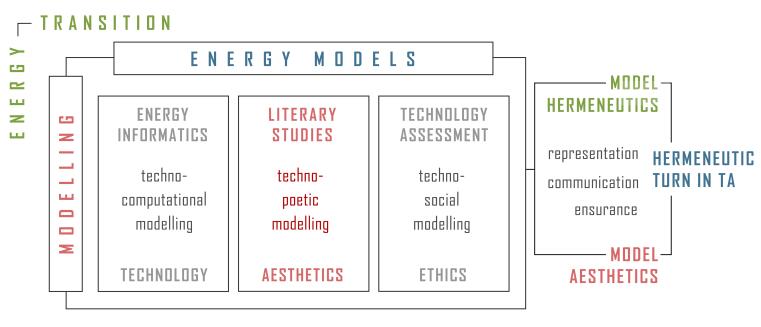
Aesthetic Modelling distinguishes itself from other types of modelling by the forms and functions it delivers: tools of representing and communicating, narratives of failure or success, modalities of being, rules of validation and evaluation, concepts of coherence and integrity, conditions of acceptance. With regard to Energy Transition, this approach to model criticism shows how features of aesthetic modelling relate to and accommodate the tensions between techno-computational and techno-social forms of modelling and so releases their discursive power (s. fig.).
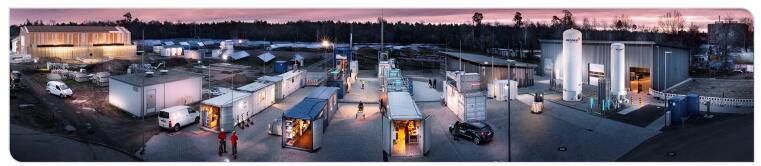
As places of collaboration, crossing boundaries between scientific expertise and public discourse, real-world labs provide an ideal testing ground both for the roles and features of aesthetic modelling and its applied poetics. In particular, the Energy Transition labs are places of joint modelling wherein aesthetic modelling is a decisive part of social modelling. It contributes a joint experience and means of fabrication to the contact zone of science and aesthetics, carried out by actors from a wide range of societal, professional and epistemic domains. Aesthetic modelling can build the bridge between the modelling of Energy Transition and its real-world lab environment. As such, it also serves a double academic purpose: to enhance and broaden the emerging field of real-world laboratory studies, and, in doing so, to close a major gap in model theory.
Project Partners
- Prof. Dr. Veit Hagenmeyer, Energy Informatics, KIT Karlsruhe (PI)
- Prof. Dr. Klaus Stierstorfer, English Studies, University of Münster (PI)
- Prof. Dr. Robert Matthias Erdbeer, German Studies, University of Münster (Research Coordinator)
- Prof. Dr. Armin Grunwald, Technology Assessment, KIT Karlsruhe / ITAS
- Prof. Dr. Daniel J. Lang, Real-World Laboratory Research, KIT Karlsruhe / ITAS
- Dr. Paulina Dobroć, Technology Assessment, KIT Karlsruhe / ITAS
- Prof. Tobias Becker, Design and Design Theory / Fine Arts, University of Siegen (ass. Partner)
Energy Futures on Campus in the Middle East: Teaching. Modelling. Realisation.
A DeveloPPP ›Partners in Transformation‹ Project

This project is a research collaboration of the University of Münster, the Imam Ja’afar al-Sadiq University of Baghdad, Iraq, and the Applied Science Private University of Amman, Jordan. It addresses the urgent need for a sustainable, resilient energy future in Jordan and Iraq. While Jordan requires support to scale up its renewable infrastructure and research capacity, Iraq needs foundational investment in infrastructure, planning, and capacity building. The asymmetry between the two countries is not just a challenge—it is a call to action. By fostering collaboration between advanced and emerging energy systems, the project aims to catalyse transformative change where it is most needed and most overdue.
The core initiative for the project originates within a long collaboration between KIT and the University of Münster exploring innovative approaches to modelling in general and energy transition in particular. The uniqueness of the approach here is the integration of modelling aesthetics and communicative aspects within models, which are themselves seen as processes rather than static constructs. This project line has been funded by the Volkswagen Foundation (2019-2023) and, currently, by the DFG (2025-2030; https://gepris.dfg.de/gepris/projekt/550232575). With the develoPPP project, modelling expertise gained for Germany can now be tested, adjusted and applied in very different contexts (Iraq and Jordan), which are promising locations precisely because of their differences to the German situation and the perceived context-contingency of models.
Project Partners
- Prof. Dr. Klaus Stierstorfer, University of Münster
- Prof. Mohammad Ahmad Hamdan, ASU, Amman
- Ass. Prof. Dr. Azeez Jasim, IJSU, Baghdad
Literary Modelling – Perspectives on a Model Poetics
A Joint Research Project at the University of Münster and Sofia University

This long-term international collaboration in research and teaching focuses on the development and application of a literary theory of models. It is has drawn substantial support by the ERASMUS+ Staff Mobility program for exchanges of research and teaching personal between Germany and Bulgaria. The research results have been published in a variety of formats like journal articles, books, conference presentations, round table discussions and others; joint workshops, seminars and lectures have been organized at Sofia University, the Bulgarian Academy of Sciences, and the University of Münster.
Project Partners
- Prof. Dr. Robert Matthias Erdbeer, Universität Münster, Deutschland
- Prof. Dr. Klaus Stierstorfer, Universität Münster, Deutschland
- Prof. Dr. Miglena Nikolchina, St.-Kliment-Ochridksi-Universität Sofia, Bulgarien
- Prof. Dr. Kamelia Spasova, St.-Kliment-Ochridksi-Universität Sofia, Bulgarien
- Prof. Dr. Darin Tenev, St.-Kliment-Ochridksi-Universität Sofia, Bulgarien
FORMER PROJECTS
LMET – Literary Modelling and Energy Transition
Development and Application of a Transdisciplinary Theory of Models

Supported by the Volkswagen Foundation, 2017-2023
Funding Line Offen für Außergewöhnliches – Off the Beaten Track
LITERARY MODELLING AND ENERGY TRANSITION (LMET) is a collaborative research and consulting network at the University of Münster (WWU) and the Karlsruhe Institute of Technology (KIT). Funded by the Volkswagen Foundation, LMET targets one of the most controversial challenges – and most ambiguous topics – of contemporary science and society: the modelling of energy transition. Analysing the transition energies that forcefully emerge whenever long-established strategies, technologies and energy resources are to be replaced by new and non-conventional alternatives, the research group develops a strategic roadmap for a thorough understanding of the process at large. By viewing it both as a technological and as a cultural endeavour, LMET takes into account the hidden or subdued agendas of the technosocial setting in question: of the undisclosed aesthetic, ethical, political, historical and even esoteric values that pervade the Energy Imaginary and its narratives.