


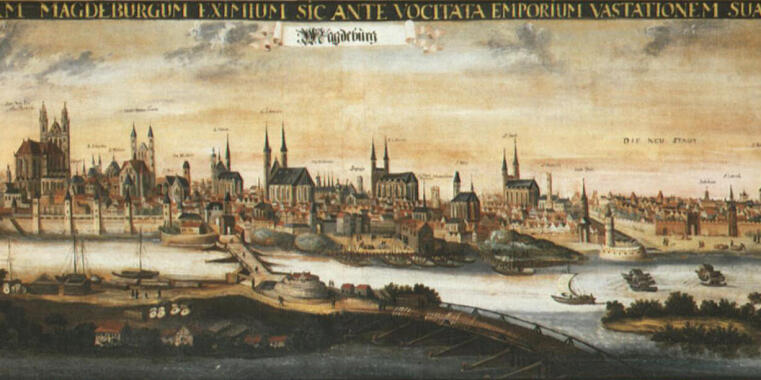
Historical survey maps and the comparative study of the functionality and morphology of urban space
Standardisation – Digital processing – Research
About the Project
The funding bid submitted by the IStG together with Prof. Dr Roman Czaja of Uniwersytet Mikołaja Kopernika in Toruń in the BEETHOVEN 4 funding programme which serves the DFG and NCN to foster Polish-German research cooperations has been accepted. The three-year collaborative project HiSMaComp started in Summer of 2022.
Focusing on comparative urban development the project is primarily based on survey maps from the 19th century. The development and spatial structures of six Polish and German cities will be reconstructed and compared on the basis of typological criteria. The six case studies can be described as manifestations of the town types “ecclesiastical town” (Olsztyn/Allenstein – Ochsenfurt), “spa town” (Inowrocław/Hohensalza – Bad Pyrmont) and “metropolis” (Warsaw – Magdeburg). The influence of these respective functions on the shape of the individual towns and the developmental paths that characterise the town types are the first research objective of the project.
In addition to the primary results, the project will focus on developing methodologies. The research is based on historical maps and written sources. The data processing will be carried out by means of a geo-information system integrating both. The creation of compatible geodata for urban comparisons represents a topical research desideratum and a particular challenge. The implementation of the UrbanOnto system of the Warsaw project “Historical Ontology of Urban Spaces” is also to be tested in practice and made usable in order to gain new insights into the transformation of urban spaces.
The experience gained and the newly developed data standards will be an important contribution to the future re-use of research data derived from the European Historic Towns Atlas projects.
Project Duration
2022 – 2025
Project Team
Project Leaders
Dr. Angelika Lampen
Dr. Daniel Stracke
Project Staff
Dr. Anna Paulina Orłowska
Tobias Runkel
Anna-Lena Schumacher
Dr. Daniel Stracke
Dr. Olga Kozubska (additional project)
Please refer to the project blog for more information:
Supplementary Project – The Dispersal of Town Types in Poland, Germany and Ukraine
The DFG-funded supplementary project started in October 2023 and will run for 21 months. As its title "The Identification and Dispersal of Functional Town Types in Germany, Poland and Ukraine. The HiSMaComp Town Types: Metropolis – Ecclesiastical Town – Spa Town" suggests, the project takes a macro perspective, aiming to identify all towns that match the profile of the town types examined in the HiSMaComp project. Their spatial distribution was then visualised in thematic maps. In addition to the countries originally studied – Poland and Germany – Ukraine was added as a third study area, representing a quantitative leap forward compared to the main project and expanding the research framework and geographical scope of the study.
Based on the HiSMaComp case studies, criteria for each of the three town types defined in the main project were developed as part of the supplementary project and made applicable to other European regions. The new findings from the supplementary project allowed the ontology developed in HiSMaComp to be significantly expanded.
In addition, the project examined the occurrence of functional topographical objects and developed a taxonomy of towns with more or less typical functions, revealing the “standard types” of “metropolis”, “ecclesiastical town” and “spa town”. Such an analysis can help enhance comparative studies and serves to highlight regional and/or transregional similarities and differences that have so far been overlooked by the research community.
This broader context also allows for a reassessment of typical and individual characteristics of the original case studies – Waszawa/Warsaw, Magdeburg, Olsztyn/Allenstein, Ochsenfurt, Inowrocław/Hohensalza and Bad Pyrmont.
Coorperation and Funding
Cooperartion
In cooperation with the Uniwersytet Mikołaja Kopernika in Toruń/Polen, the Stadtarchiv Magdeburg, the Stadtarchiv Ochsenfurt and the Landesamt für Geoinformation und Landesvermessung Niedersachsen, Regionaldirektion Hameln-Hannover.

© UniwersytetMK_Torun 
© Stadtarchiv Magdeburg 
© Stadt Ochsenfurt 
© LGLN
