

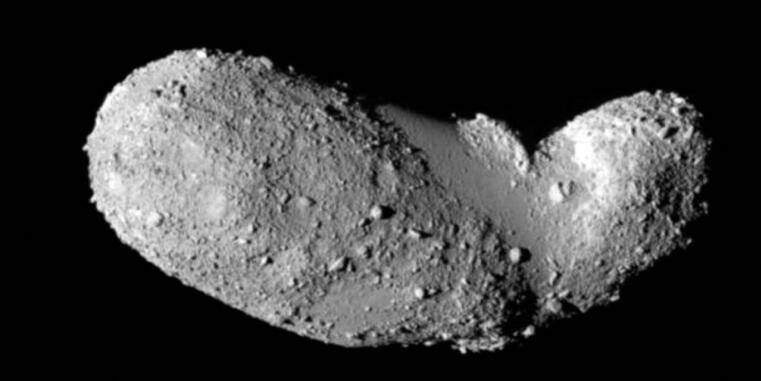
Asteroids are small celestial bodies believed to be remnants from the early days of the solar system. They are particularly common in the asteroid belt between Mars and Jupiter, but also occur as near-Earth asteroids (NEAs) or as Trojans in stable orbits near large planets. Asteroids move in elliptical orbits around the Sun and are altered over long periods of time by collisions, gravitational influences, and thermal processes.
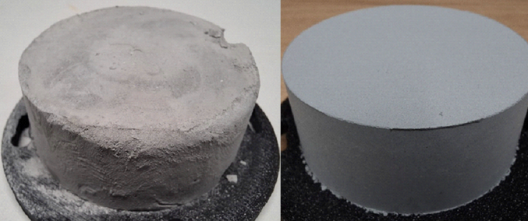
Many asteroids are not monolithic boulders, but rather porous, rugged bodies or so-called “rubble piles.” Their surfaces are covered by regolith, a layer of loose dust and rock fragments whose properties (e.g., grain size, porosity, or thermal conductivity) influence how asteroids heat up and cool down under solar radiation. Asteroids thus provide important information about the formation and evolution of the solar system and are also relevant for space probe missions and the assessment of impact risks. In some cases, they even exhibit activity such as dust emissions, which can blur the line between them and comets.
At the Institute of Planetary Science, we therefore study asteroids using laboratory analog experiments and numerical simulations. In the laboratory, we analyze how asteroid-like materials and regolith behave under space-like conditions—for example, during extreme temperature fluctuations, radiation exposure, and mechanical stress. In addition, we use thermophysical models to calculate the heat generation of asteroids and to understand how surface properties, rotation, and shape influence temperatures, regolith formation, and long-term dynamic effects. In this way, we combine experimental data with simulations to better quantify the processes on and within asteroids.
A central goal of our asteroid research is to eventually collect a sample from an asteroid and return it to Earth. To this end, our research group is developing a Brush-Wheel-Sampler that efficiently collects regolith during brief surface contact and transports it to a collection container—particularly suitable for touch-and-go maneuvers. Following successful tests with various analog materials, the system has since also been tested in microgravity and reduced gravity conditions; the campaigns were highly successful and confirm the concept’s potential for future sample-return missions.