

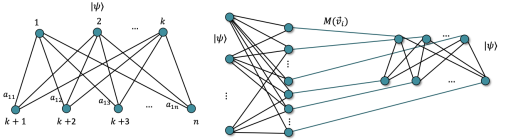
Multipartite quantum systems exhibit a much richer structure than bipartite systems, yet many of their fundamental properties remain poorly understood. Which multipartite states represent genuinely distinct quantum resources? How can they be classified and characterized? How do these questions change when moving beyond qubits to higher-dimensional quantum systems?
Our research addresses these questions through the study of graph states, absolutely maximally entangled states, local Clifford equivalence, and mathematical connections to coding theory and combinatorics. We are particularly interested in understanding how the structure of multipartite entanglement determines its role in quantum communication, quantum cryptography, and quantum error correction.
Research topics:
- Graph states — A versatile framework for describing multipartite entanglement and its applications to communication, computation, and error correction.
- Absolutely maximally entangled (AME) states — Highly entangled quantum states with connections to quantum codes, secret sharing, and distributed quantum information tasks.
- Local Clifford equivalence — Classification of graph and stabilizer states under local transformations to identify inequivalent quantum resources.
- Higher-dimensional multipartite systems — Qudits provide larger local Hilbert spaces than qubits, enabling richer forms of multipartite entanglement and new opportunities for quantum communication and information processing.
- Quantum combinatorial designs — Combinatorial structures provide powerful mathematical tools for constructing and characterizing highly entangled quantum states, revealing deep connections between quantum information and coding theory.
Selected publications:
- "Non-symmetric GHZ states: weighted hypergraph and controlled-unitary graph representations", H. Zakaryan, K-R. Revis, Z. Raissi, Phys. Rev. A 112, 032438 (2025).
- "χ-Colorable Graph States: Closed-Form Expressions and Quantum Orthogonal Arrays", K-R. Revis, H. Zakaryan, Z. Raissi, J. Phys. A: Math. Theor. 58, 355301 (2025).
- "General stabilizer approach for constructing highly entangled graph states", Z. Raissi, A. Burchardt, and E. Barnes, Phys. Rev. A 106, 062424 (2022).
- "Constructions of k-uniform and absolutely maximally entangled states beyond maximum distance codes", Z. Raissi, A. Teixidó, C. Gogolin, and A. Acín, Phys. Rev. Research 2, 033411 (2020).
- "Entanglement and quantum combinatorial designs", D. Goyeneche, Z. Raissi, S. Di Martino, and K. Życzkowski, Phys. Rev. A 97, 062326 (2018).