

Research Focus
An overview that will blow your damn mind:
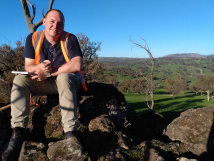
Have you ever wondered what the coolest and most interesting rock class on the Earth is? Fear not, it is the potassic and highly-alkaline mafic and ultramafic rocks. You're welcome. What makes them so flipping awesome? Great question, I am glad you asked! Strap in, this is gonna be fun! The melts that eventually crystallise to form these rock upon exhumation are among the most important, enigmatic, and potentially essential magmas for the transport of life essential elements like hydrogen, carbon, phosphorous, nitrogen, and sulfur. These melts also capture some of the first melting processes, and allow us a direct insight in to how nutrients and metals are sequentially concentrated and exchanged between the Earth's mantle, crust, and atmosphere. Bloody hell! That's sick! How do you do that? I use a range of analytical geochemical and experimental techniques to determine the mineralogy and chemistry of rocks collected in the field to piece together their genesis. Sometimes I even make my own rocks in the large hydraulic presses that can cook a rock up to 1800°C, which is a bit like the mad scientist equivalent of baking a cake by building the oven first out of lego. I choose to work with some of the most complex rocks and melts, including some we only think might exist, because the formation of these geological materials encapsulate the true diversity of processes that have made our planet a habitable and cosy home for species like us! Aside from this I have a general interest in high-pressure semi-conductor research, mineral physics, FAIR data and open science principles, and occassionally mummified cats. Want to know more? Check out my publications below, or shoot me an email. Stay funky! Ant
Doctoral AbstractThesis
The origin of ultrapotassic magmas
- Supervisor
- Prof. Stephan Klemme, PhD
- Doctoral Subject
- Mineralogie
- Targeted Doctoral Degree
- Dr. rer. nat.
- Awarded by
- Department 14 – Geosciences
Alkaline mafic magmas, but more specifically the potassic and ultrapotassic varieties enriched with more potassium (K) than sodium (Na), are essential for our understanding planetary habitability, evolution, and volatile cycles. Despite this importance they have been neglected by the Earth Science community, relative to the more widespread basalts like those that erupt at mid-ocean ridges or ocean islands. The enigmatic nature of these melts has hindered their investigation in part due to analytical challenges such as their propensity to be volatile laden, but also because their genesis is wrapped in paradoxical processed. For example, it is well established that the bulk of the Earth's mantle is made of peridotite which is also known to be largely devoid of K. This alone would more or less eliminate the possibility of mantle--derived melting processes producing magmatic compositions that could crystallise at the surface to form potassic or ultrapotassic rocks.
The widespread occurrence across all geodynamic settings of K--enriched rock types like lamproites, lamprophyres, leucitites, as well as basanites or shoshonitic basalts is in direct contradiction to this impossibility. Likewise the existence of this rocks, and the fact they represent a spectrum of K enrichments also suggests that for all of them to be derived from melting in the mantle they must be sampling source assemblages with different mineral components. Within the mantle geoscience community this is known as "Mantle Heterogeneity" and as a concept captures processes that produce magmas of all compositions, not just those that are potassic and ultrapotassic. Heterogeneity on this scale is not a widely accepted concept, and debate exists as to the existence and breadth of any non-peridotite assemblage within the mantle. A furtherance to this debate is the complexity added by isolating the type, style, and drivers of any process that could materialise significant changes to both the physical and chemical profiles of the mantle.
These are the central questions that this doctoral thesis aims to approach. Through the use of these unique potassium-rich magmas and rocks that are believed to capture the first stages of mantle melting and sample these heterogeneous regions, this work will evaluate both natural and synthetic samples in the field and laboratory to isolate melting and enrichment processes. In doing so this work will also provide a deeper understanding of potassic rocks and their formation processes.
CV
Academic Education
- Doktor der Naturwissenschaften, Institut für Mineralogie, Universität Münster, Münster, Germany (co-tutelle).
- PhD in Earth and Planetary Sciences, Macquarie University, Sydney, Australia (co-tutelle).
- Master of Research in Earth & Planetary Sciences, Macquarie University, Sydney, Australia.
- Bachelor of Science in Geology & Geophyscis, Macquarie University, Sydney, Australia.
Positions
- Demonstrator & Tutor (sessional teaching; classes up to 40 students), Department of Earth & Planetary Sciences, Macquarie University. Sydney, Australia.
- Lab Manager - High Pressure Experimental, Department of Earth & Planetary Sciences, Macquarie University. Sydney, Australia.
- Research Assistant - Sydney Water project, Department of Earth & Planetary Sciences, Macquarie University. Sydney, Australia.
- Summer Research Intern - Sample Environment Team, Australian Centre for Neutron Scattering, Australian Nuclear Science and Technology Organisation (ANSTO). Lucas Heights, Sydney, Australia.
Publications
- Lanati, AW, Shea, JJ, Foley, SF, Klöcking, M, Rohrbach, A, and Klemme, S. . “The East Australian Potassic Suite: Petrology, Bulk Chemistry, and Origin.” Journal of Petrology 67 (2) egag002. doi: 10.1093/petrology/egag002.
Abstract in a Digital Collection (Conferences)
- Lanati, Anthony, Rohrbach, Arno, Tiraboschi, Carla, Berndt, Jasper, Klemme, Stephan, and Foley, Stephen. . “Experimentally determined melting and phase relations in a volatile bearing mica-pyroxenite system – implications for mantle metasomatism and alkaline volcanism.” contribution to the EGU General Assembly, Vienna doi: 10.5194/egusphere-egu25-18420.
Research Articles in a Digital Collection
- Lanati, Anthony, Shea, Joshua, Foley, Stephen, Klöcking, Marthe, Rohrbach, Arno, and Klemme, Stephan. . “The Petrology, Geochemistry, and Origin of the East Australian Potassic Suite: Bulk Chemistry and Genesis.” Preprint. EarthArXiv doi: 10.31223/X5613R.
- Shea, J., Foley, S., Dalton, H., Lanati, A., and Phillips, D. . “Mid-Jurassic volcanism at Bokhara River and insights into metasomatism in the lithospheric mantle of the Thomson Orogen, eastern Australia.” Australian Journal of Earth Sciences 71 (3): 325–337. doi: 10.1080/08120099.2024.2302360.
Research Article (Journal)
- Amulele, G, Manghnani, MH, Werheit, H, Lanati, AW, and Clark, SM. . “Electrical conductivity of B∼4.3C boron carbide up to 9 GPa and 1273 K.” Solid State Sciences 140: 107185–107185. doi: 10.1016/j.solidstatesciences.2023.107185.
Review Article (Journal)
- Klöcking, Marthe, Wyborn, Lesley, Lehnert, Kerstin A., Ware, Bryant, Prent, Alexander M., Profeta, Lucia, Kohlmann, Fabian, Noble, Wayne, Bruno, Ian, Lambart, Sarah, Ananuer, Halimulati, Barber, Nicholas D., Becker, Harry, Brodbeck, Maurice, Deng, Hang, Deng, Kai, Elger, Kirsten, Franco, Gabriel de Souza, Gao, Yajie, Ghasera, Khalid Mohammed, Hezel, Dominik C., Huang, Jingyi, Kerswell, Buchanan, Koch, Hilde, Lanati, Anthony W., ter Maat, Geertje, Martínez-Villegas, Nadia, Nana Yobo, Lucien, Redaa, Ahmad, Schäfer, Wiebke, Swing, Megan R., Taylor, Richard J.M., Traun, Marie Katrine, Whelan, Jo, and Zhou, Tengfei. . “Community recommendations for geochemical data, services and analytical capabilities in the 21st century.” Geochimica et Cosmochimica Acta 351: 192–205. doi: 10.1016/j.gca.2023.04.024.
- Amulele, GM, Lanati, AW, and Clark, SM. . “The electrical conductivity of albite feldspar: Implications for oceanic lower crustal sequences and subduction zones.” American Mineralogist 107: 614–624. doi: 10.2138/am-2021-7836.
- Shea, JJ, Ezad, IS, Foley, SF, and Lanati, AW. . “The Eastern Australian Volcanic Province, its primitive melts, constraints on melt sources and the influence of mantle metasomatism.” Earth-Science Reviews 233: 104168–104168. doi: 10.1016/j.earscirev.2022.104168.
Research Articles (Journals)
- Amulele, G.M., Lanati, A.W., and Clark, S.M. . “The electrical conductivity of albite feldspar: implications for oceanic lower crustal sequences and subduction zones.” American Mineralogist -. doi: 10.2138/am-2021-7836.
- Pintér, Z., Foley, S.F., Yaxley, G.M., Rosenthal, A., Rapp, R.P., Lanati, A.W., and Rushmer, T.A. . “Experimental investigation of the composition of incipient melts in upper mantle peridotites in the presence of CO2 and H2O.” Lithos 396-397. doi: 10.1016/j.lithos.2021.106224.
- Pintér, Z, Foley, S.F, Yaxley, G.M, Rosenthal, A, Rapp, R.P, Lanati, A.W, and Rushmer, T. . “Experimental investigation of the composition of incipient melts in upper mantle peridotites in the presence of CO2 and H2O.” Lithos 396–397: 1–15. doi: 10.1016/j.lithos.2021.106224.
Research Articles in a Digital Collection
- Lanati, A, Pourret, O, Jackson, C, and Besançon, L. . “Research Funding Bodies Need to Follow Scientific Evidence: Preprints Are Here to Stay.” Preprint. OSFPreprints Center for Open Science. doi: 10.31219/osf.io/k54pe.
- Amulele, GM, Lanati, AW, and Clark, SM. . “Electrical conductivity studies on silica phases and the effects of phase transformation.” American Mineralogist 104: 1800–1805. doi: 10.2138/am-2019-7120.
- Raymond, C.A., Bevitt, J.J., Tristant, Y., Power, R.K., Lanati, A.W., Davey, C.J., Magnussen, J.S., and Clark, S.M. . “Recycled Blessings: An Investigative Case Study of a Rewrapped Egyptian Votive Mummy Using Novel and Established 3D Imaging Techniques.” Archaeometry 61 (5). doi: 10.1111/arcm.12477.
- Amulele, G.M., Lanati, A.W., and Clark, S.M. . “Electrical conductivity studies on silica phases and the effects of phase transformation.” American Mineralogist 104 (12). doi: 10.2138/am-2019-7120.
- Raymond, C.A., Bevitt, J.J., Tristant, Y, Power, R.K, Lanati, A.W, Davey, C.J., Magnussen, J.S, and Clark, S.M. . “Recycled blessings: an investigative case study of a rewrapped Egyptian votive mummy using novel and established 3D imaging techniques.” Archaeometry 61: 1160–1174. doi: 10.1111/arcm.12477.
Research Article in Edited Proceeding (Conference)
- Amulele, G, Clark, S, and Lanati, A. . “THE INFLUENCE OF HYDROUS MELTING ON THE ELECTRICAL CONDUCTIVITY IN FELDSPAR LABRADORITE.” in 113th Annual Meeting: proceedings, edited by Cordilleran Section GSA. Boulder, Colorado: Geological Society of America. doi: 10.1130/abs/2017cd-293039.
Abstracts in Edited Proceedings (Conferences)
- Lanati, A, Amulele, G.M, and Clark, S.M. . “Hydrous melting of labradorite: an electrical conductivity investigation.” in Geological Society of Australia Abstract, edited by Society of Australia Geological. Sydney: Geological Society of Australia.
- Lanati, A, Amulele, G.M, and Clark, S.M. . “Silica phases and the effects of phase transformation on electrical conductivity – just another mineral to test or a major player in the Earth's field?” in Geological Society of Australia - Earth Sciences Student Symposium 2017, Vol. 125 of Geological Society of Australia Abstracts, edited by S.Andrew Anita. Adelaide: Geological Society of Australia.