

Potential of Wet-mechanical Processing for Battery Recycling Investigated
Wet-mechanical processing of batteries is a low-energy, safe, and cost-effective recycling method. During this procedure, cells are shredded in a liquid medium, often water. One advantage is that prior process steps, such as time-consuming deep discharge or extensive safety measures, can be reduced, as the battery cells are deactivated by the aqueous matrix during the shredding process. However, the method is still rarely used in industry. To further develop it, a team from MEET Battery Research Center at the University of Münster and the Institute for Infrastructure, Water, Resources, and Environment (IWARU) at FH Münster has now investigated how the aqueous medium affects the battery materials during shredding.
Enhancing the Recycling Rate of Lithium Ion Batteries
First, the scientists analyzed how water – in addition to deactivation – can help to separate the materials used. During this process, they discovered that water dissolves the conducting salt and mixes with the electrolyte solvents and separates them from the black mass. Additionally, lithium was leached from the cathode material over time. “As a result, lithium selectively accumulated in the water relative to other metals and can therefore be separated more easily,” explains MEET researcher Julius Buchmann.
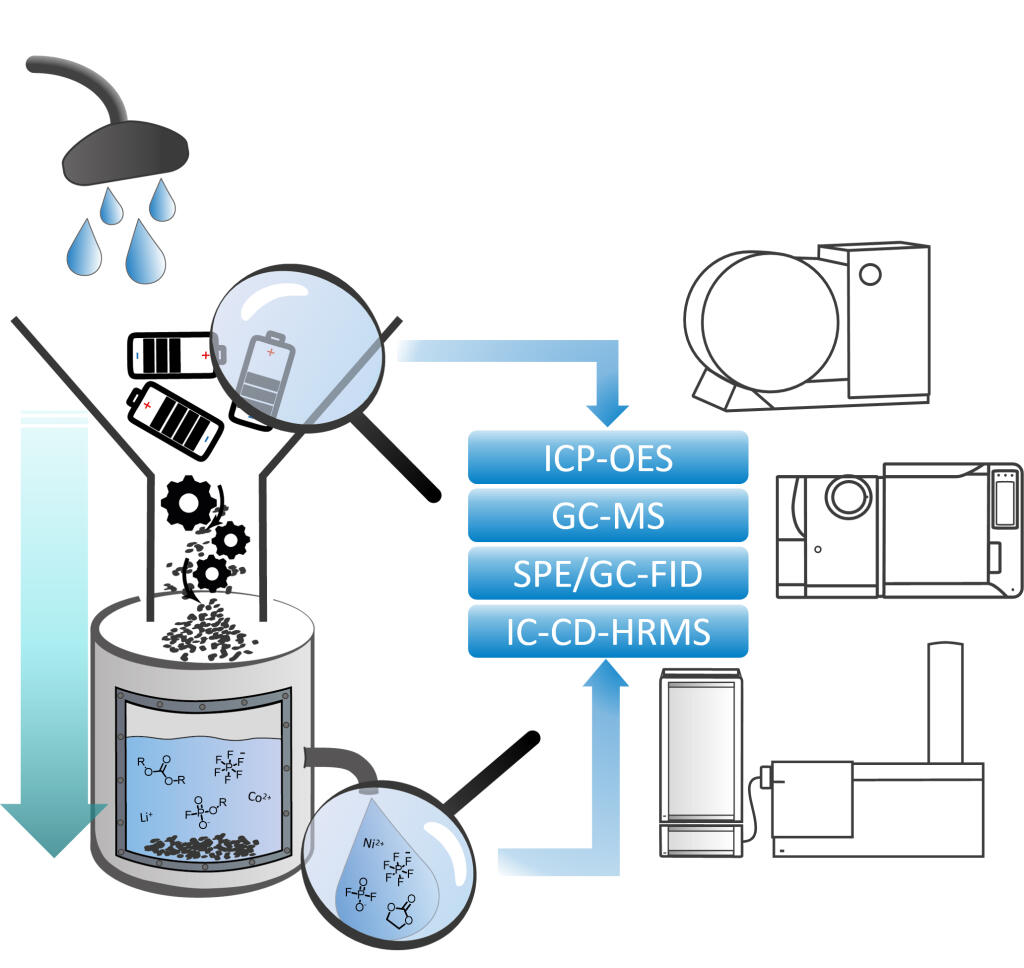
However, the water also triggered undesirable reactions. Its use caused the solvents to hydrolyze and degrade over time. This process was intensified at high temperatures and under basic conditions. The conducting salt, in contrast, remained stable in the process water and did not degrade further, not even under extreme conditions. “Nevertheless, we detected toxic decomposition products in the process water that may have been generated, for example, by the shredding of aged cells or thermal reactions during the shredding process. Further research is necessary to improve occupational safety and environmental protection for such processes,” explains Buchmann. The results already represent an important step towards a circular economy of batteries, as current recycling methods are often limited to recovering valuable metals such as cobalt or nickel. “Our study shows that it is also possible to preserve and separate the rarely addressed conducting salt and solvents in the aqueous medium. In the future, these components can be recovered, thereby increasing the recycling rate of lithium ion batteries,” Buchmann concludes.
Detailed Results Online Available
The entire study has been published by the authors Julius Buchmann, Dr Simon Wiemers-Meyer and Dr Sascha Nowak, MEET Battery Research Center, Moritz Goldkuhle and Prof. Dr Sabine Flamme, IWARU at FH Münster, as well as Prof. Dr Martin Winter, MEET Battery Research Center and Helmholtz Institute Münster of Forschungszentrum Jülich, in the journal “Advanced Energy and Sustainability Research”.