

Sustainable Battery Recycling with Supercritical Carbon Dioxide
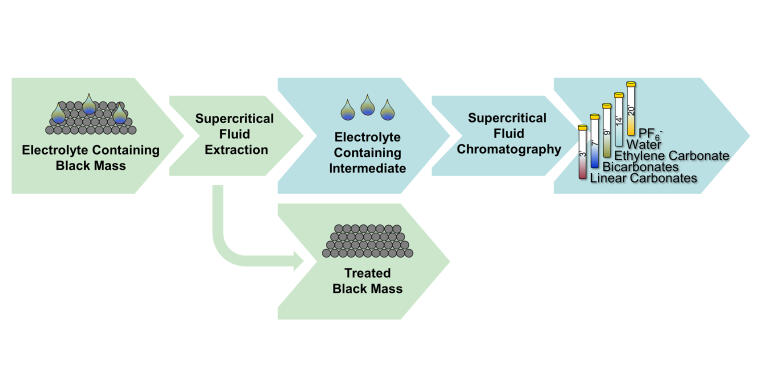
In addition to valuable metals, lithium ion batteries (LIBs) also contain electrolyte components, the recovery of which has received little attention to date. A research team from MEET Battery Research Center at the University of Münster and Shimadzu Europa GmbH is now presenting a two-step process that allows the electrolyte to be extracted sustainably and selectively from the black mass, the key recycling material from used batteries. By using supercritical carbon dioxide (scCO₂), valuable components, particularly the conductive salt, can be recovered without the use of large quantities of chemicals.
Supercritical CO₂ Enables Sustainable Electrolyte Recycling
This work builds on existing research but takes a decisive step further: By using supercritical carbon dioxide as an environmentally friendly solvent, it is possible not only to extract organic electrolyte components from the black mass but also to recover the conductive salt it contains and separate the complex mixture into several fractions. These electrolyte fractions exhibit high purity, ensuring their reuse as LIB electrolytes. Compared to previous approaches, the process also requires significantly smaller amounts of additional chemicals and opens up new possibilities for resource-efficient battery recycling.
“Until now, the focus in lithium ion battery recycling has primarily been on metal recovery. Our results show that electrolyte components, such as the conductive salt, can also be specifically recovered and, in the future, reused,” explains MEET researcher Jakob Hesper. This approach can reduce resource consumption and, in the long term, the costs of recycling processes. Furthermore, the process helps meet the European Union’s increasing recycling requirements, which mandate minimum quotas for the production of new and the recycling of end-of-life batteries. In addition, handling the black mass in the recycling process becomes safer once electrolyte components that are potentially harmful to health and the environment have been removed.
Detailed Results Online Available
The entire study has been published by the authors Jakob Hesper, Marie Heidler, Nick Fehlings, Lea-Sophie Kemper, Jan Henrik Hintemann, Verena Naber, Debbie Stappers, Dr Simon Wiemers-Meyer, Dr Sascha Nowak, MEET Battery Research Center, and Dr Vadim Kraft, Philipp Jochems, Shimadzu Europa GmbH, as well as Prof. Dr Martin Winter, MEET Battery Research Center and Helmholtz Institute Münster of Forschungszentrum Jülich, in the “Journal of Power Sources Advances“.