

MEET PhD Student Silvan Stuckenberg Honored for His Research
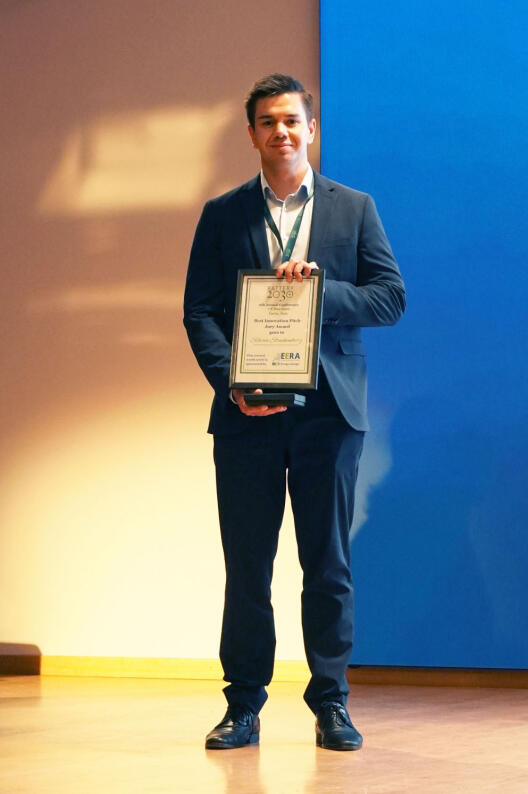
For his research findings on “Ultralong cycling of Li metal cells enabled by aromatic diluents in localized high-concentration electrolytes”, MEET PhD student Silvan Stuckenberg was honored at the annual conference of the Battery 2030+ Initiative in Turin. He first presented his results in a pitch, answered the jury’s questions in the second round, and finally won the “Best Innovation Pitch Jury Award”. The prize, which was endowed with 200 euros, was sponsored by the European Energy Research Alliance (EERA). In his work, Stuckenberg investigated localized high-concentration electrolytes for lithium metal batteries.
Number of Charge and Discharge Cycles Substantially Increased
Lithium metal batteries theoretically offer a higher energy density than lithium ion batteries by replacing the graphite electrode with one made of lithium metal. However, the material’s high reactivity places special demands on the electrolyte. “A promising approach is the use of localized high-concentration electrolytes, which consist of a lithium salt, a solvent, and a diluent,” explains Stuckenberg. Previous research has focused on polyfluorinated ethers from the group of per- and polyfluorinated alkyl compounds (PFAS). Their problem is that PFAS are so-called “forever chemicals”. They are not only difficult to decompose, but also considered potentially harmful to the environment. “We have developed an alternative that uses PFAS-free aromatic compounds. Subsequently, we optimized the localized high-concentration electrolyte so far that lithium metal batteries with a lithium iron phosphate cathode and liquid electrolyte have achieved stable 3,000 charge and discharge cycles,” Stuckenberg emphasizes. Additionally, this approach reduces the cost of the electrolyte.
Co-authors of the poster are Nick Fehlings, Arndt Strohschein, Tim Messink, Dr Dominik Voigt, Dr Johannes Kasnatscheew, and Dr Verena Küpers, MEET Battery Research Center, as well as Prof. Dr Martin Winter, MEET Battery Research Center and Helmholtz Institute Münster of Forschungszentrum Jülich.