

MEET PhD Student Laurin Profanter Wins Poster Prize
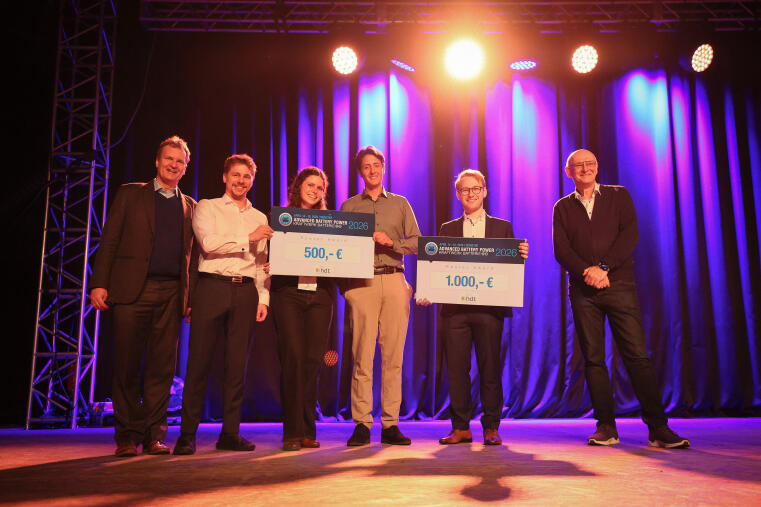
For his poster “Novel Polysaccharide Binder for N-Methyl-2-Pyrrolidone-Based Electrode Processing of Ni-rich Layered Oxide Cathodes”, MEET PhD student Laurin Profanter was awarded the poster prize at this year's Advanced Battery Power Conference in Münster. In his work, Profanter investigated a polysaccharide binder for cathode processing that can be used in the currently employed solvent N-methyl-2-pyrrolidone (NMP). In a lightning talk, he presented his results impressively and – together with Marie Göhring from Mercedes-Benz AG and Thorsten Tegetmeyer-Kleine from the Center for Aging, Reliability and Lifetime Prediction of Electrochemical and Power Electronic Systems (CARL) at RWTH Aachen University – won second and third place. The first place was awarded to Felix Frobart from the Technical University of Braunschweig.
Polysaccharide Binder with Considerable Potential for Industry
“Through screening, we identified a polysaccharide that is soluble in NMP. It offers an environmentally friendly alternative to the currently used polyvinylidene fluoride (PVDF) and, unlike fluorine-free binders, which typically require replacing the solvent NMP with water, can be directly integrated into existing industrial processes,” Profanter explained in his talk. In their analyses, the researchers discovered that the polysaccharide produces a shear-thinning electrode paste. Furthermore, they adjusted the viscosity to prevent sedimentation within the paste. Therefore, the material fulfills a basic requirement for binders. The electrodes with polysaccharide binders also demonstrated effective long-term cycling performance. Compared to PVDF electrodes, they showed higher capacities after approximately 50 cycles.
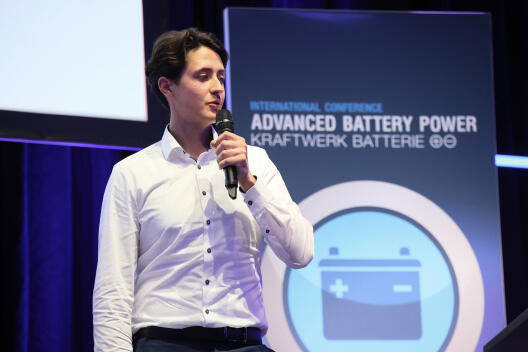
However, the scientists observed slightly higher resistances, which could be attributed to the carbon-binding domain. “We identified substantial differences between the two binders in this area. Therefore, the polysaccharide binder needs to be further improved, for example by shortening the chain length or modifying the side chains,” Profanter concluded. “However, our study has already highlighted its potential.”
Co-authors of the poster are Dr Aleksei Kolesnikov, Dr Simon Albers, Johanna Kauling, and Dr Johannes Kasnatscheew, MEET Battery Research Center, Dr Hyuck Hur, LG Energy Solution, as well as Prof. Dr Martin Winter, MEET Battery Research Center and Helmholtz Institute Münster of Forschungszentrum Jülich.