

Innovative Analytical Devices Provide Deep Insights into Battery Cells
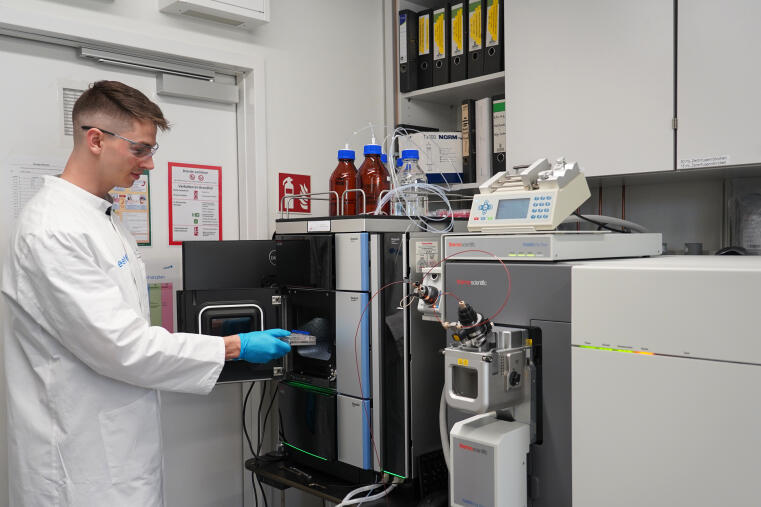
MEET Battery Research Center at the University of Münster expands its battery cell analytics capabilities with two innovative devices. Additions to the existing equipment include an inductively coupled plasma time-of-flight mass spectrometer (ICP-TOF-MS) and an Orbitrap mass spectrometer with options for liquid chromatography (LC) and matrix-assisted laser desorption/ionization (MALDI). The aim is to investigate and understand reactions within battery cells even more comprehensively. The new acquisitions are part of the project “AUForPro - Analytics to Support Lithium Ion Battery Research, Production, and Recycling”, which is funded by the European Union and the State of North Rhine-Westphalia through the funding program “Forschungsinfrastrukturen.NRW”. The project has received several million euros in funding.
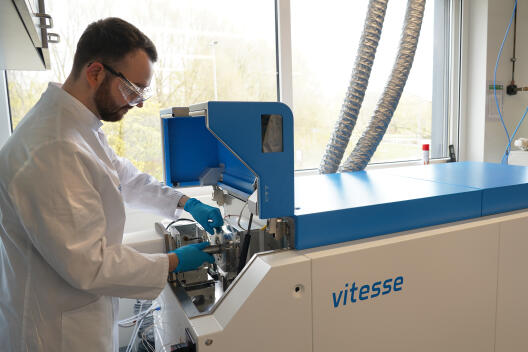
“The new devices not only expand our analytical capabilities, but also symbolize the innovative power of our institute. Until now, these devices have hardly been used in battery research. This enables us to continue our battery research and, in particular, analytics at an international top level,” emphasizes Dr Sascha Nowak, Head of the Research Division Analytics & Environment at MEET Battery Research Center. The new acquisitions enable two things: On the one hand, wanted reactions, such as the formation of the solid electrolyte interphase (SEI), the protective layer between the liquid electrolyte and the solid electrode, can be investigated. On the other hand, undesirable processes, such as aging effects, can be examined in even greater depth to mitigate or completely avoid them.
Specifically, the plasma spectrometer can be used to analyze individual particles of battery materials in order to determine aging effects not averaged across the entire electrode, but individually for each particle. Such investigations also help to further develop battery recycling and characterize the corresponding materials at the particle level. The MEET team uses the second device for electrolyte and interphase analysis to identify molecular structures. A particular highlight is the MALDI option, which makes it possible to precisely determine the structure and distribution of molecules, for example on the electrode surface, to draw conclusions about the composition and homogeneity of interphases. “In the long term, the analysis results will help to develop more powerful, durable, and stable batteries and advance cell production”, underlines Dr Simon Wiemers-Meyer, Deputy Head of the Research Division Analytics & Environment at MEET.
Opportunities for Industrial Cooperation
Industrial partners can also benefit from the new analysis capabilities at MEET. The battery research center is an excellent partner for joint projects, especially for small and medium-sized enterprises that do not have their own analytical resources.