

Modification of Test Protocol Enables a More Systematic Anode Research
Research and development of anodes for lithium ion batteries faces crucial challenges. To eliminate the influence of the cathode, half-cells are frequently examined instead of full cells. In these half-cells, it is not the cathode material such as nickel-manganese-cobalt (NMC) that supplies the lithium, but a lithium metal electrode (“Li source”). As a result, the half-cell has an excess of lithium and fully lithiates the anode during each charge cycle at conventional test protocol. Therefore, lithium and capacity losses that normally occur because NMC cathodes do not have such an excess of lithium, are not considered. A team from MEET Battery Research Center at the University of Münster has now modified the test protocol required for the analyses to enable more systematic research of anodes without a possible interference of the cathode.
Criterion for Charge Termination is now the Capacity
With their approach, the scientists solve another problem of previous anode research: The charge cut-off potential, the maximum voltage at which the charging process of the anode test cell ends to prevent overcharging, is sensitively affected by even smallest changes in resistance and overvoltage. This results in capacity fluctuations and low reproducibility of the data. “Therefore, we modified the test protocol so that the end-of-charge criterion that terminates the charging process no longer corresponds to the charge cut-off potential, but to capacity, which corresponds to the discharge capacity of the previous cycle,” explains Ibrahim Lawan Abdullahi, PhD student at MEET Battery Research Center and the International Graduate School BACCARA. “This enables us to create more realistic conditions for our investigations.”
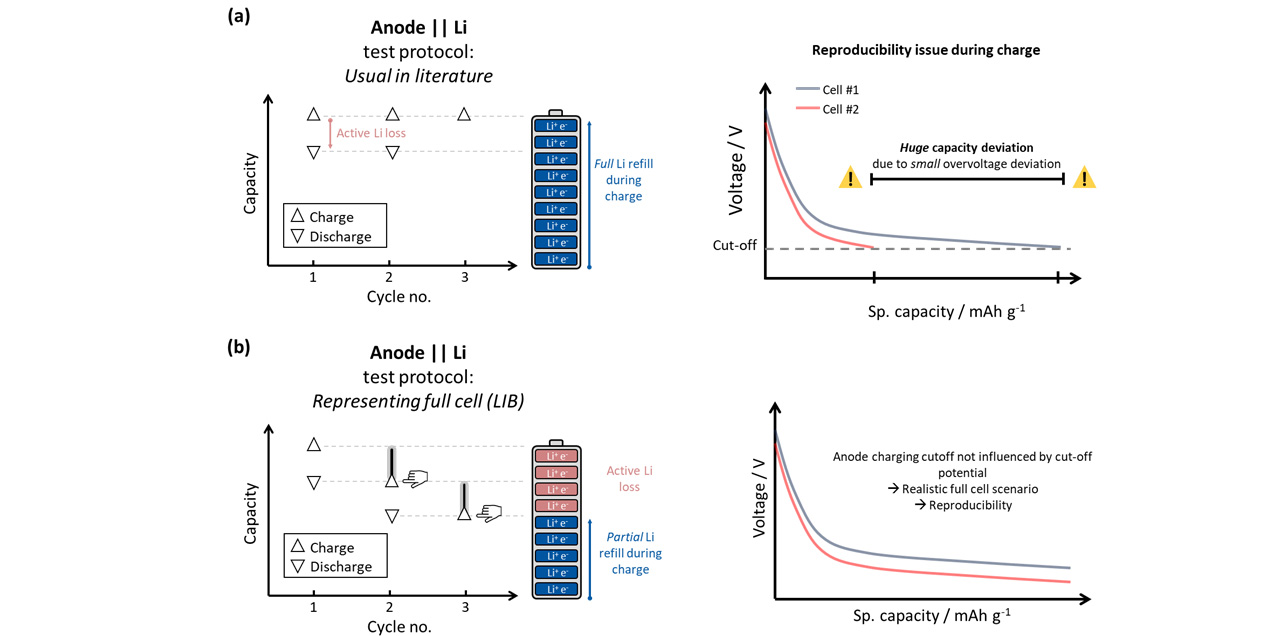
Dr Johannes Kasnatscheew, Head of the Research Division Materials at MEET Battery Research Center, concludes: “In this way, we not only consider lithium losses, but also increase reproducibility. By no longer coupling the end-of-charge criterion to the charge cut-off potential, the latter no longer influences our results – similar to application-like lithium ion battery where the anode potential is also not fixed to a defined value.”
Detailed Results Online Available
The entire study has been published by the authors Ibrahim Lawan Abdullahi, Laurin Profanter, Ineke Weich, Chirag Vankani, Dr Lukas Stolz and Dr Johannes Kasnatscheew, MEET Battery Research Center, as well as Prof. Dr Martin Winter, MEET Battery Research Center and Helmholtz Institute Münster of Forschungszentrum Jülich, in the journal “Advanced Energy and Sustainability Research”.