

Additive Lithium Difluorophosphate Enables New Electrolyte Formulations
Precisely tailored electrolyte formulations are crucial to reduce the continuous degradation of active materials in battery cells and thus counteract capacity loss. In particular, the strategic use of additives helps to minimize undesirable side reactions within the cells. A team from MEET Battery Research Center at the University of Münster has now investigated various electrolyte formulations for batteries used in high-voltage applications. The scientists combined different concentrations of fluoroethylene carbonate (FEC) with lithium difluorophosphate (DFP) and then conducted long-term cycling tests.
Synergy Effects Through the Additive DFP
Their work builds on findings of a previous study. In that research, the scientists had already discovered that electrolytes consisting of similar amounts of ethylene carbonate (EC) and FEC perform worse in high-voltage applications than the standard electrolyte based on EC and ethyl methyl carbonate (EMC). Only when EC was completely replaced by FEC, the performance improves substantially, regardless of the voltage.
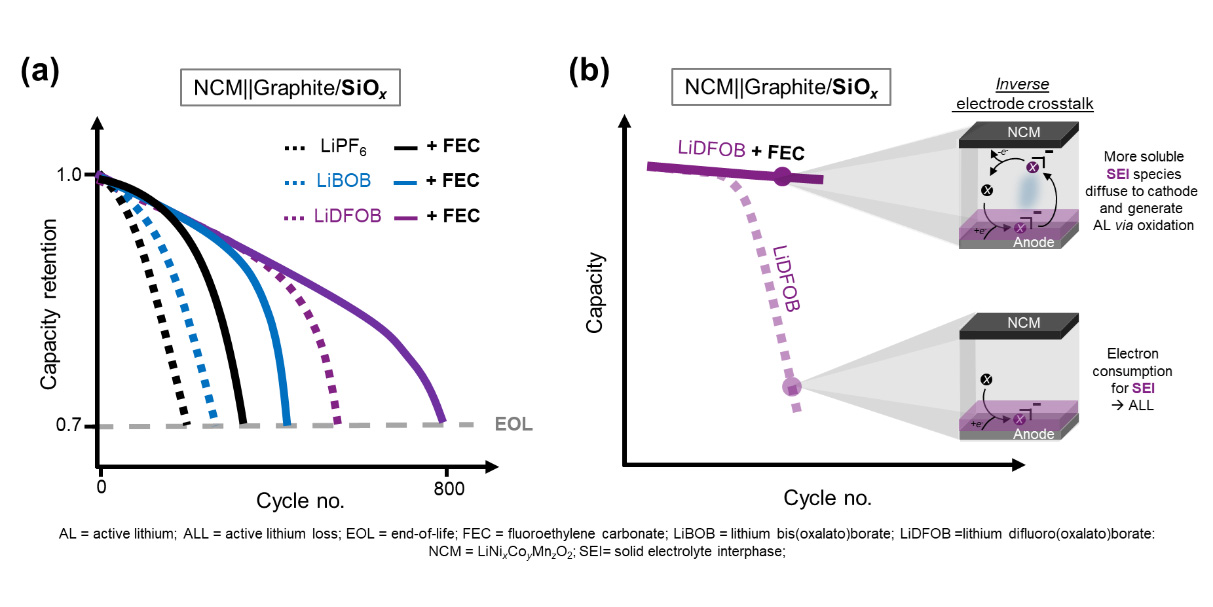
To examine whether EC and FEC could still be used as cosolvents, the team added the additive DFP to the electrolyte in the current study. “DFP is typically used to prevent the dissolution of transition metals,” explains MEET researcher Nick Fehlings. “We have proven that the additive has synergistic effects in combination with FEC and also reduces electrolyte decomposition. Consequently, it is possible to use EC and FEC as cosolvents. The combination even achieved better performance than the standard electrolyte based on EC and EMC.”
Using instrumental analysis, the scientists first identified the aging products produced during cycling. Their detailed examination showed that the decomposition products of FEC and DFP counteract the negative effects of the pure FEC-EC combination. “These results give us a better understanding of how the electrolyte components FEC and DFP interact with each other,” Fehlings concludes. “Such mechanistic insights are essential for designing specific electrolytes and thereby increasing the long-term performance of battery cells for high-voltage applications.”
Entire Study Available
The detailed results have been published by the authors Nick Fehlings, Alexandros Tsoufios, Tim Messink, Dr Simon Wiemers-Meyer und Dr Sascha Nowak, MEET Battery Research Center, as well as Prof. Dr Martin Winter, MEET Battery Research Center and Helmholtz Institute Münster of Forschungszentrum Jülich, in the journal “Small Methods”.