

Influence of Transition Metals on Battery Aging Decoded
How do dissolved transition metals from the cathode influence the aging of lithium ion batteries? A recent study by researchers at MEET Battery Research Center at the University of Münster addressed this question. Using a newly developed cell design, the scientists were able to investigate, for the first time, the direct influence of individual transition metals during the ongoing aging process. The results show that manganese, in particular, accelerates aging - not, however, due to the deposition of manganese itself, but rather due to its catalytic effect on the decomposition of the electrolyte.
Manganese accelerates battery aging more than previously thought
NMC materials are frequently used as cathode materials in lithium ion batteries. During operation, transition metals such as nickel, manganese, or cobalt can leach out of these materials and deposit on the anode. This process, known as transition metal deposition, is considered a key factor influencing the lifetime of battery cells. “Our methodology makes it possible for the first time to specifically investigate the influence of individual transition metals during the aging of an already-formed cell,” explains MEET researcher Tobias Brake. Using a specially developed cell design with an integrated injection port, the researchers were able to introduce transition metals into the cell only after an intact solid electrolyte interphase (SEI) had formed, and directly monitor their effects under conditions that closely mimic realistic conditions.
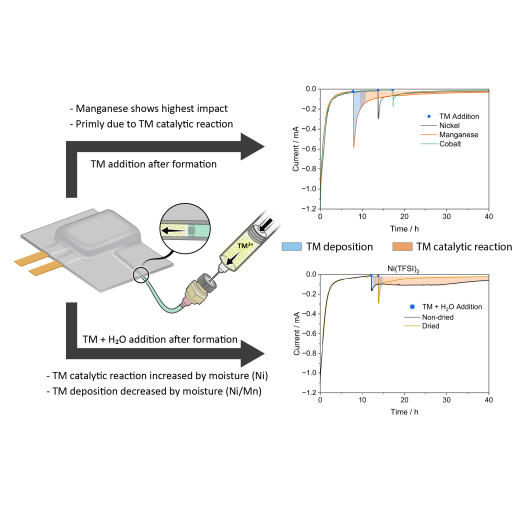
The results show that it is not the metallic deposition itself that contributes most to capacity loss, but rather that it promotes the decomposition of the electrolyte and accelerates the loss of active lithium. “We were able to show that manganese, in particular, acts as a catalyst for electrolyte decomposition and thus contributes significantly to capacity loss,” Brake summarizes. In addition, the researchers investigated the combined influence of transition metals and water. An aspect that is becoming particularly important in the context of aqueous processing of NMC electrodes. The newly developed method opens up a wide range of possibilities for investigating the influence of electrolyte additives or gases on aging processes in the future.
Detailed Results Online Available
The entire study has been published by the authors Tobias Brake, Kai Brüning, Dr Simon Albers, Dr Simon Wiemers-Meyer and Dr Sascha Nowak, MEET Battery Research Center at the University of Münster as well as Prof. Dr Martin Winter, MEET Battery Research Center and Helmholtz Institute Münster of Forschungszentrum Jülich, in the journal „Journal of The Electrochemical Society“.