

Comparison of Binder Systems for Aqueously Processed Electrodes
Processing positive electrodes aqueously is an important step towards a more sustainable battery cell production. Water and a compatible, fluorine-free binder replace environmentally harmful materials such as the organic solvent N-methyl-2-pyrrolidone (NMP) and the fluorine-containing binder polyvinylidene difluoride (PVDF). A team from MEET Battery Research Center at the University of Münster has now compared the influence of four potential binders on the physical properties and electrochemical performance of aqueously processed lithium iron phosphate (LFP) electrodes.
Combination of Three Binders with Promising Results
Specifically, the scientists analyzed the binders carboxymethyl cellulose (CMC), styrene-butadiene rubber (SBR), xanthan gum (XG), and poly(3,4-ethylenedioxythiophene):polystyrene sulfonate (PEDOT:PSS), as well as their combination. “Our results show that a combination of CMC, PEDOT:PSS, and SBR, each at one percent by weight, is most promising,” summarizes MEET scientist Chirag Vankani. In this binder system, CMC enhances the particle dispersion and tailors the electrode pore structure. PEDOT:PSS increases the electronic conductivity and improves the interfacial charge-transfer kinetics. SBR, in turn, strengthens the adhesion and mechanical flexibility of the electrode. “The result is an aqueously processed electrode with well-balanced physical properties and electrochemical performance,” says Vankani. “Despite its rather low proportion of typically one to five percent by weight of the composite electrode, the binder system has a crucial influence on these factors.”
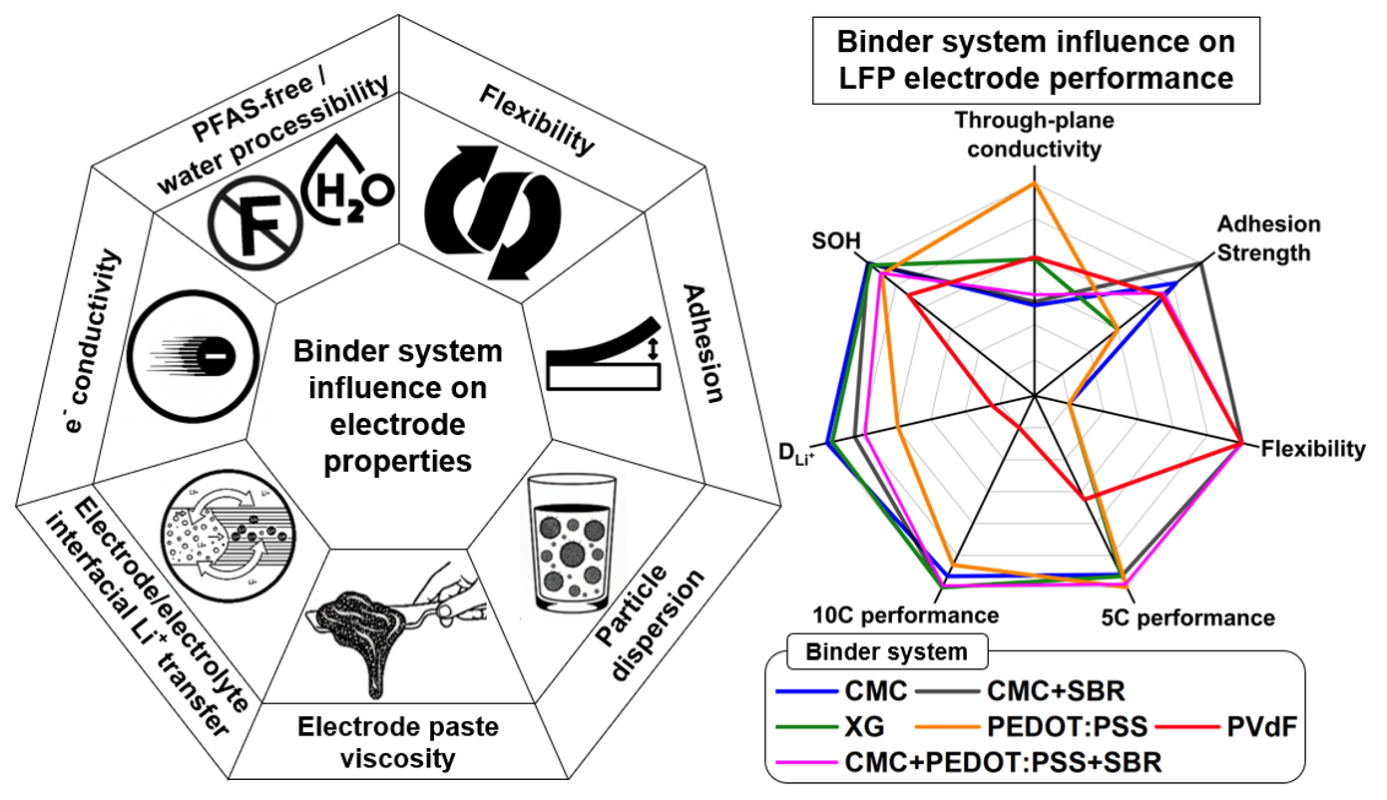
In addition, the research team examined the long-term cycling stability of the binders over 1,000 cycles. In contrast to previous studies, the scientists used a functional full cell based on LFP and graphite with practically relevant loadings for this purpose. In contrast, earlier studies mainly analyzed non-practical half-cells (LFP||Li) over fewer cycles, which were limited by dendritic lithium growth.
Entire Study Available
The detailed results have been published by the authors Chirag Vankani, Atif Javed and Dr Markus Börner, MEET Battery Research Center, as well as Prof. Dr Martin Winter, MEET Battery Research Center and Helmholtz Institute Münster of Forschungszentrum Jülich, in the journal “Advanced Energy and Sustainability Research”.