

Sustainable Additive Improves Lifetime of High-voltage Lithium Ion Batteries
High-voltage lithium ion batteries are characterized by high energy and power densities, but often suffer from a shorter lifetime. This is caused by electrode instability resulting from increased delithiation: More extracted lithium ions lead to undesirable phase transformations and enhance the dissolution of transition metals. This triggers a failure cascade – known as “electrode crosstalk” – in which the metals migrate to the anode and damage its surface, reducing the lifetime of the battery cells. A team from MEET Battery Research Center and the Institute for Plant Biology and Biotechnology at the University of Münster has now investigated whether this process can be mitigated using a bio-based electrolyte additive.
Maleimide Ensures an Intact Anode Surface
After screening potential bio-based additives, the research team identified the fluorine-free maleimide as a suitable chemical compound. “Although maleimide does not suppress crosstalk or the amount of dissolved transition metals on the anode, the anode surface remains intact and free of unwanted lithium metal deposits,” explains MEET scientist Dr Nils Flothkötter. The protective layer, the solid electrolyte interphase (SEI) between the electrolyte and the electrode, consists of oligo- and polymer-based decomposition products of maleimide. They capture the transition metals via their coordinating chemistry on the outer SEI layer, thereby preventing the metals from blocking the essential pathways for lithium ion transfer. “This provides maleimide with substantial advantages over the literature-known additive lithium difluorophosphate, which is, for instance, chemically and thermally unstable,” adds Flothkötter.
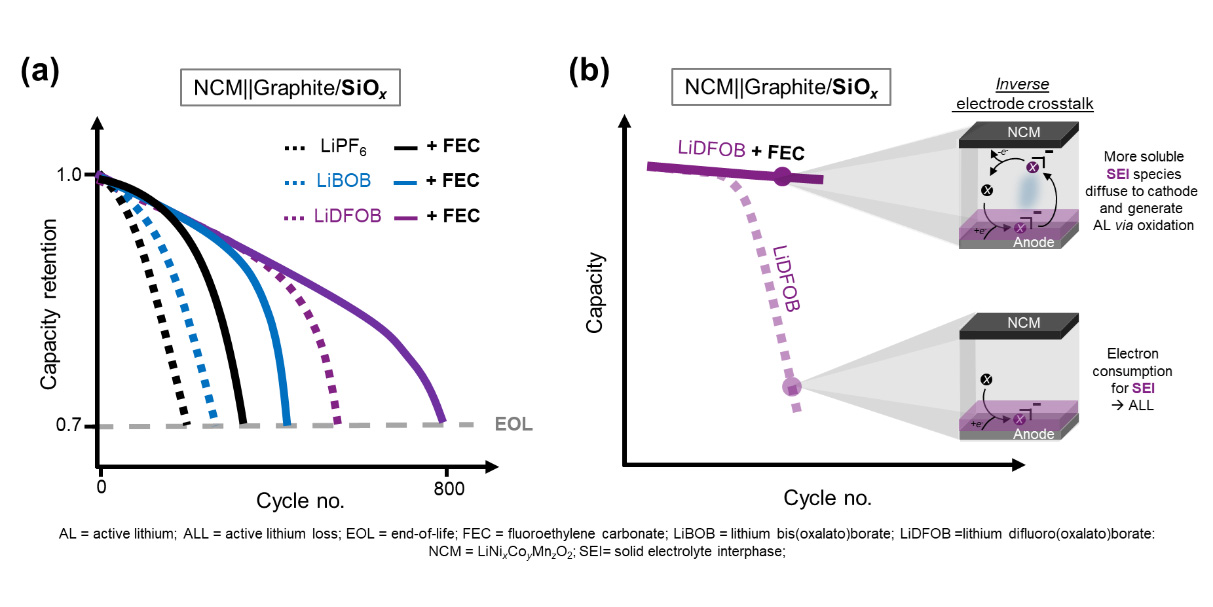
The results highlight two key findings: It is not the amount of crosstalk that determines the lifetime of the battery cells, but rather where exactly the transition metals deposit on the anode. “Furthermore, we have conducted one of the first in-depth investigations of the role of the SEI in this context and not only demonstrated its critical relevance for high-voltage applications, but also gained a deeper mechanistic understanding,” summarizes the MEET researcher.
Detailed Results Available Online
The entire study has been published by the authors Dr Nils Flothkötter, Dr Simon Albers, Niklas Markus Abke, Nick Fehlings, Alexandros Tsoufios, Dr Anindityo Arifiadi, Jakob Roland Seidl, Dr Simon Wiemers-Meyer, Dr Sascha Nowak, Dr Dominik Voigt and Dr Johannes Kasnatscheew, MEET Battery Research Center, Dr Kai-Uwe Lubisch Roelfs, Dr Lisa Sophie Wrobel and Prof. Dr Dirk Prüfer, Institute of Plant Biology and Biotechnology of the University of Münster, as well as Prof. Dr Martin Winter, MEET Battery Research Center and Helmholtz Institute Münster of Forschungszentrum Jülich, in the journal “Advanced Energy and Sustainability Research”.
The results are embedded in the interdisciplinary project “BIOSTORE” at the University of Münster, which aims to develop sustainable batteries using bio-based and recyclable materials and additives. The project is funded by the Ministry of Culture and Science of the State of North Rhine-Westphalia.