
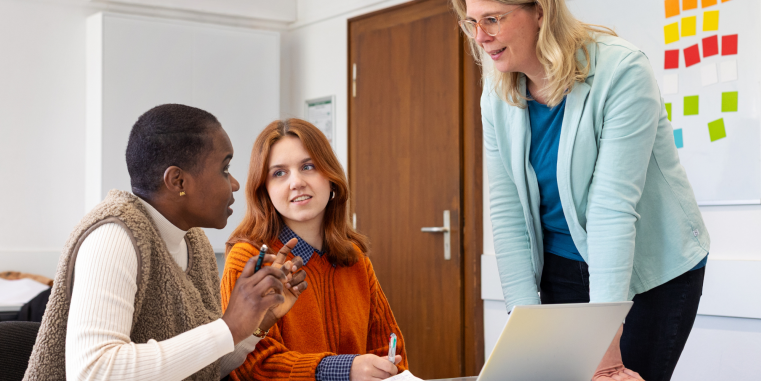
Growing together: Students from the first cohort of the MA in Knowledge and Communication share their study experience
(22.06.2026) Applications are now open for the second intake of the English-taught Master’s programme in Knowledge and Communication at the Department of Communication. Launched in the winter semester of 2025/26, the programme is aimed at students who wish to explore how knowledge is generated and communicated, and its impact in an interconnected world. The programme currently has students from four different countries.
In this interview, Julia Prawitz (23) and Becky Osazuwa (37) explain why they chose this Master’s degree programme, their experiences of the first two semesters, and their career prospects after graduation. Applications for the MA in Knowledge and Communication, and for the department’s two other German-taught Master’s programmes (the MA in Communication Science and the MA in Strategic Communication) are open until 15 July.
Why did you choose this Master programme „Knowledge and Communication“ in Münster?
Julia Prawitz: I am fascinated by the question of how people tackle complex issues that require solutions but are rarely simple. From my surroundings and personal experience, I increasingly perceive frustration and overwhelm in dealing with media. How should one handle the flood of information, opinions and formats? Who is saying what, and where is the information coming from? Who can I trust – and is the information even real or AI-generated? Those who end up in the wrong ‘bubble’ or lack sufficient media literacy are often defenceless against the flood of information. I am concerned about how easily hate and discrimination can be shared and normalised online. Through my studies, I hope to gain a better understanding of how and why certain information reaches and is absorbed by people, and, above all, how we can protect people and enable fact-based, tolerant discourse.
Becky Osazuwa: I chose the M.A. Knowledge and Communication programme in Münster because it is taught in English and connects strongly with my previous academic background in Mass Communication. At the same time, it offers a more current and interdisciplinary focus, which was very important to me. I was interested in a programme that goes beyond traditional communication studies and reflects the realities of 21st century where AI, digital media and the way people engage with public issues are constantly evolving. Germany was also a choice for me because I lived here during my early childhood with my family before relocating back to Nigeria. Also, I wanted to experience a different academic environment.
Have your expectations been met?
Becky Osazuwa: Yes, my expectations have been met. Although the first semester was challenging, the experience has been rewarding so far. The programme has helped me think more critically about communication and the role it plays in society. I have also been introduced to new perspectives that have expanded how I understand communication. The programme has exposed me to different ways of researching including qualitative approaches that focus on people, culture and everyday practices, as well as more analytical methods that explore patterns in communication. It has also introduced me to current discussions around AI and its role in newsroom practices.
Julia Prawitz: It would take too long to list all the details here, but I am very satisfied and have not regretted my decision. I think the content is great, I am learning a lot of new things – particularly in terms of methods – and I feel very much at home as part of the degree programme. It's a challenging degree programme, as, for example, in the ‘Computational Methods’ module you work your way through a completely new field, but I appreciate that because it helps you grow. I also learn a lot from the interactions on the course and from my fellow students’ experiences – this really enriches the programme.
What do you particularly like about the programme?
Julia Prawitz: I particularly appreciate how accessible the department and lecturers are – this creates a pleasant atmosphere where it is easy to ask questions and individual needs are taken into account. As we are a small group, we get to know each other quickly. Everyone is challenged, but at the same time, there is enough space for everyone. This creates a dynamic in which you really have to think, but you can also stay on top of things very well.
Becky Osazuwa: I value the international learning environment as well. Being in classes with students from diverse academic and cultural backgrounds makes discussions richer and helps me see communication issues from different perspectives. Another thing I particularly like about the programme is its interdisciplinary nature. It brings together different perspectives on communication and connects them to current social issues such as misinformation, public trust, online communication and how complex knowledge can be made accessible to different audiences.
Julia Prawitz: The seminars complement each other very well while continually opening up new perspectives. This is exactly what I had hoped for: specialising without losing the broad perspective or interdisciplinarity. The teaching and examination formats are varied, and there is plenty of opportunity to contribute one’s own questions or set one’s own areas of specialisation in degree-relevant examinations. The degree programme is further characterised by the variety of backgrounds and perspectives that come together: media systems, politics, internet usage and much more differ significantly from country to country. For this very reason, I consider the exchange between each other to be valuable.
What career do you hope to pursue with this degree?
Becky Osazuwa: I hope to pursue a career in digital communication and content strategy. I am especially interested in roles that involve making complex information clear, accessible and trustworthy for different audiences. In the future, I would like to work in a role that combines communication and digital media, especially in contexts where clear, user-friendly, and responsible communication is important.
Julia Prawitz: I do not yet have a very precise idea – partly because I do not want to base my expectations on the constantly changing job market, and partly because studying opens up many new perspectives. Essentially, I see myself supporting projects, organisations or associations with my knowledge of media systems, information dissemination and processing, and my methodological skills. I would like to support those whose work aims to empower people with knowledge. These could be non-governmental or international organisations, scientific institutions, anti-discrimination projects, or initiatives in the field of fact-checking and corruption prevention. Perhaps the path will also lead me into science, because with new knowledge new questions inevitably arise.
More information in this article from the University of Münster and in wissen|leben
Interview: Julia Harth (Editor wissen|leben)
Contact person public relations:
Dr Stephan Völlmicke
Telefon: +49 251 83-23006
Telefax: +49 251 83-21310 (Geschäftszimmer IfK)