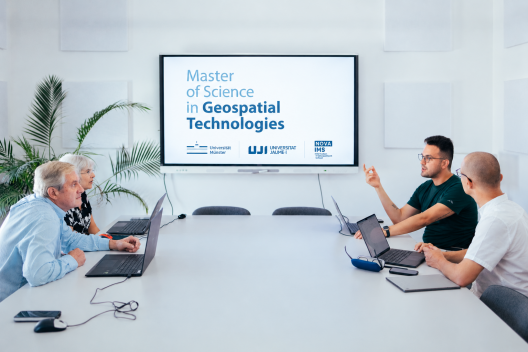
Erasmus Mundus “Master in Geospatial Technologies” Secures more than €3.5 Million in New EU Funding
The programme has received successive European funding since 2007 and has supported the education of more than 400 geospatial professionals from over 85 countries
The Erasmus Mundus Master’s Programme in Geospatial Technologies has secured more than €3.5 million in funding in its fifth successful funding round, awarded under the 2025 Erasmus Mundus Joint Masters call.
This new grant will enable the programme to continue an exceptional trajectory that began in 2007, when the Master’s was first launched. Since then, it has received successive rounds of European Union funding, making it one of the pioneering Erasmus Mundus programmes and one of the longest running in terms of sustained financial support.
The programme is jointly delivered by three of Europe’s most prestigious universities and research institutes in the field of Geographic Information Science and geospatial technologies:
The Institute for Geoinformatics (IFGI) at the University of Münster, Germany;
The GEOTEC research group, Institute of New Imaging Technologies (INIT) at Universitat Jaume I of Castellón, Spain; and
NOVA Information Management School (NOVA IMS) at Universidade NOVA de Lisboa, Portugal.
The three partner institutions bring together internationally recognised expertise in geoinformatics, geographic information science, computer science, advanced analytics and data science, remote sensing, location-based services and innovative geospatial technologies. Their complementary academic profiles provide students with a genuinely interdisciplinary education and the opportunity to study in three different European countries.
The European Union investment has financed the education of more than 400 outstanding students and professionals from over 85 countries, creating a truly international community of experts working across academia, government, industry and civil society. A considerable part of this funding is allocated into scholarships for international students, in favor of an equitable and excellency focused cohorts.
The programme international structure allows students to study in a multicultural academic environment while benefiting from the complementary expertise of the three partner universities, and the alumni community is one of the programme’s greatest achievements. It reflects the lasting impact of the Erasmus Mundus initiative on professional development, international mobility and academic cooperation.
For Dr. Fillipe Feitosa, coordinator of the programme at IFGI, University of Münster, the new funding period also brings new challenges. “The amount of geospatial and Earth Observation data available today is growing rapidly, but its value for society depends on our capacity to turn it into actionable knowledge,” he says. “Artificial Intelligence, and GeoAI in particular, is changing how complex spatial and temporal data are analysed, and employers increasingly need professionals who combine geospatial thinking with machine learning, Large Language Models, cloud computing and Earth Observation analytics. Few degree programmes integrate these competences in a coherent way. Our task over the coming years is to keep the joint curriculum aligned with this pace of change across three universities, and to rethink how we teach and assess now that AI tools are part of our students’ daily work.”
The new funding represents an important recognition of the programme’s academic excellence and proven capacity to prepare highly qualified professionals to address complex global challenges through geospatial knowledge and technologies. It also provides a strong foundation for the programme’s next stage, ensuring that new generations of talented students from around the world can continue to receive high-quality, internationally oriented education in this strategically important field.
The Erasmus Mundus Master’s Programme in Geospatial Technologies enters its next chapter with renewed ambition and a firm commitment to academic excellence, innovation and global cooperation.
The new selection of scholarship candidates for the 2027 intake is expected to start in late October. More information on the application process and the admission requirement are available at https://mastergeotech.info/.