
Learning from life stories
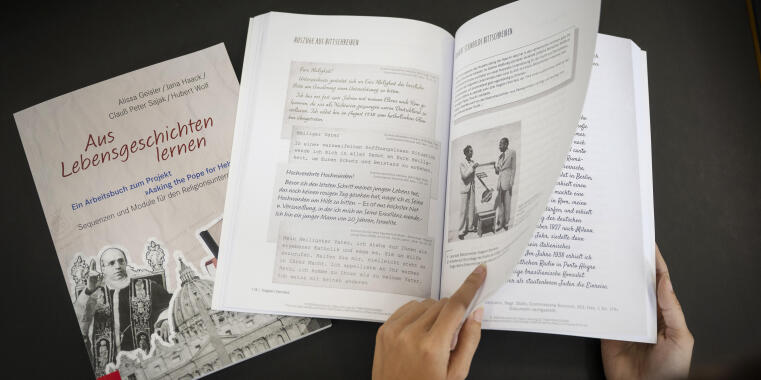
Learning from real-life stories rather than abstract texts about the Second World War and the Shoah: this is now possible with the free, digitally available workbook Learning from Life Stories. A workbook accompanying the ‘Asking the Pope for Help’ project. Based on four biographies of Jewish victims of persecution, students can independently discover, explore and reflect on Jewish life during the era of totalitarianism, the World War and the Shoah.
Each of the teaching units takes its starting point from petitions that persecuted Jews, in their desperation, addressed to the Vatican. These sources from the Vatican archives, which have only been accessible since 2020, are being systematically analysed and made available to the public as part of the ‘Asking the Pope for Help’ project at the Department of Medieval and Modern Church History at the University of Münster. “The sources, which have been prepared for educational use, provide insights into the biographies of their authors. Through engagement with the documents, they are remembered as victims of Nazi persecution, but also emerge as historical subjects with their own agency,” explains Prof. Dr Clauß Peter Sajak, who has compiled the sources together with Alissa Geisler from the Institute for Religious Education and Pastoral Theology. “In this way, the tried-and-tested method of remembrance-based learning is combined with new elements of biographical and research-based archival learning,” adds the research assistant.
The teaching materials, which centre on the life stories of Martin Wachskerz, Alex Weißberger, Hildegard Jacobi and Siegbert Steinfeld, have been designed for use in grades 9 and 10, as well as in the upper secondary school. These unique sources provide insight not only into the life stories of those who were persecuted, but also into the decision-making processes within the Vatican. “With the help of our materials, students can explore for themselves how the Vatican responded to these requests and what happened as a result,” explains Hubert Wolf, one of the book’s authors and project leader of the research project ‘Asking the Pope for Help’. “To ensure this is done on a historic basis and to counter social polarisation and digital disinformation, it was important to us to include copies of the original letters in the book.”
The modular design of the teaching materials enables teachers to adapt the scope and focus of the lesson plan precisely to their class and the available teaching time. A glossary and explanatory notes on the project, the structure of the Curia and the project’s educational potential supplement the materials.
The workbook is the result of a collaboration between the Institute for Religious Education and Pastoral Theology and the Department of Medieval and Modern Church History at the University of Münster. Thanks to the support of the German Bishops’ Conference, the publication is available as open access and can be downloaded via the following link: https://www.vandenhoeck-ruprecht-verlage.com/detail/index/sArticle/60703/sCategory/1431?srsltid=AU7gw4VR_W7o5KodBNFJLy30YPHEPGLUzTz3pSkwkHLBS0bkG9RS4RKO
Publication: Alissa Geisler, Jana Haack, Prof. Dr Clauß-Peter Sajak and Prof. Dr Hubert Wolf (2026): Aus Lebensgeschichten lernen. Ein Arbeitsbuch zum Projekt „Asking the Pope for Help“. Sequenzen und Module für den Religionsunterricht, Vandenhoeck & Ruprecht, 196 pages.