
Nachhaltigkeitsdesign auf und in Dingen der Alltagswelt. Über die gesellschaftliche Verbreitung von designten Vermittlungsweisen und Aufforderungsstrukturen
DOI:
https://doi.org/10.17879/sun-2026-9297Keywords:
Design, Nachhaltigkeit, Pädagogik der nachhaltigen Dinge, persuasive Kommunikation, AffordanzAbstract
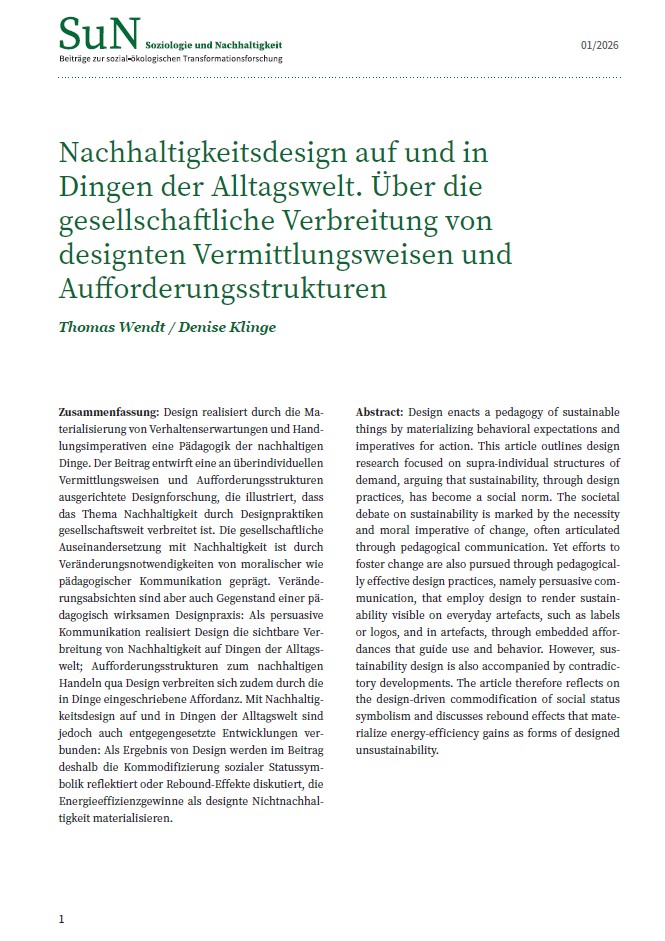
Design enacts a pedagogy of sustainable things by materializing behavioral expectations and imperatives for action. This article outlines design research focused on supra-individual structures of demand, arguing that sustainability, through design practices, has become a social norm. The societal debate on sustainability is marked by the necessity and moral imperative of change, often articulated through pedagogical communication. Yet efforts to foster change are also pursued through pedagogically effective design practices, namely persuasive communication, that employ design to render sustainability visible on everyday artefacts, such as labels or logos, and in artefacts, through embedded affordances that guide use and behavior. However, sustainability design is also accompanied by contradictory developments. The article therefore reflects on the design-driven commodification of social status symbolism and discusses rebound effects that materialize energy-efficiency gains as forms of designed unsustainability.
Downloads
Published
How to Cite
Issue
Section
License
Copyright (c) 2026 Thomas Wendt, Denise Klinge

This work is licensed under a Creative Commons Attribution 4.0 International License.