
Secondment #11: Kai
Kai has recently completed his research secondment in the UK and shares his experience with us:
"In the past two months (June – July 2026), I travelled to the UK for my secondment. I was lucky enough to have the opportunity to work with four reputable scholars in fields related to my doctoral project, at two esteemed universities – King’s College London (2 weeks) and Leeds Beckett University (3 weeks). Below are the details of what I learnt from my secondment:
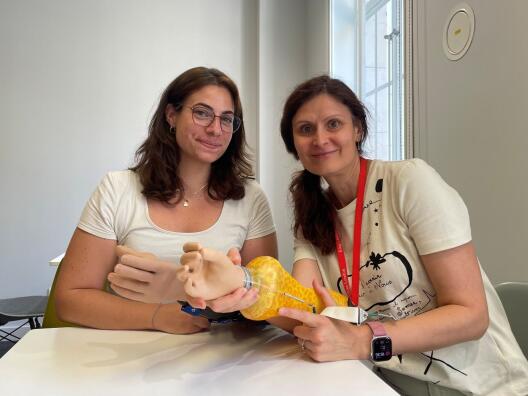
1. Time spent with Dr. Crina Grosan (Division of Digital Health and Applied Technology Assessment, King’s College London): Crina, as one of two supervisors for my secondment, helped me explore the potential application of machine learning in analysing the brain activity data (fNIRS, functional near infrared spectroscopy) we have collected from our project;
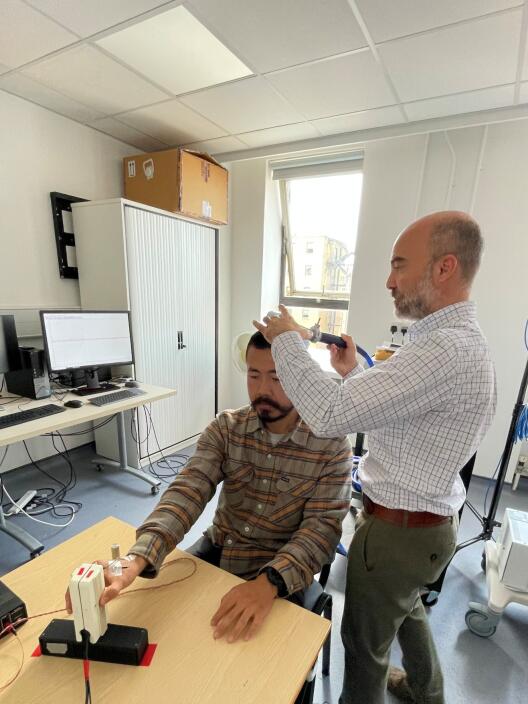
2. Time spent with Dr. Marco Davare (Reader in Neurophysiology, King’s College London): I was involved in several master thesis research projects with Marco and his students. I learnt the basics of some commonly used tools in the field of neurophysiology – Transcranial magnetic stimulation (TMS) and electromyography (EMG). Marco also introduced me to some exciting studies (from him as well as from other scholars) in perception and motor control;
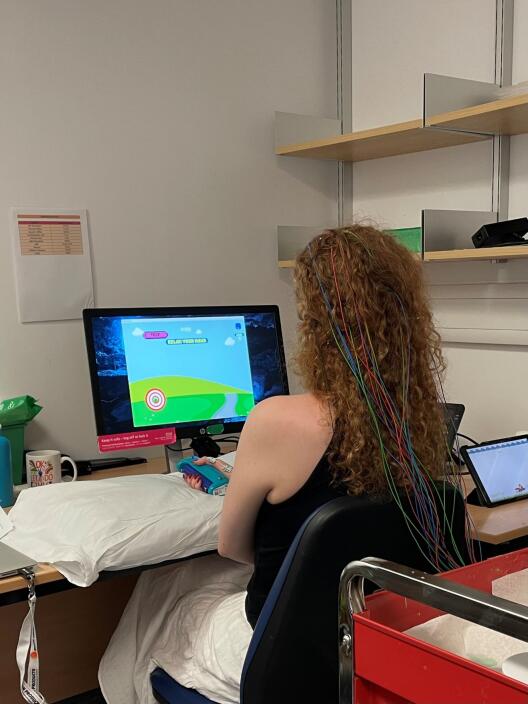
3. Time spent with Dr. Verity McClelland (Academic Clinical Neurophysiologist, King’s College London): I got the opportunity to shadow an experiment led by Verity and her team. In this experiment, Verity was trying to explore the brain activity from the research subject through EEG (electroencephalography) while the subject was conducting some fine motor precision tasks in a virtual environment. This was my first exposure to EEG as a brain measurement tool;
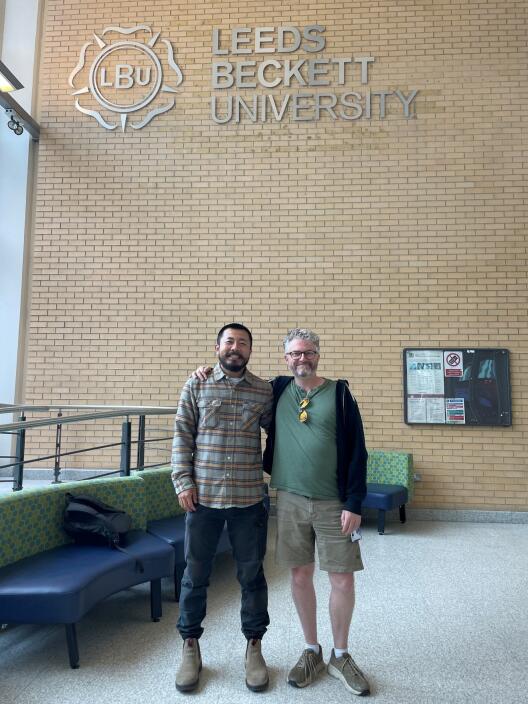
4. Time spent with Dr. Andrew Wilson (Reader in Perception and Action, Center for Psychological Research, Leeds Beckett University): Andrew guided me through the analysis of the 3D movement data we collected, from the perspective of the ecological approach in applied psychology. Also, thanks to Andrew’s academic network, we had the chance to discuss the potential use of uncontrolled manifold analysis (UCM) for assessing prosthetic movements with two more human movement scientists, Tim Bennett and Raoul Bongers. I also helped generate a testing checklist for Andrew’s motion capture lab.
Additionally, I would like to thank Ilaria Bufacchi, one of the TReND doctoral candidates from King’s College London, for her kind support and assistance throughout my secondment. I had the chance to spend much time with her during my stay in London and was impressed by her in-depth foundational knowledge in sports biomechanics and biological engineering. Together, we discussed further the potential use of machine learning to analyse the brain activity data (fNIRS).
Overall, this secondment experience has been meanginful and valuable for the progress of my doctoral project, as well as to me personally as a scholar, and as a person. I would genuinely like to thank everyone who has helped me along this journey. Thanks TReND for this valuable opportunity.
“Doing a PhD might not get you change the world, but it helps you develop certain skills to change the world.” – Thanks Andrew, for your words of wisdom."