
Secondment #5: Victoria
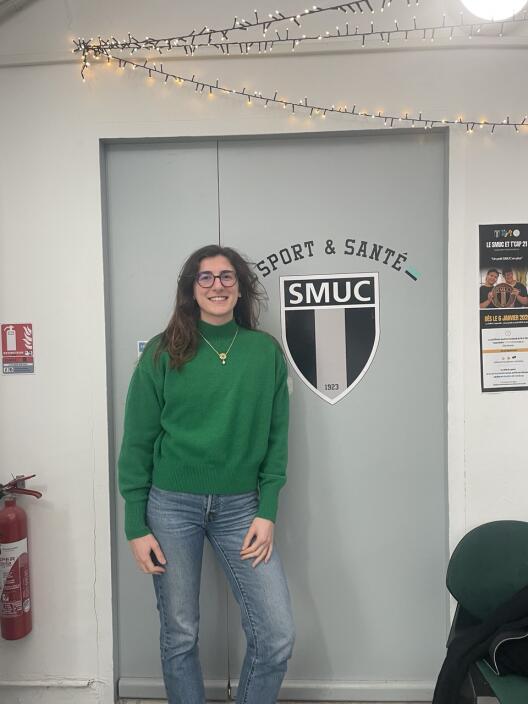
This time our fellow Victoria is telling us about her secondment that she completed in December. Victoria is doing her PhD project at the Institut des Sciences du Mouvement, Aix-Marseille Université and had the opportunity to visit the Stade Marseillais Université Club (S.M.U.C.), Marseille, France.
"In December 2025, I completed a 3-month secondment at Stade Marseillais Université Club (S.M.U.C.), Marseille, France, working with the coordinator, Isabelle Petit, and the adapted physical activity coach, Martin Nottin. S.M.U.C. is a local civil society organisation in Marseille that promotes physical activity among various populations, including older adults and people with special needs. As such, benefiting from their facilities, resources, and knowledge was particularly insightful for my PhD goals, which are focused on improving methodological approaches in geriatric assessments and training protocols targeting older adults’ wellbeing. This secondment enabled me to: (i) gain insight into multidisciplinary, evidence-based assessment and training practices; (ii) initiate participant recruitment and cohort development for my experimental studies; and (iii) observe functional assessment sessions in older adults, improving my understanding of best practices in applied evaluation.
In more detail, I had the opportunity to observe real-life functional assessments, including handgrip strength, single-leg stance test, sit-to-stand test, 6-minute walk test, timed up-and-go test, body composition test (analysis of body muscle and fat), and numerous questionnaires. This gave me insight into how professionals administer and evaluate these assessments. This was particularly useful as I will administer some of these tests during my experimental program to link my studies on the temporal structure of variability with the more tangible, comparable outcomes evident by those tests. Furthermore, I had the unique opportunity to establish relationships with S.M.U.C. professionals, who have helped me and will continue to do so in the future by sharing their hands-on expertise on training protocols and providing contacts with some of the centre’s visitors, who are part of the cohorts of interest for my experimental program. Finally, I had the opportunity to attend a few sports classes at the centre and meet some of the older adults who are dedicated to enhancing their health and wellbeing. I especially liked this opportunity, as it allowed me to better understand the needs and struggles of older adults and to appreciate more fully the value of my PhD contributions. I return from this secondment inspired and invigorated to transform my research into a more easily translatable, practical tool for assessing functional capacity of older adults that can be used by non-specialists clinicians and researchers."