
Secondment #9: Louise
During my secondment at King’s College London, I mainly focused on moving forward with the quantitative analysis of the TMS/MEP data for the next part of my PhD. The TMS data had already been acquired and used qualitatively in my first paper to classify corticospinal tract organisation. However, I was still unsure to what extent these recordings could also be used quantitatively for my second paper.
Together with Marco, we explored Signal in more depth and worked on how to better inspect, process, and extract information from the MEP traces. This was particularly useful because some variables that initially seemed too noisy to be included could actually be recovered and extracted more reliably. As a result, the amount of usable data increased, which strengthened the dataset available for the analyses of my second paper.
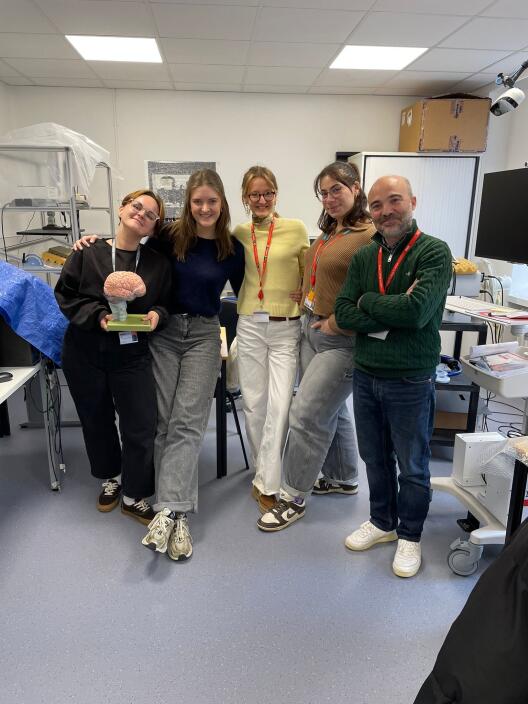
Being in the same lab as Alex and Illaria, who are also part of the TReND network, was another very positive aspect of the secondment. Although we were not working on the same analyses, sharing the lab environment made the process fun and constructive for the overall TReND cohesion. I also participated as a TMS participant in their studies, which gave me more hands-on experience with the experimental procedures behind the type of data I am analysing.
All-in-all, this secondment came at a very useful moment in my PhD. It helped me gain a clearer and more practical understanding of TMS/MEP data processing, increased the usable sample size for my analyses, and allowed me to properly start the quantitative work for my second paper. Beyond this specific project, the skills and experience gained in London will also be valuable for future TMS-related analyses and for interpreting this type of data more independently. Finally, it was a great pleasure to share this time with Marco, Alex and Illaria .