Research Project Doctoral Candidate 07

Effects of increasing variability during training on motor learning: Developing models and concepts for motor rehabilitation (task-specific practice)


Fellow

Aleksandra Kaner


Host Institution

Tel-Aviv University, Physical Therapy


Supervisor

Prof. Dr. Jason Friedmann


Project description

As previous studies have been inconclusive regarding the effects of increasing variability during training in motor learning, in this project we will test the effectiveness on motor learning of increasing variability independently in multiple task-relevant dimensions. We will determine whether subject-specific selection of training schedules enhancing variability individually based on a machine learning approach is a useful strategy, and define if there are any correlations between the level of initial variability and improvement during training. We will also test whether increasing variability is a useful tool with stroke patients, who have a higher baseline level of variability as is, and whether it is useful in different age groups, including older adults, and how baseline variability changes over the lifespan. The studies will combine experimental and modelling approaches for examining these questions.

We hypothesize that enhanced movement variability during training may lead to a more efficient learning process, including improvements in transfer skills and long-term outcomes in different populations, and can be applied to a stroke rehabilitation process and to improve motor learning in older groups. 


(Planned) Secondments

King's College London

University of Münster 
Project updates

May 2026

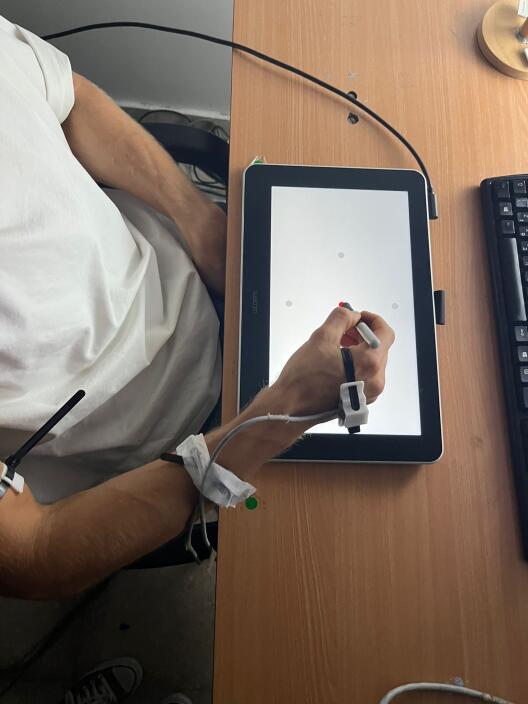
We are finishing our initial study on how task-relevant variability affects motor learning in healthy young adults. The task with induced task-relevant variability was created based on the classical center-out reaching task. Variability is manipulated independently along single and multiple dimensions, allowing causal testing of its role in motor learning rather than relying on correlational baseline variability (Picture 1).

Our approach successfully integrates behavioral, kinematic, and physiological data (including heart rate variability) to provide a complete picture of the learning process. Preliminary results demonstrate that variability can be experimentally induced in a controlled and stable manner without disrupting task execution. The groups that trained with increased, particularly multidimensional, variability show early signs of enhanced learning-related change, including improved transfer and retention performance.

The results and insights obtained from Study 1 form the empirical and conceptual basis for the remaining studies. These include the development of subject-specific variability schedules using adaptive staircase procedures, the application of variability-based training in stroke patients, and the examination of age-related differences in variability and learning efficacy. Task adaptation strategies, and recruitment planning for these studies have already been initiated.

Picture 1
© Aleksandra Kaner

June 2025

To test our hypotheses, four experiments will be conducted. All experiments are on the pilot stage. 

© Alexandra Kaner