
Many physical systems obey reciprocal interactions at the most fundamental level: when two objects interact, the force exerted by one on the other is equal and opposite, as required by Newton’s third law. This reciprocity is deeply embedded in equilibrium statistical physics and is closely tied to conservation laws, energy balance, and time-reversal symmetry.
However, a growing number of active systems of current interest do not satisfy this assumption. In these systems, interactions can be nonreciprocal, meaning that one degree of freedom affects another without a corresponding back-action of equal strength. Such behavior appears naturally in nonequilibrium settings, including active matter, chemically driven systems, and certain biological and synthetic materials.
In a recent article published in SciPost Physics, a Diamond Open Access journal, Dr. Kristian Blom and Prof. Uwe Thiele from the Institute of Theoretical Physics at the University of Münster, together with Prof. Aljaž Godec from the University of Freiburg, investigate how such nonreciprocal interactions can be described within a coarse-grained field-theoretical framework.
From microscopic dynamics to field equations
The central goal of their work is to derive effective dynamical equations for two interacting fields starting from microscopic models. Field theories are widely used to describe collective behavior in complex systems, but their structure is often postulated on symmetry grounds rather than derived from underlying particle dynamics.
Here, the authors explicitly construct the macroscopic equations by coarse-graining microscopic models with nonreciprocal couplings. This approach clarifies which terms are allowed, how nonreciprocity enters the equations, and how it modifies the system’s large-scale behavior.
The role of conservation laws
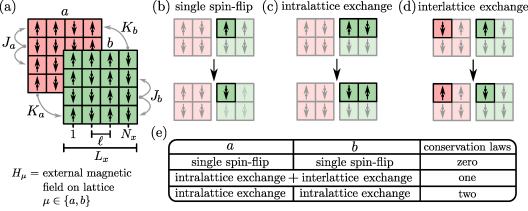
An important organizing principle in the paper is the presence or absence of conservation laws, such as conservation of particle number or density. Conservation laws strongly constrain the form of dynamical equations and influence how disturbances propagate through a system.
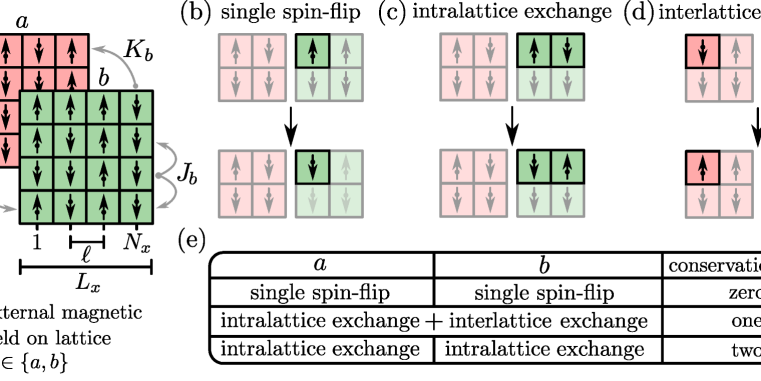
The authors analyze three distinct cases: systems with no conserved quantities, systems with one conserved field, and systems with two conserved fields.
Each case leads to a different class of dynamical behavior. The study shows that nonreciprocity interacts with conservation laws in nontrivial ways, producing effects that do not occur in equilibrium systems, such as persistent currents or unconventional instabilities.
Implications for nonequilibrium physics
By providing a controlled microscopic derivation, the work helps place phenomenological models of nonreciprocal dynamics on firmer theoretical ground. This is particularly relevant for the study of active and driven systems, where detailed balance is violated and traditional equilibrium concepts no longer apply.
The framework developed in the paper can be used as a starting point for analyzing pattern formation, collective motion, and stability in a wide range of nonequilibrium systems. More broadly, it contributes to ongoing efforts to classify and understand universal features of nonequilibrium dynamics beyond the constraints of reciprocity.
Conclusion
This study demonstrates how nonreciprocal interactions emerge naturally at the macroscopic level from simple microscopic rules, and how their effects depend crucially on conservation laws. By bridging particle-level dynamics and field-theoretic descriptions, the work advances our theoretical understanding of nonequilibrium systems with nonreciprocal interactions.
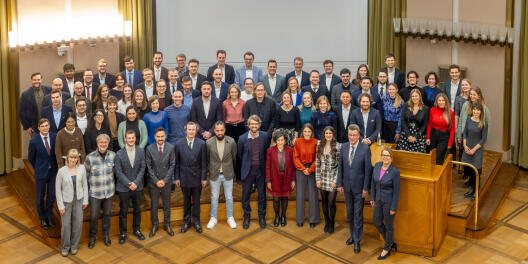
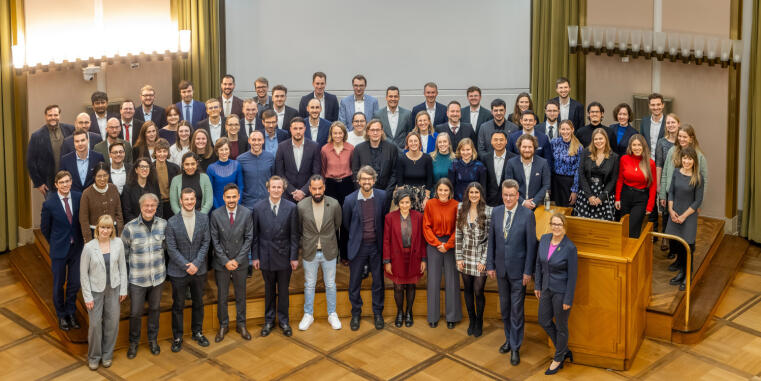
Das Rektorat der Universität Münster hat am Freitag (5. Dezember) die besten Doktorarbeiten des Jahres 2025 ausgezeichnet. Unter den ausgezeichneten Promotionen, sind auch zwei Arbeiten aus der nichtlinearen Physik, zu denen wir Thomas Seidel (Arbeitsgruppe Gurevich) und Tobias Wand (Arbeitsgruppe Thiele) ganz herzlich gratulieren.
Insgesamt 122 Nachwuchswissenschaftlerinnen und -wissenschaftler hatten für ihre Arbeiten das bestmögliche Prädikat „summa cum laude“ bekommen. Ihnen zu Ehren lud das Rektorat zu einem Empfang in die Aula im münsterschen Schloss ein und schloss sich diesem "höchsten Lob" an. „Wir sind stolz darauf, eine solch große Zahl erfolgreicher Absolventinnen und Absolventen zu ehren. Das ist ein Beleg dafür, dass die Universität Münster in ihrer gesamten Fächerbreite exzellenten Nachwuchs ausbildet“, betonte Rektor Prof. Dr. Johannes Wessels. „Mit den Themen und Inhalten ihrer Arbeiten setzen sie bedeutende Impulse in ihren Forschungsfeldern und tragen so zur Fortentwicklung des universitären Forschungsprofils bei.“ Insgesamt promovieren rund 750 Nachwuchswissenschaftler pro Jahr an der Universität Münster.
Mit gleich zwei Artikeln in renommierten Fachzeitschriften verabschiedet sich Alina Steinberg nach erfolgreichen Jahren vom Institut für theoretische Physik. Neben den dicht aufeinanderfolgenden Veröffentlichungszeitpunkten erscheint vor allem eines überraschend: Die beiden Arbeiten behandeln völlig unterschiedliche Forschungsfelder!
Im Artikel "Localized states in dipolar Bose-Einstein condensates: To be or not to be of second order", deren Titel Shakespeare zweifelsohne gefallen hätte, widmete sie sich der Frage nach Phasenübergängen in Bose-Einstein-Kondensaten. Die überraschende, in Physical Review Research publizierte Erkenntnis: Obwohl es auf den ersten Blick scheint, als träten dort Phasenübergänge zweiter Ordnung auf, kann mithilfe einer Bifurkationsanalyse gezeigt werden, dass stabile Phasenkoexistenz und somit ein Phasenübergang erster Ordnung vorliegt.
Im Gegensatz dazu beschäftigte sich Alina Steinberg zusammen mit ihren Koautoren im Artikel "Motility-induced crystallization and rotating crystallites", der in der Zeitschrift Physical Review Letters veröffentlicht wurde, mit der theoretischen Beschreibung selbst-angetriebener Teilchen durch aktive Phasenfeldkristallmodelle. Der Umstand, dass diese Systeme nicht den klassichen Gesetzmäßigkeiten der Gleichgewichtsthermodynamik unterliegen, kann zu verblüffenden Effekten führen: Neben verschiedenen Formen statischer Phasenkoexistenz erscheinen rotierende Kristalle und wenn man ganz genau hinsieht, dann auch manche, die zum Abschied winken...
Wir wünschen Alina für die Zukunft alles Gute!
Originalveröffentlichungen:
A. B. Steinberg, F. Maucher, S. V. Gurevich, and U. Thiele, Localized states in dipolar Bose-Einstein condensates: To be or not to be of second order, Physical Review Research 7, 10.1103/13k1-rxmw (2025).
M.P. Holl*, A. B. Steinberg*, M. te Vrugt, and U. Thiele, Motility-induced crystallization and rotating crystallites, Phys. Rev. Lett. 135, 158301 (2025).
*geteilte Erstautorenschaft