Between 2016 and 2025, the ZIN organized the annual public and interdisciplinary lecture series “ZIN-Brotzeitkolloquium” (ZIN Brown Bag Lectures), inspired by the American Brown Bag Lunch format. Each year, the series focused on a different topic relevant to sustainability and was aimed at students from all faculties of the University of Münster as well as the interested public.
The majority of the lectures were given by ZIN scholars themselves, who also regularly incorporated the ZIN Brown Bag Lectures into their teaching. External researchers and practitioners also contributed as speakers. Information on all ZIN Brown Bag Lectures held in recent years can be found here
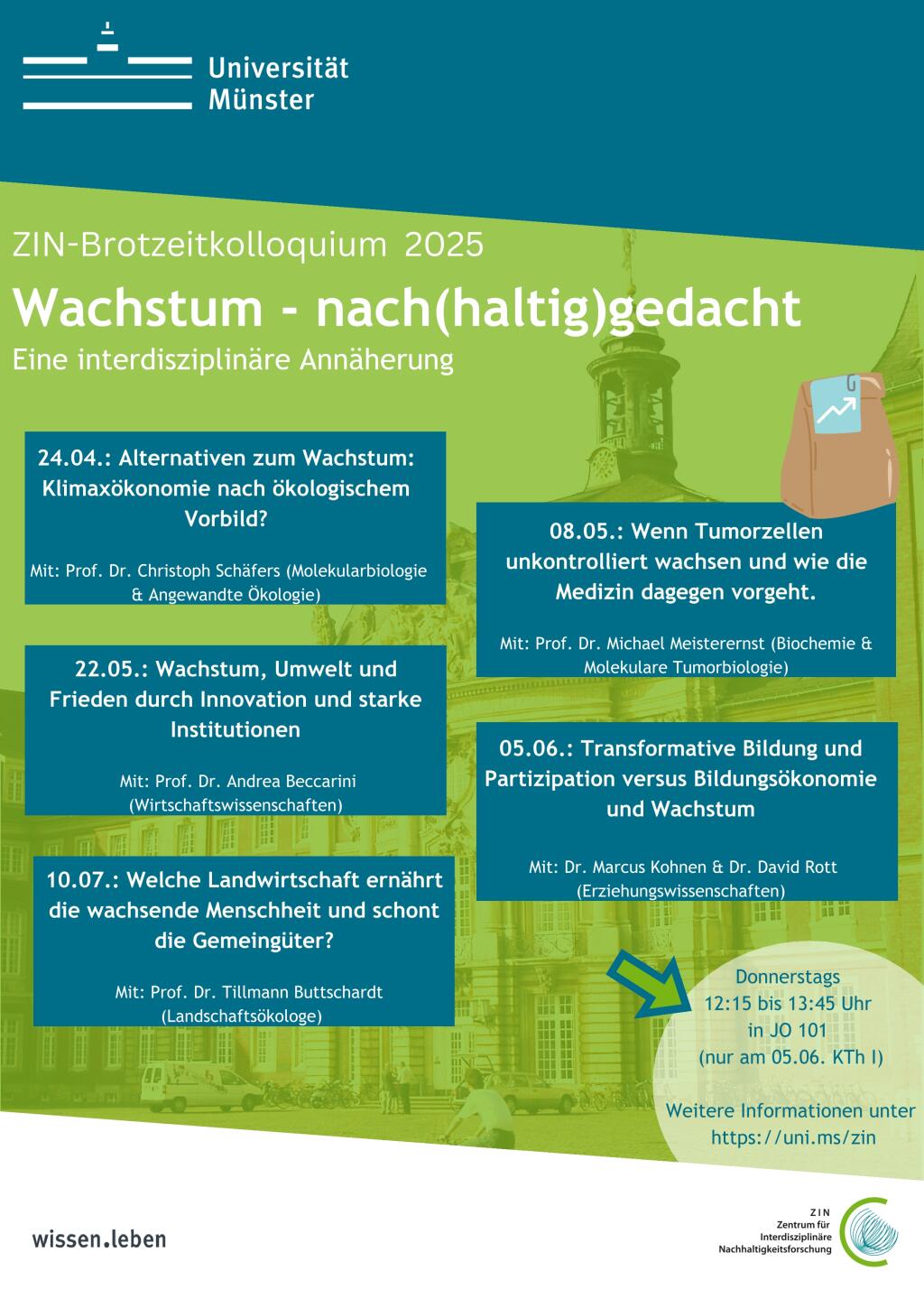
ZIN Brown Bag Lectures 2025: Shaping Growth Sustainably
Across five sessions, speakers from the University of Münster gave short presentations approaching the topic of growth from five different disciplinary perspectives: molecular biology, biochemistry, economics, educational science, and landscape ecology.
Announcement text:
What does growth mean in different academic disciplines, and how can these perspectives enrich one another? Under the title “Wachstum aus interdisziplinärer Perspektive” (translatable as “Growth from an Interdisciplinary Perspective”), students and interested members of the public were invited to a lecture series featuring experts from economics, landscape ecology, educational science, biology, and medicine, who presented their findings and perspectives. Across five Thursdays from April to July, from 12:15 to 1:45 p.m., the series explored topics including social developments, individual and collective growth, economic dynamics, and biological processes. Its aim was to bring together different perspectives on growth and thereby generate new impulses for academia and society.
Speakers and Lectures:
Molecular Biologist Dr. Christoph Schäfers: “Alternativen zum Wachstum: Klimaxökonomie nach ökologischem Vorbild?” (translatable as “Alternatives to Growth: Climax Economics Based on Ecological Models?”)
Biochemist Prof. Dr. Michael Meisterernst: “Wenn Tumorzellen unkontrolliert wachsen und wie die Medizin dagegen vorgeht” (translatable as “When Tumour Cells Grow Uncontrollably and How Medicine Responds”)
Economist Dr. Andrea Beccarini: “Wachstum, Umwelt und Frieden durch Innovation und starke Institutionen” (translatable as “Growth, the Environment and Peace through Innovation and Strong Institutions”)
Educational Scientists Dr. Markus Kohnen and Dr. David Rott: “Transformative Bildung und Partizipation versus Bildungsökonomie und Wachstum” (translatable as “Transformative Education and Participation versus the Economics of Education and Growth”)
Landscape Ecologist Prof. Dr. Tillmann Buttschardt: “Welche Landwirtschaft ernährt die wachsende Menschheit und schont die Gemeingüter?” (translatable as “Which Kind of Agriculture Can Feed a Growing Humanity While Protecting the Commons?”)
ZIN Brown Bag Lectures 2024: Digging for Diversity
Across five sessions, two ZIN speakers gave short presentations approaching the topic of diversity from the perspectives of seven different disciplines: political science, landscape ecology, psychology, communication science, microbiology, information systems, and educational science.
Announcement text:
In the summer semester of 2024, the ZIN once again organized a public and interdisciplinary lecture series, this year dedicated to the overarching theme “Digging for Diversity.” Previously known as the ZIN-Brotzeitkolloquium, the series was held in English for the first time as the “ZIN Brown Bag Lectures.” As an “open class,” the lectures were also available virtually to students from ULYSSEUS European University partner institutions. ULYSSEUS is a European university network of which the University of Münster is a member alongside partner universities in six other European countries.
Acroos five sessions, two ZIN speakers gave short presentations approaching the topic of diversity from the perspectives of seven different disciplines. Students from all disciplines at the University of Münster and the six partner universities, as well as interested members of the public, were warmly invited to attend the lectures, which took place over five Thursdays around lunchtime between April and June. The sessions were streamed via Zoom from Lecture Hall F4 in the Fürstenberghaus, where participants were also welcome to attend in person. Each session began at 12:15 p.m.
In 2024, the ZIN Brown Bag Lectures were organized not only in cooperation with the ULYSSEUS project, but also with the SUNRISE LAB and LATERNE projects, which investigate and test ways of making universities more sustainable, including through so-called “real-world experiments.” The lecture series itself formed part of such a real-world experiment investigating interdisciplinary and transdisciplinary teaching in the context of socio-ecological transformation.
No prior knowledge was required to follow the lectures. All information about the series, including an overview of the program and access details for each session, can be found in the “ZIN Brown Bag Lectures/Brotzeitkolloquium” section of our website. Information about the ZIN Brown Bag Lectures was also shared via our LinkedIn and Facebook accounts.
Speakers and Lectures:
Political scientist Julia Wiethüchter and landscape ecologist Dr. Cornelia Steinhäuser: “Diverse People, Diverse Knowledges”
Communication scientist Prof. Sigrid Kannengießer and psychologist Simin Ziegler: “Diverse Beliefs, Norms, and Value Systems”
Landscape ecologist Prof. Tillmann Buttschardt and microbiologist Prof. Bodo Philipp: “Biodiversity and Bio-Cultural Diversity”
Political scientists Dr. Pia Mamut and Lea Becker and information systems researcher Prof. Tobias Brandt: “Diverse Lifestyles, Work, and Livelihoods”
Political scientists Prof. Antonia Graf and Tomma Wagner and educational scientists Prof. Christian Fischer and Dr. David Rott: “Diverse Arenas of Political and Social Participation and Learning”
ZIN Brown Bag Lectures 2023: Conflicts surrounding Sustainability
In five lectures, the speakers explored different “conflicts over sustainability,” addressing topics such as insect decline, digitalization, and species conservation.
Announcement text:
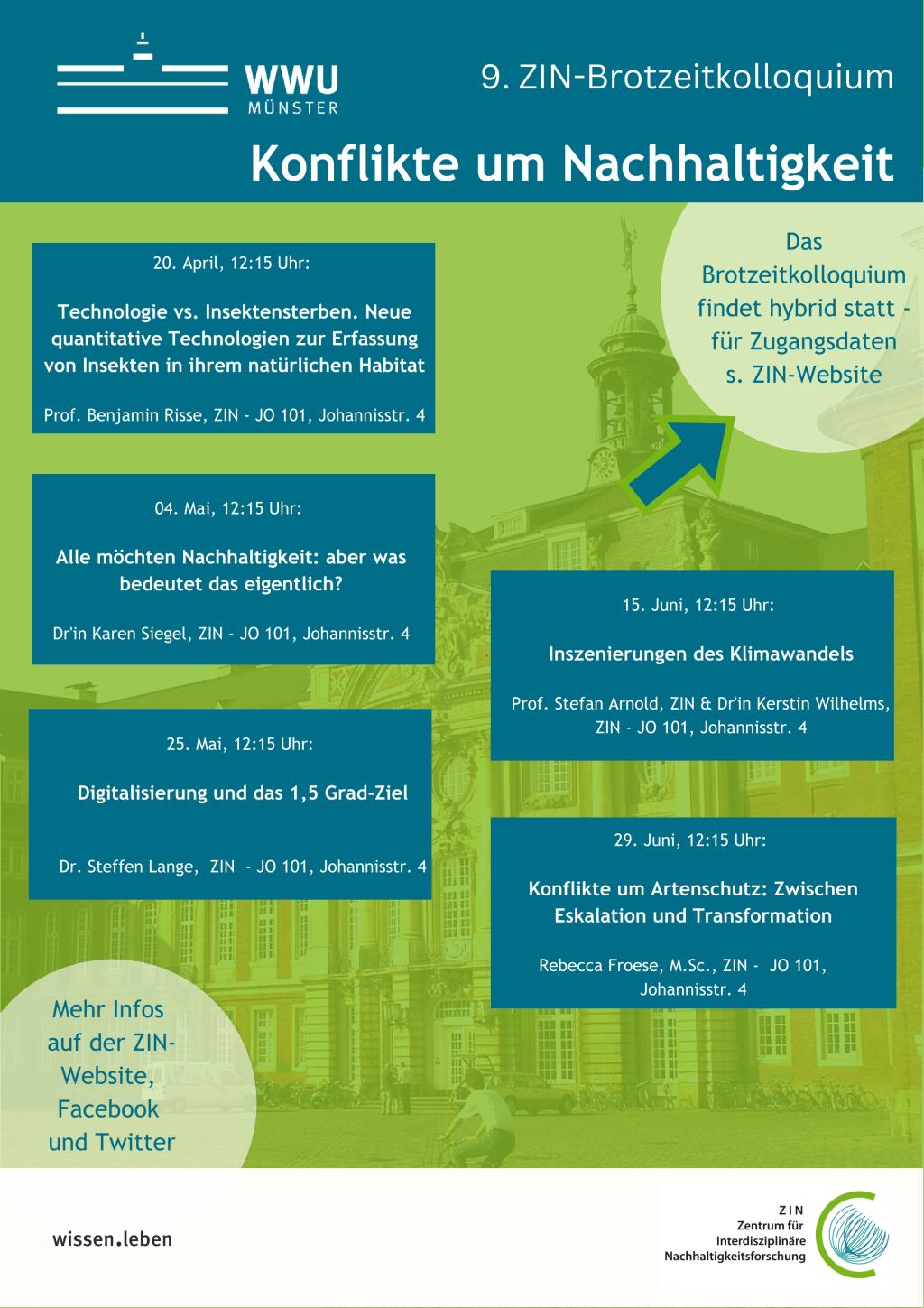
The 9th ZIN Brown Bag Lectures, dedicated to the theme “Konflikte um Nachhaltigkeit” (translatable as “Conflicts surrounding Sustainability”), began on 20 April 2023. The series comprised five hybrid lectures during the summer semester of 2023, taking place every Thursday at 12:15 p.m.
Students and interested members of the public were invited to five lectures as part of the ZIN Brown Bag Lectures in summer 2023. The speakers explored different “conflicts surrounding sustainability,” addressing topics such as insect decline, digitalization, and species conservation.
Since the summer semester of 2016, ZIN has organized the ZIN Brown Bag Lectures, a lecture series inspired by the American Brown Bag Lunch format. In summer semester 2023, the successful series was held for the ninth time.
The speakers were ZIN members who examined various aspects of the overarching theme “Konflikte um Nachhaltigkeit” (translatable as “Conflicts over Sustainability”) from the perspectives of different disciplines, including political science, computer science, and law.
The lecture series was aimed at students from all disciplines at the University of Münster as well as the interested public and therefore required no prior disciplinary knowledge. All events were held in a hybrid format. Zoom links and access details were shared via the ZIN website. The five lectures took place throughout the summer semester on Thursdays from 12:15 to 1:45 p.m. in JO 101 (Johannisstr. 4).
The 9th ZIN Brown Bag Lectures opened with the lecture “Technologie vs. Artensterben. Neue quantitative Technologien zur Erfassung von Insekten in ihrem natürlichen Habitat” (translatable as “Technology vs. Species Decline. New Quantitative Technologies for Recording Insects in Their Natural Habitat”) by ZIN member Prof. Benjamin Risse on Thursday, 20 April 2023 at 12:15 p.m.
Speakers and Lectures:
Prof. Dr. Benjamin Risse: “Technologie vs. Artensterben. Neue quantitative Technologien zur Erfassung von Insekten in ihrem natürlichen Habitat” (translatable as “Technology vs. Species Decline. New Quantitative Technologies for Recording Insects in Their Natural Habitat”)
Dr. Karen Siegel: “Alle möchten Nachhaltigkeit: Aber was bedeutet das eigentlich?” (translatable as “Everyone Wants Sustainability: But What Does It Actually Mean?”)
Dr. Steffen Lange: “Digitalisierung und das 1,5 Grad-Ziel” (translatable as “Digitalization and the 1.5°C Target”)
Prof. Dr. Stefan Arnold and Dr. Kerstin Wilhelms: “Inszenierungen des Klimawandels” (translatable as “Staging Climate Change”)
Rebecca Froese, M.Sc.: “Konflikte um Artenschutz: Zwischen Eskalation und Transformation” (translatable as “Conflicts over Species Conservation: Between Escalation and Transformation”)
ZIN Brown Bag Lectures 2022: Democracy and Sustainability
The speakers approached different aspects of the overarching theme “Democracy and Sustainability” from a range of disciplinary perspectives, addressing topics such as public participation and the relationship between the economy and democracy.
Announcement text:
Students and interested members of the public were invited to five lectures as part of the ZIN Brown Bag Lectures in summer 2022. The speakers explored various aspects of the overarching theme, including public participation and the relationship between the economy and democracy.
Since the summer semester of 2016, ZIN has organized the ZIN Brown Bag Lectures, a lecture series inspired by the American Brown Bag Lunch format. In summer semester 2022, the successful series was held for the eighth time.
Speakers from different disciplines examined various facets of the overarching theme “Demokratie und Nachhaltigkeit” (translatable as “Democracy and Sustainability”). Most of the speakers were ZIN members or staff. The line-up was complemented by two guest speakers: Prof. Dr. Nora Markard, Chair of International Public Law and International Human Rights Protection at the University of Münster, and Prof. Peter Newell (University of Sussex, United Kingdom).
The lecture series was aimed at students from all disciplines at the University of Münster as well as the interested public and therefore required no prior disciplinary knowledge. Due to the COVID-19 pandemic, all events were held in a hybrid format. Zoom links and access details were shared via the ZIN website. The venues were listed on the event series poster and were also announced again shortly before each event.
The 8th ZIN Brown Bag Lectures opened with the lecture “From Transition to Transfomration: Shifting power for sustainability” by guest speaker Prof. Peter Newell on Thursday, 28 April 2022 at 1:00 p.m. This was the only lecture held exclusively online.
The ZIN Brown Bag Lectures took place on five Thursdays during the semester, generally from 12:15 to 1:45 p.m. (exception: the first lecture on 28 April). Participants were welcome to bring their lunch. The exact dates and venues were listed in the “Dates” section on the homepage and on the event series poster.
Speakers and Lectures:
Prof. Dr. Peter Newell (University of Sussex): “From Transition to Transfomration: Shifting power for sustainability”
Lena Siepker: “Dialogische Bürgerbeteiligung – eine Antwort auf demokratische und sozial-ökologische Krisen?” (translatable as “Deliberative Public Participation – An Answer to Democratic and Socio-Ecological Crises?”)
Prof. Dr. Christian Fischer and Dr. Marcus Kohnen: “Nachhaltige Potenzialentwicklung in Projekten zur nachhaltigen Zukunftsgestaltung” (translatable as “Sustainable Development of Potential in Projects for Shaping a Sustainable Future”)
Prof. Dr. Nora Markard: “Wie nachhaltig ist die Abschottung? Migrantische Kämpfe um Zugang an den EU-Außengrenzen” (translatable as “How Sustainable Is Border Closure? Migrants’ Struggles for Access at the EU’s External Borders”)
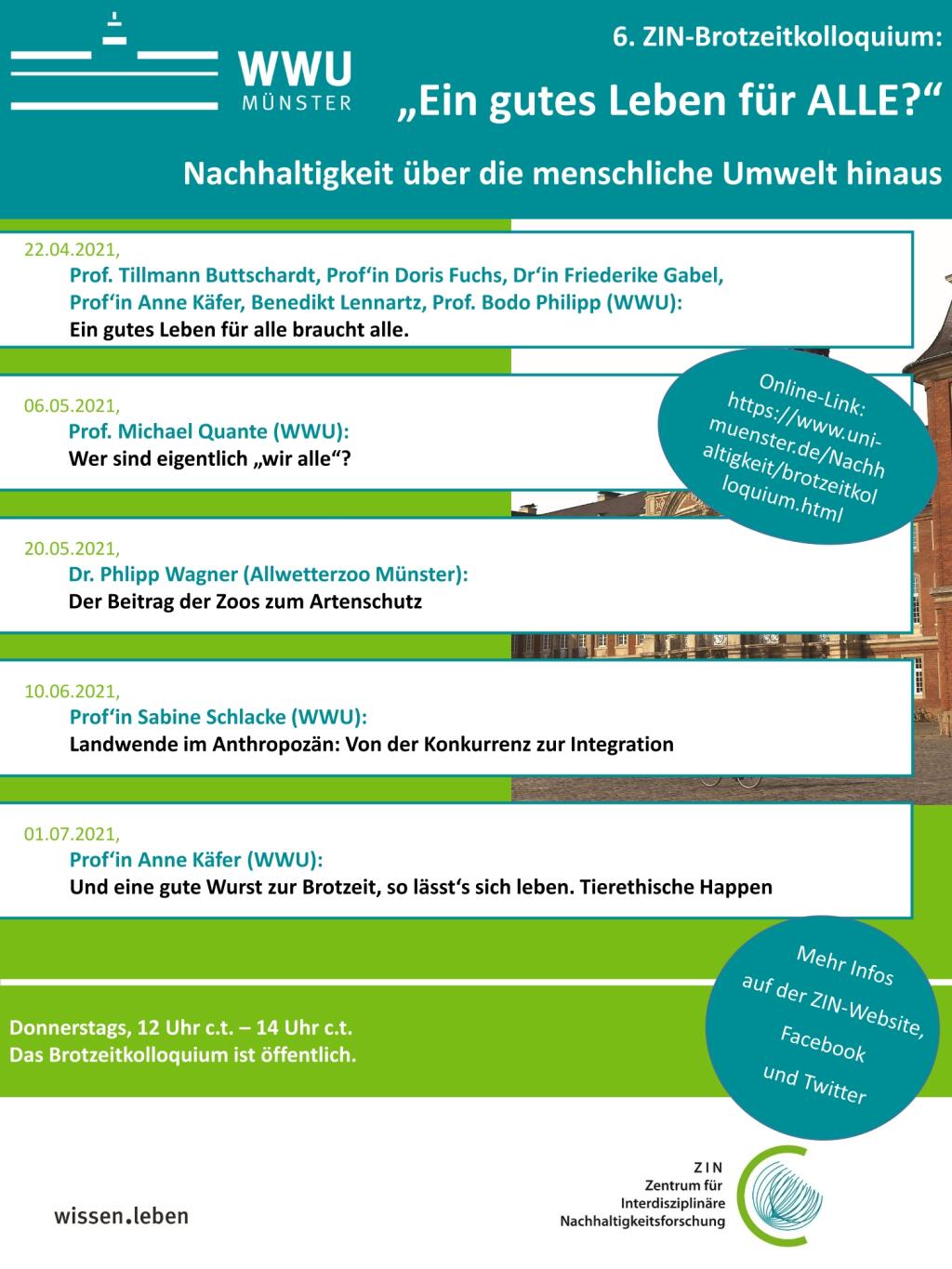
ZIN Brown Bag Lectures 2021: A Good Life for ALL? Sustainability Beyond the Human Environment
In five lectures, the Brown Bag Lectures explored perspectives on sustainability in the fields of politics, philosophy, species conservation, land use, and ethics. This year, particular attention was paid to sustainability-related issues beyond the human environment.
Announcement text:
In 2021, ZIN organized its sixth ZIN Brown Bag Lectures under the title “Ein gutes Leben für ALLE?” (translatable as “A Good Life for ALL?”). In five lectures, the series explored perspectives on sustainability in the fields of politics, philosophy, species conservation, land use, and ethics. Particular attention was paid to sustainability-related issues beyond the human environment. Students from all disciplines as well as interested members of the public were invited to attend the lectures, which took place on five Thursdays from late April to July.
Speakers and Lectures:
Prof. Dr. Tillmann Buttschardt, Prof. Doris Fuchs, Dr. Friederike Gabel, Prof. Dr. Anne Käfer, Benedikt Lennartz, and Prof. Dr. Bodo Philipp: “Ein gutes Leben für alle braucht alle.” (translatable as “A Good Life for All Requires Everyone.”)
Prof. Dr. Michael Quante: “Wer sind wir eigentlich „wir alle“?” (translatable as “Who Exactly Are ‘All of Us’?”)
Dr. Philipp Wagner (Allwetterzoo Münster): “Der Beitrag der Zoos zum Artenschutz” (translatable as “The Contribution of Zoos to Species Conservation”)
Prof. Dr. Sabine Schlacke: “Landwende im Anthropozän: Von der Konkurrenz zur Integration” (translatable as “Land Transformation in the Anthropocene: From Competition to Integration”)
Prof. Dr. Anne Käfer: “Und eine gute Wurst zur Brotzeit, so lässt’s sich leben. Tierethische Happen” (translatable as “And a Good Sausage for Lunch – That’s the Good Life. Bites of Animal Ethics”)
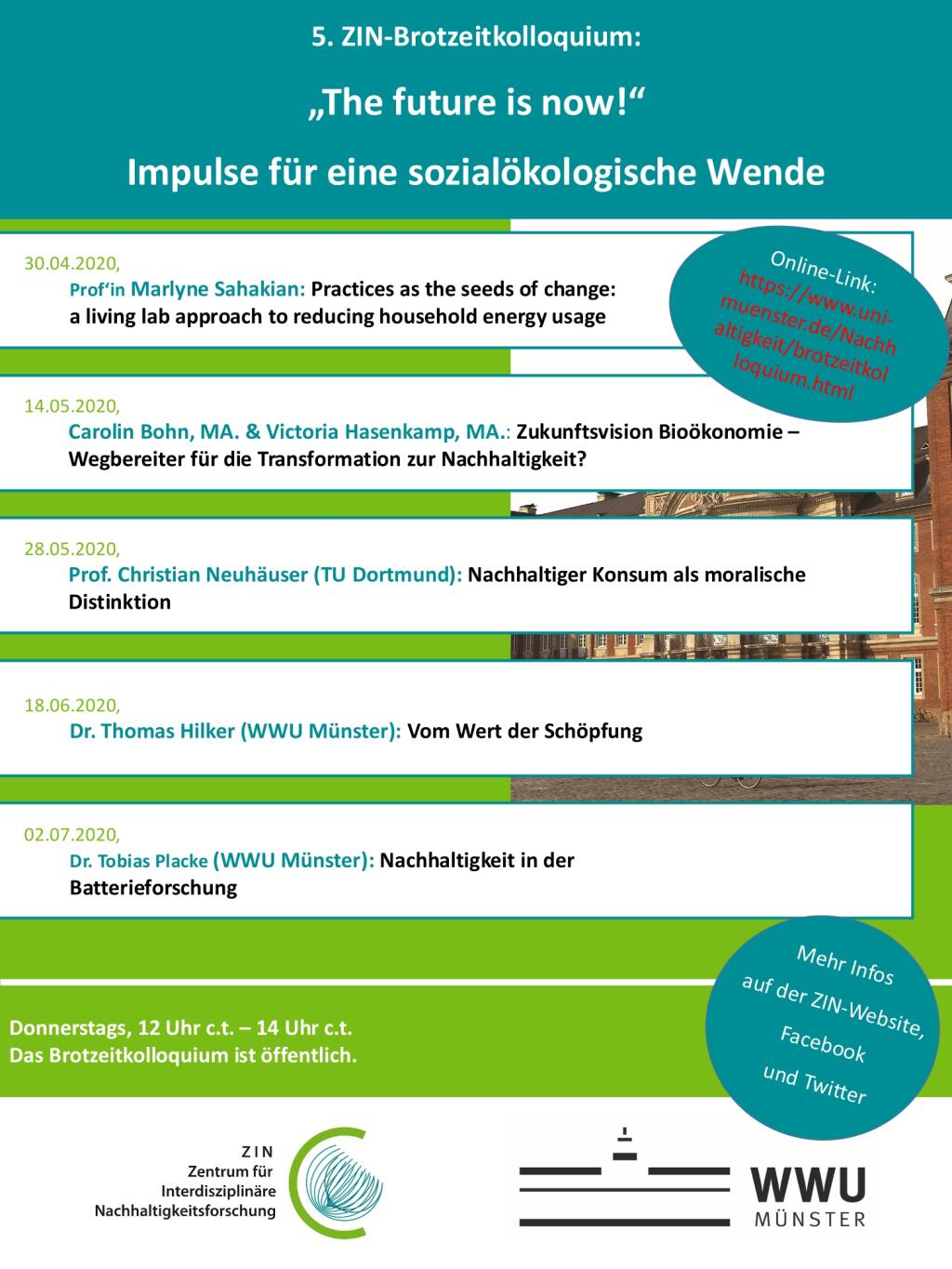
ZIN Brown Bag Lectures 2020: The Future Is Now! – Impulses for a Socio-Ecological Transition
Under the title “The future is now! – Impulse für eine sozialökologische Wende” (translatable as “The Future Is Now! – Impulses for a Socio-Ecological Transition”), the speakers, some of whom are ZIN members, explore a range of topics in sustainability research.
Announcement text:
“The future is now! – Impulse für eine sozialökologische Wende” (translatable as “The Future Is Now! – Impulses for a Socio-Ecological Transition”). Under this title, the ZIN Brown Bag Lectures enter their fifth edition in the summer semester of 2020.
The opening lecture will be given on Thursday, 30 April, by sociologist Prof. Dr. Marlyne Sahakian from the University of Geneva. From 12:15 to 1:45 p.m., she will discuss the significance of everyday practices for the transformation towards sustainability (in English). The format is based on the “Brown Bag Lectures” commonly held in Anglo-American academic settings, which take place during lunchtime. Students from all disciplines and interested members of the public are warmly invited to listen while having lunch or a midday snack and, when their mouths are free, join the discussion.
In the four subsequent lunchtime lectures, the speakers, some of whom are ZIN members, will explore further topics in sustainability research. On 14 May, for example, Carolin Bohn and Victoria Hasenkamp will discuss the foundations of the bioeconomy as well as its potential contributions to the ecological, social, and economic dimensions of sustainability in their lecture “Zukunftsvision Bioökonomie” (translatable as “A Vision for the Future: The Bioeconomy”). “Nachhaltiger Konsum als moralische Distinktion” (translatable as “Sustainable Consumption as Moral Distinction”) is the title of a lecture by Prof. Christian Neuhäuser from TU Dortmund University on 28 May. Theologian Dr. Thomas Hilker from the University of Münster will speak on “Vom Wert der Schöpfung” (translatable as “On the Value of Creation”) on 18 June, while Dr. Tobias Placke from the MEET Battery Research Center at the University of Münster will provide insights into questions of sustainability in battery research on 2 July.
Unlike in previous years, all lectures this semester will take place digitally via Zoom. Links to the individual events will be made available on the ZIN website (https://www.uni-muenster.de/Nachhaltigkeit/brotzeitkolloquium.html) in good time before each event, as well as on Twitter and Facebook.
Speakers and lectures:
Marlyne Sahakian (University of Geneva): “Practices as the Seeds of Change: A Living Lab Approach to Reducing Household Energy Usage”
Carolin Bohn, M.A., and Victoria Hasenkamp, M.A.: “Zukunftsvision Bioökonomie – Wegbereiter für die Transformation zur Nachhaltigkeit?” (translatable as “A Vision for the Future: The Bioeconomy – Enabler of the Transformation towards Sustainability?”)
Prof. Dr. Christian Neuhäuser (TU Dortmund University): “Nachhaltiger Konsum als moralische Distinktion” (translatable as “Sustainable Consumption as Moral Distinction”)
Dr. Thomas Hilker: “Vom Wert der Schöpfung” (translatable as “On the Value of Creation”)
Dr. Tobias Placke (MEET): “Nachhaltigkeit in der Batterieforschung” (translatable as “Sustainability in Battery Research”)
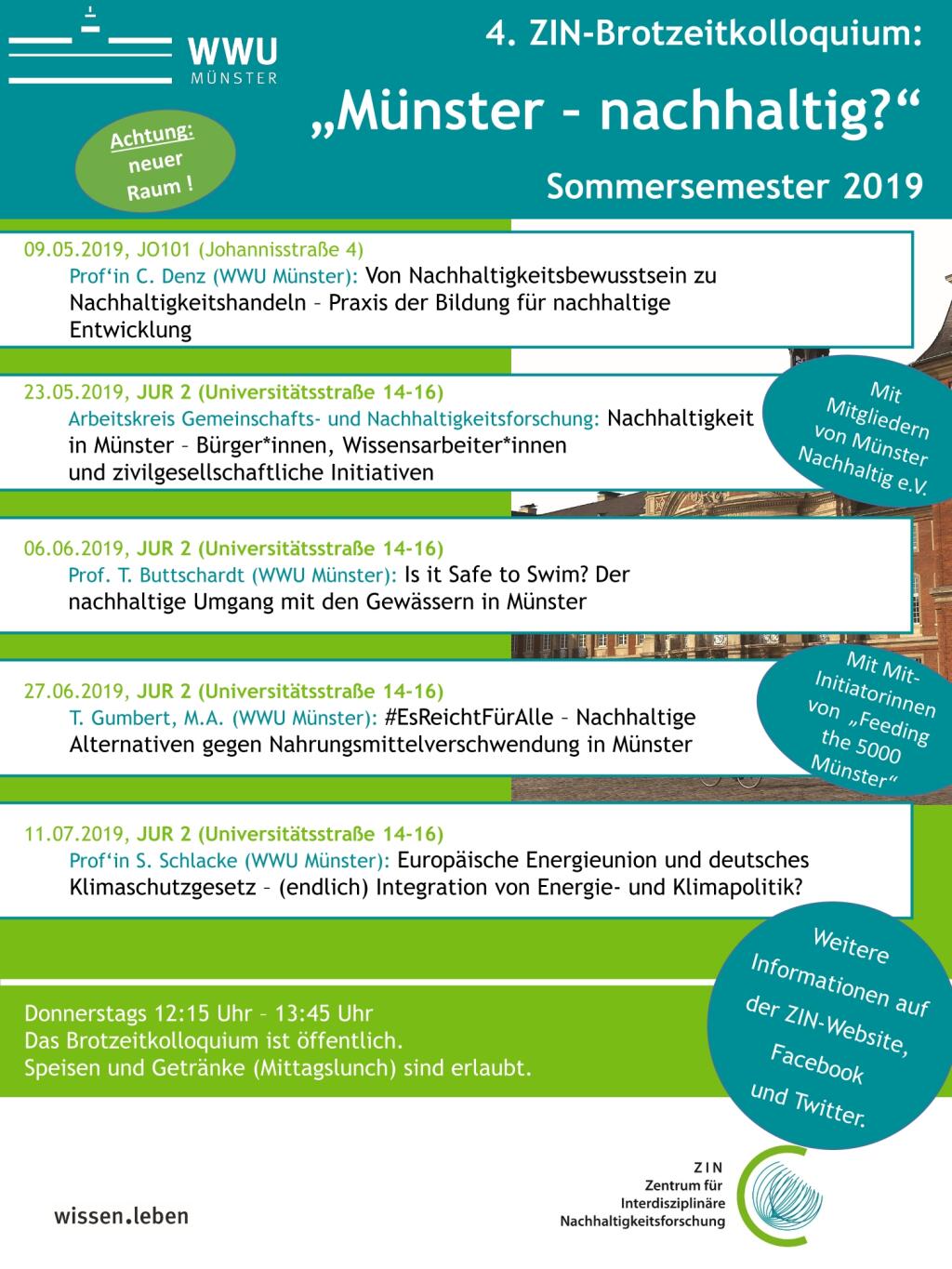
ZIN Brown Bag Lectures 2019: Münster – Sustainable?
The speakers, who are members of or affiliated with ZIN, explore the question “Münster – nachhaltig?” (translatable as “Münster – Sustainable?”) in five lectures addressing topics such as water protection, food waste, education for sustainable development, and sustainability engagement in Münster.
Announcement text:
The successful ZIN Brown Bag Lectures are taking place for the fourth time in the summer semester of 2019, under the title “Münster – nachhaltig?” (translatable as “Münster – Sustainable?”). In five lectures, the speakers, who are members of or affiliated with ZIN, explore sustainability-related topics such as water protection, food waste, education for sustainable development, and sustainability engagement in Münster. In many cases, the academic analyses are complemented by contributions from practitioners involved in sustainability initiatives in Münster. Students from all disciplines and interested members of the public are warmly invited to attend the lectures, which take place at lunchtime on five Thursdays between May and July. No prior knowledge is required, and participants are welcome to bring a small lunch!
All information on the lectures in the ZIN-Brotzeitkolloquium series is also available on the event poster here. The series was also promoted on Twitter (@zin_wwu) and Facebook (@zin.wwu).
Speakers and lectures:
Prof. Dr. C. Denz: “Vom Nachhaltigkeitsbewusstsein zu Nachhaltigkeitshandeln – Praxis der Bildung für nachhaltige Entwicklung” (translatable as “From Sustainability Awareness to Sustainable Action – Practices of Education for Sustainable Development”)
Working Group on Community and Sustainability Research: “Nachhaltigkeit in Münster – Bürgerinnen, Wissensarbeiterinnen und zivilgesellschaftliche Initiativen” (translatable as “Sustainability in Münster – Residents, Knowledge Workers, and Civil Society Initiatives”)
Prof. Dr. Tillmann Buttschardt: “Is it Safe to Swim? Der nachhaltige Umgang mit den Gewässern in Münster” (translatable as “Is it Safe to Swim? Sustainable Management of Münster’s Water Bodies”)
Tobias Gumbert, M.A.: “#EsReichtFürAlle – Nachhaltige Alternativen gegen Nahrungsmittelverschwendung in Münster” (translatable as “#ThereIsEnoughForEveryone – Sustainable Alternatives to Food Waste in Münster”)
Prof. Dr. Sabine Schlacke: “Europäische Energieunion und deutsches Klimaschutzgesetz – (endlich) Integration von Energie- und Klimapolitik?” (translatable as “European Energy Union and Germany’s Climate Protection Act – (Finally) Integrating Energy and Climate Policy?”)
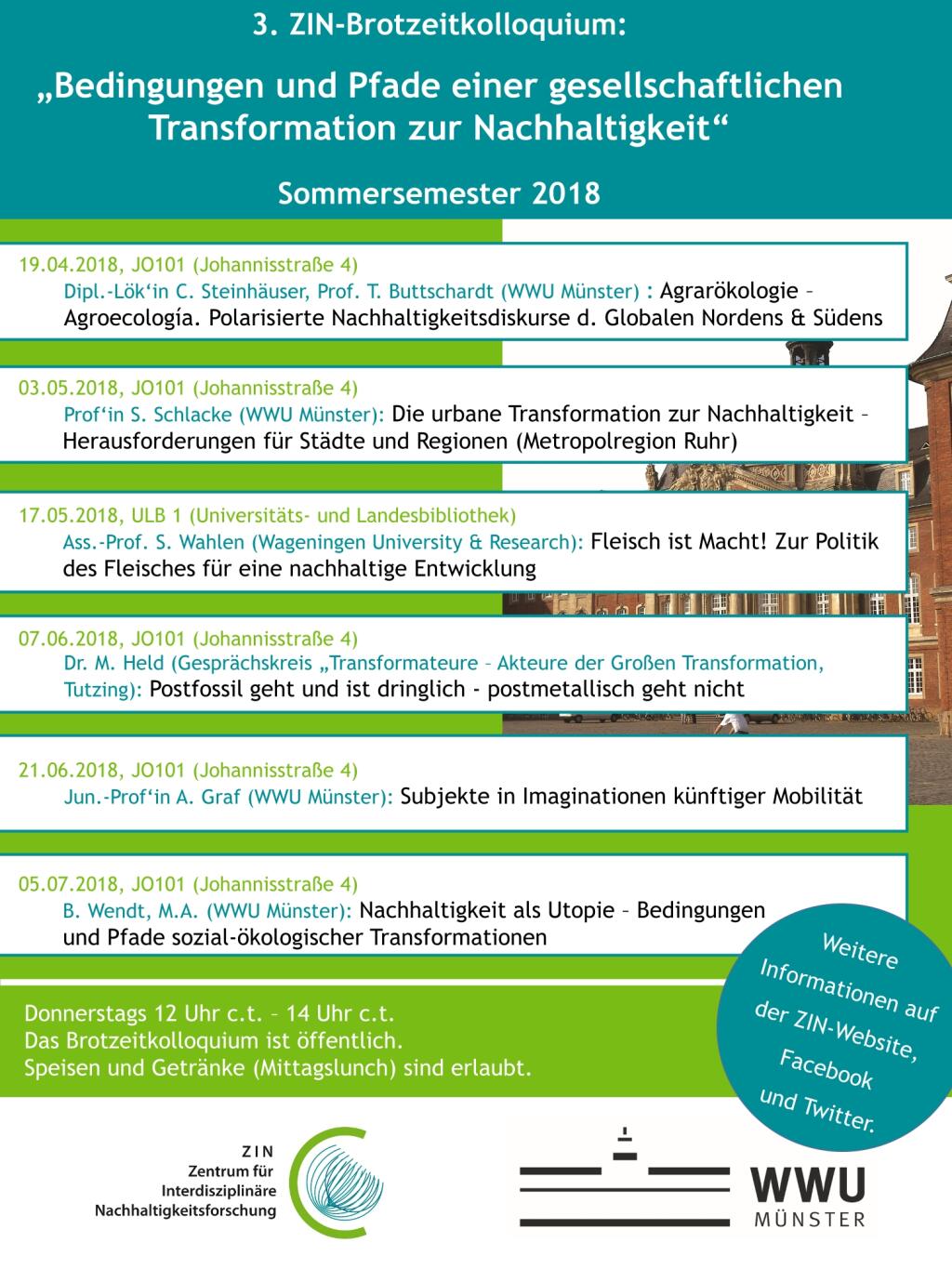
ZIN Brown Bag Lectures 2018: Conditions and Pathways for a Societal Transformation towards Sustainability
The lectures explore diverse aspects of societal transformation towards sustainability. The challenging transformation of cities towards sustainability, the political and social dimensions of meat consumption, and visions of future mobility are just some of the topics addressed.
Announcement text:
The 3rd edition of the ZIN Brown Bag Lectures starts in April 2018. Students from all faculties and interested members of the public are invited to six lectures on topics including agroecology, mobility, utopias, and more.
Since the summer semester of 2016, ZIN has organized the ZIN Brown Bag lectures, a lecture series inspired by the American Brown Bag Lunch format. In the summer semester of 2018, the successful series will take place for the third time. The overarching theme of this year’s six lectures is “Bedingungen und Pfade einer gesellschaftlichen Transformation zur Nachhaltigkeit” (translatable as “Conditions and Pathways for a Societal Transformation towards Sustainability”).
Speakers from different disciplines will explore various facets of this topic. Most of the speakers are members of or affiliated with ZIN. The line-up is complemented by two guest speakers: Assoc. Prof. Stefan Wahlen from Wageningen University & Research (the Netherlands) and Dr. Martin Held, coordinator of the discussion group “Transformateure – Akteure der großen Transformation” (translatable as “Transformers – Actors of the Great Transformation”) and long-standing programme director at the Evangelische Akademie Tutzing. The lectures will address diverse aspects of societal transformation towards sustainability, including the challenging transformation of cities towards sustainability, the political and social dimensions of meat consumption, and visions of future mobility.
The series is aimed at students from all disciplines at WWU as well as all interested members of the public and therefore does not require any prior subject-specific knowledge. The lectures will take place on six Thursdays during the coming semester, from 12:00 to 2:00 p.m. c.t. Participants are welcome to bring their own lunch. Exact dates and locations can be found in the “Events” section on the homepage and on the event poster.
Speakers and lectures:
Dipl.-Lök. Cornelia Steinhäuser, Prof. Dr. Tillmann Buttschardt: “Agrarökologie – Agroecología. Polarisierte Nachhaltigkeitsdiskurse des Globalen Nordens & Südens” (translatable as “Agroecology – Agroecología. Polarized Sustainability Discourses in the Global North & South”)
Prof. Sabine Schlacke: “Die urbane Transformation zur Nachhaltigkeit – Herausforderungen für Städte und Regionen (Metropolregion Ruhr)” (translatable as “Urban Transformation towards Sustainability – Challenges for Cities and Regions (Ruhr Metropolitan Region)”)
Assoc. Prof. Stefan Wahlen (Wageningen University & Research): “Fleisch ist Macht! Zur Politik des Fleisches für eine nachhaltige Entwicklung” (translatable as “Meat is Power! The Politics of Meat for Sustainable Development”)
Dr. Martin Held (Discussion Group “Transformateure – Akteure der Großen Transformation”, Tutzing): “Postfossil geht und ist dringlich – postmetallisch geht nicht” (translatable as “A Post-Fossil Future Is Possible and Urgent – a Post-Metal Future Is Not”)
Jun.-Prof. Dr. Antonia Graf: “Subjekte in Imaginationen künftiger Mobilität” (translatable as “Subjects in Imaginations of Future Mobility”)
Björn Wendt, M.A.: “Nachhaltigkeit als Utopie – Bedingungen und Pfade sozial-ökologischer Transformationen” (translatable as “Sustainability as Utopia – Conditions and Pathways of Socio-Ecological Transformations”)
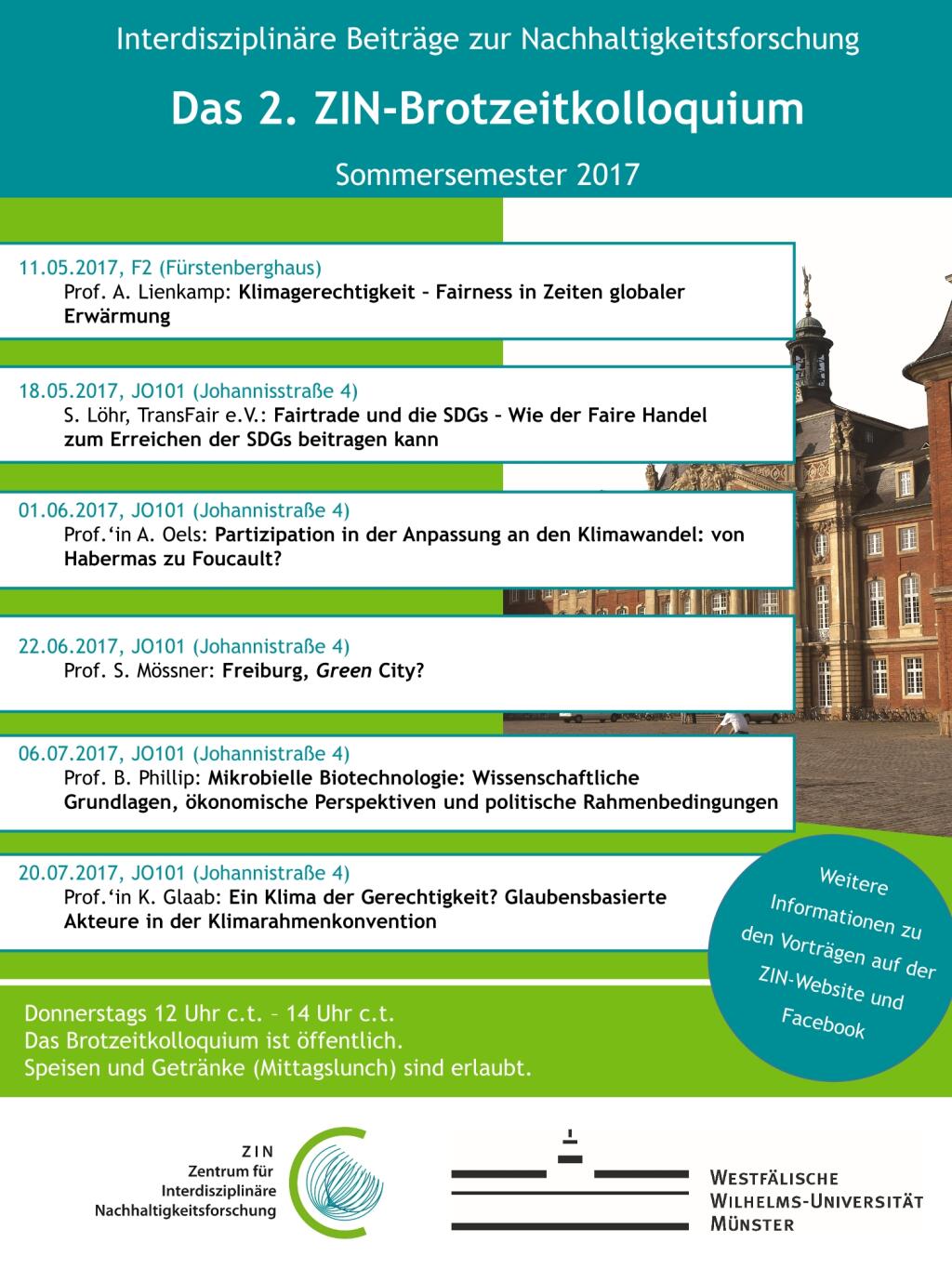
The 2nd edition of the ZIN Brown Bag lectures series explores various aspects of sustainability from different perspectives, including climate justice and the relationship between the Sustainable Development Goals and fair trade.
Speakers and lectures:
Prof. Dr. Andreas Lienkamp (University of Osnabrück): “Klimagerechtigkeit – Fairness in Zeiten globaler Erwärmung” (translatable as “Climate Justice – Fairness in Times of Global Warming”)
Stefanie Löhr (TransFair e. V.): “Fairtrade und die SDGs – Wie der Faire Handel zum Erreichen der SDGs beitragen kann” (translatable as “Fair Trade and the SDGs – How Fair Trade Can Contribute to Achieving the SDGs”)
Prof. Dr. Angela Oels (Open Universiteit Nederland): “Partizipation in der Anpassung an den Klimawandel: von Habermas zu Foucault?” (translatable as “Participation in Climate Change Adaptation: From Habermas to Foucault?”)
Prof. Dr. Samuel Mössner: “Freiburg, Green City?” (translatable as “Freiburg, Green City?”)
Prof. Dr. Bodo Philipp: “Mikrobielle Biotechnologie: Wissenschaftliche Grundlagen, ökonomische Perspektiven und politische Rahmenbedingungen” (translatable as “Microbial Biotechnology: Scientific Foundations, Economic Perspectives, and Political Frameworks”)
Prof. Dr. Katharina Glaab (Norwegian University of Life Sciences): “Ein Klima der Gerechtigkeit? Glaubensbasierte Akteure in der Klimarahmenkonvention” (translatable as “A Climate of Justice? Faith-Based Actors in the UN Climate Change Convention”)
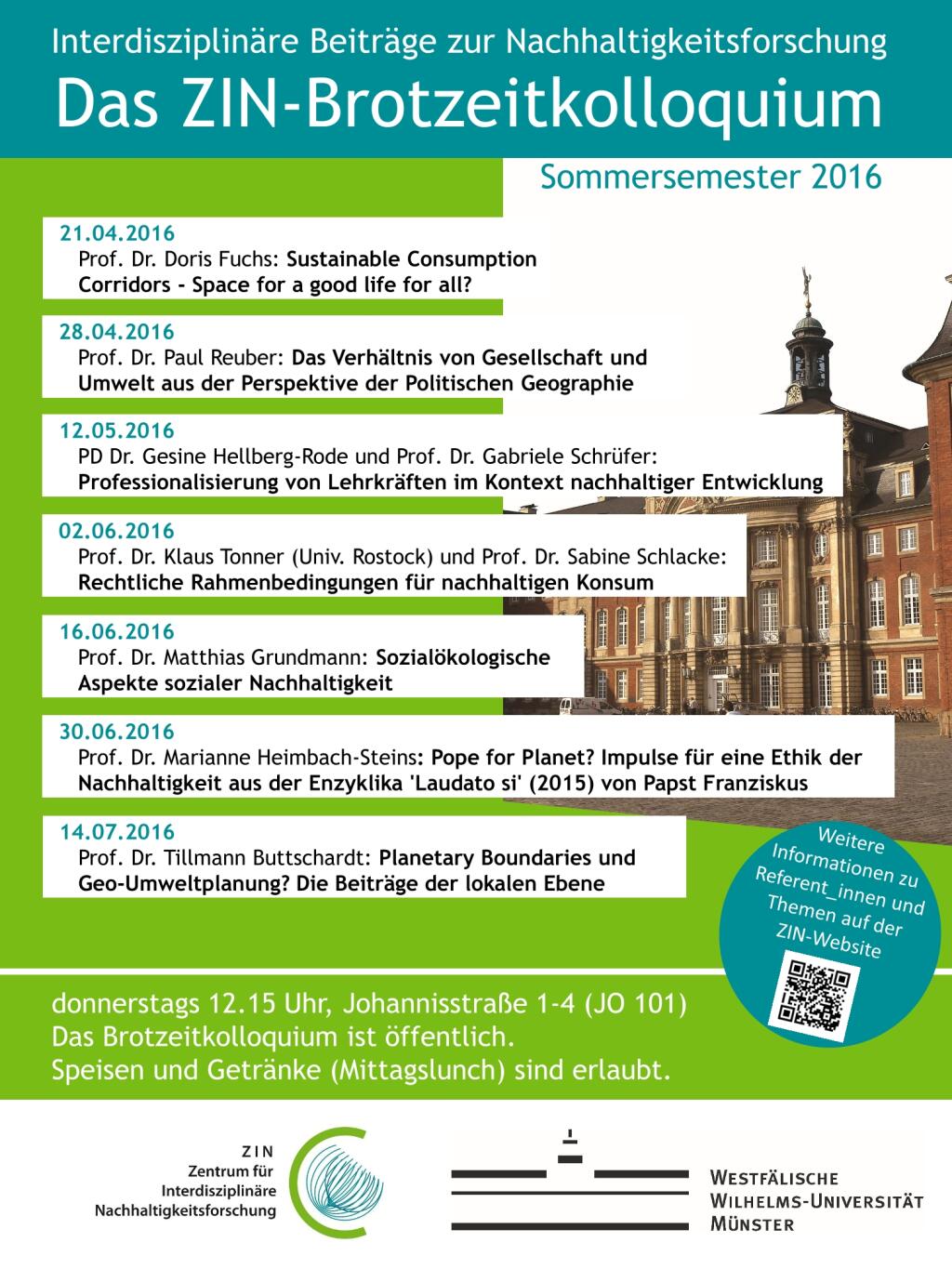
The Brotzeitkolloquium is a new lecture and discussion series launched by the Center for Interdisciplinary Sustainability Research (ZIN). Together with members of the Center and invited guests, the series addressed and discussed sustainability-related topics from the social sciences and humanities.
Speakers and lectures:
Prof. Dr. Doris Fuchs: “Sustainable Consumption Corridors – Space for a Good Life for All?”
Prof. Dr. Paul Reuber: “Das Verhältnis von Gesellschaft und Umwelt aus der Perspektive der Politischen Geographie” (translatable as “The Relationship between Society and the Environment from the Perspective of Political Geography”)
PD Dr. Gesine Hellberg-Rode and Prof. Dr. Gabriele Schrüfer: “Professionalisierung von Lehrkräften im Kontext nachhaltiger Entwicklung” (translatable as “Professionalization of Teachers in the Context of Sustainable Development”)
Prof. Dr. Klaus Tonner (University of Rostock) and Prof. Dr. Sabine Schlacke: “Rechtliche Rahmenbedingungen für nachhaltigen Konsum” (translatable as “Legal Frameworks for Sustainable Consumption”)
Prof. Dr. Matthias Grundmann: “Sozialökologische Aspekte sozialer Nachhaltigkeit” (translatable as “Socio-Ecological Aspects of Social Sustainability”)
Prof. Dr. Marianne Heimbach-Steins: “Pope for Planet? Impulse für eine Ethik der Nachhaltigkeit aus der Enzyklika „Laudato si“ (2015) von Papst Franziskus” (translatable as “Pope for Planet? Impulses for an Ethics of Sustainability from Pope Francis’ 2015 Encyclical “Laudato Si’”)
Prof. Dr. Tillmann Buttschardt: “Planetary Boundaries und Geo-Umweltplanung? Die Beiträge der lokalen Ebene” (translatable as “Planetary Boundaries and Geo-Environmental Planning? The Contributions of the Local Level”)