
The Münster School of Ancient Cultures (MSAC) is an interdisciplinary graduate school founded in December 2020 at Münster University. It unites the numerous subjects and disciplines of ancient studies at Münster University.
The aim of the MSAC is to provide the best possible support and guidance for doctoral students during the realization of their doctoral projects.
From the beginning of the doctoral phase and in close exchange between the doctoral students and their supervisors, the MSAC aims to offer a thematically, theoretically and methodologically open ideal platform for the most diverse research projects from the named subjects and disciplines. At the same time, the MSAC wants to promote the exchange with peers and more advanced scientists through appropriate interdisciplinary and international formats, events and coaching, as well as facilitate the establishment of international research networks.
Whether you are visiting the MSAC site as a student, faculty member, or otherwise interested, you are welcome! Have a look around and feel free to contact us.



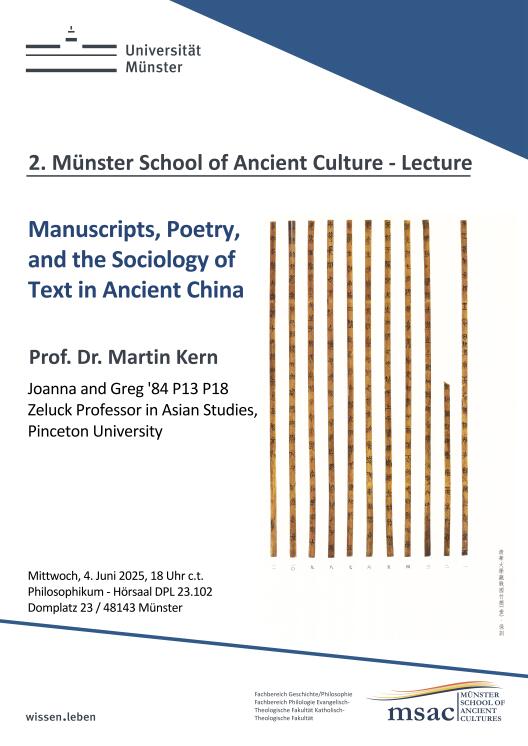
Recent decades have seen the discovery of large numbers of ancient Chinese manuscripts on bamboo, wood, and silk, some archaeologically retrieved, others looted. Their contents range from literary, philosophical, and historical texts to administrative, legal, medical, divinatory, mathematical, and other technical writings. Most prominent among the literary bamboo manuscripts from the Warring States period (453–221 BCE) is the ancient Classic of Poetry. Its related manuscripts allow for a comparative study of their material and visual features, textual contents, and—where known—local funerary contexts across multiple finds. Such comprehensive analysis suggests that all these manuscripts, both unprovenanced and archaeologically recovered, derive from a single place, time, and sociological context: the royal capital of the ancient state of Chu in south-central China around 300 BCE where a small group of literary but lowly-ranked scholars used these writings to provide traditional education to the royal elite at court.

The conference book "Bridges in the Ancient Mediterranean", written by the MSAC-Fellow-Workshop "Bridges in Antiquity" (Jul 2022) will be published on February 10th, 2024 as Bd. 26 from the series "Mittelmeerstudien", which is edited i. a. by board member Prof. Dr. Achim Lichtenberger. Congratulations to our fellows Anna Falke and Florian Neitmann for an amazing workshop and for publishing the volume!