
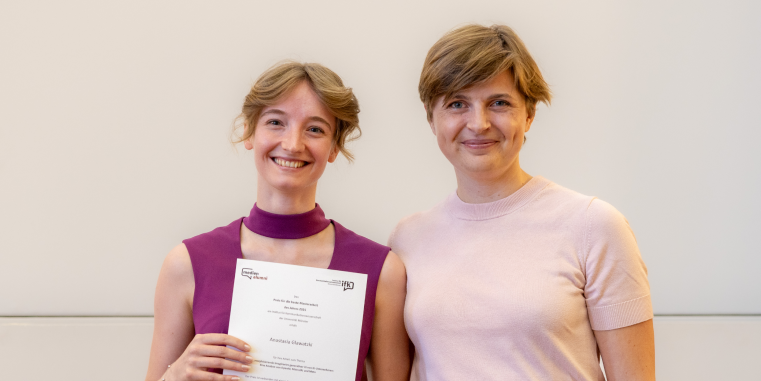
MedienAlumni Münster e.V. awards the 2025 Prize for Best Thesis to Anastasia Glawatzki
(28.07.2026) The jury was most impressed by the master's thesis on the attribution of human characteristics to artificial intelligence.
Artificial intelligence (AI) is transforming the economy, the workplace, and everyday life by making processes more efficient, enabling new services, and facilitating data-driven decision-making. At the same time, it presents both opportunities and risks – for example, in terms of ethics, privacy, security, and social inequality – which is why responsible governance and regulation are essential.
In this regard, it is of the utmost importance to investigate how AI companies view their technology and intend to integrate it into society. This is the focus of Anastasia Glawatzki’s master’s thesis. Supervised by Dr. Anne Mollen and Prof. Dr. Sigrid Kannengießer, the thesis examines how AI companies (OpenAI, Mistral AI, Meta) humanize generative AI in their documents (“anthropomorphization”) and thereby construct sociotechnical visions of the future (“imaginaries”). Two central research questions guide the thesis: Which anthropomorphizing imaginaries do the companies employ, and how is the technology portrayed as influential in future societies through anthropomorphism?
Previous research has mostly focused on anthropomorphism from the perspective of users. Companies as anthropomorphizing actors have been scarcely studied, even though these Big Tech firms occupy a “hegemonic position” in shaping the future of AI, largely without democratic legitimacy.
To answer her research questions, Ms. Glawatzki conducted a qualitative, content-structuring analysis of 36 corporate documents, followed by a typology to derive types of agency. The author identified three central anthropomorphizing imaginaries shared by all three companies: 1. AI as a tool with human capabilities that increases human productivity; 2. AI as an empowering assistant that relieves fallible humans of routine tasks; 3. AI as an anthropomorphized superintelligence that develops autonomously but also harbors potential dangers from which the companies themselves wish to “save” themselves.
The author highlights that all three imaginaries obscure corporate interests (profit, market power) as well as societal costs (e.g., dependencies, exploitation of human labor for AI optimization, devaluation of human creativity and relationships). Theoretically, this thesis expands the concept of anthropomorphism to include a dimension of influence and a strategic level of agency. The concept of “imaginaries” is supplemented by a normative dimension of democratic legitimacy, since influential companies such as Meta and OpenAI are able to implement their visions of the future through infrastructure to a far greater extent than other social actors.
The jury based its decision on the thesis’s excellent theoretical examination of the research topic of the humanizing imaginaries of generative AI. By addressing a highly topical issue, the thesis is highly relevant, innovative, and distinguished by a critical, deeply reflective engagement with artificial intelligence and AI tools.
The comprehensive answers to the two research questions have yielded essential insights not only for democratic societies, which are increasingly shaped by AI and AI companies. The findings of the thesis have important implications, particularly for journalism, regarding the use of artificial intelligence. In the jury’s view, the author has addressed a controversial research topic critically and impartially. For the field of communication studies, her outstanding analysis and interpretation of the findings open up new avenues for research on artificial intelligence and technology companies – and on how we, as a society, (should) deal with this technology.
Anastasia Glawatzki therefore deserves the award for the best master’s thesis of 2025. With this award from MedienAlumni Münster e. V., she receives prize money in the amount of 500 euros. The award for the best master’s thesis of the previous year is presented once a year by MedienAlumni Münster e. V.
This year’s jury consisted of Dr. Laura Badura (product manager and team lead for “Editorial Solutions” at the innovation and digital agency ida), Anne Elshorst, M.A. (senior audience researcher at RTL in Hamburg), Desiree Hammer, M.A. (research assistant at the Institute for Communication Studies), and Dr. Annika Summ (specialist for social innovation in the Research and Transfer Division at Carl von Ossietzky University of Oldenburg).
Contact person public relations:
Dr. Stephan Völlmicke
Telefon: +49 251 83-23006
Telefax: +49 251 83-21310 (Geschäftszimmer IfK)