
Excursion to the SPIEGEL magazine in Hamburg
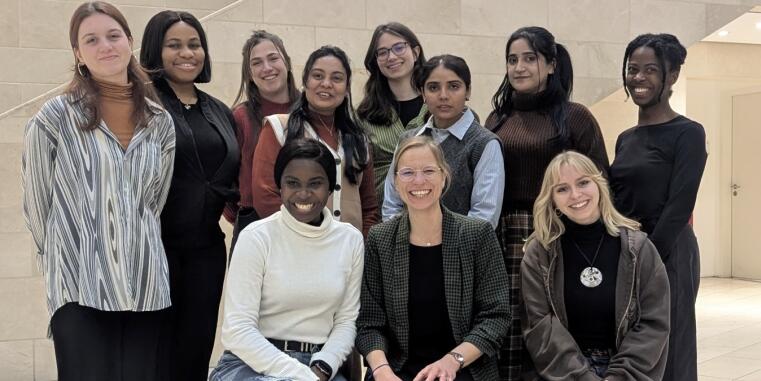
(30 January 2026) Master's students from the Department of Communication visited the SPIEGEL magazine in Hamburg in mid-January. There they spoke with journalists from SPIEGEL, manager magazin and Harvard Business Manager. The excursion took place as part of a seminar in the new English-language Master's programme ‘Knowledge and Communication’.
In the seminar ‘Knowledge Transfer’ (Dr Pamela Nölleke-Przybylski), the Master's students are dealing with various facets of knowledge transfer in and through journalism during the current winter semester: How and under what conditions does journalism convey scientific findings? How does it process data into knowledge and how does it use AI in the process? And what role does user data play in the design of journalistic offerings? The Master's students were able to discuss all of these questions with professionals during the excursion.
Karin Stawski, Head of Digital at manager magazin and Harvard Business Manager, explained how user dashboards influence the planning and design of journalistic articles. She spoke about the aspiration to produce investigative business journalism and about editorial decisions in the area of conflict between usage-based data and journalistic goals, such as promoting greater visibility for women in business. Wiebke Harms, editor at Harvard Business Manager, presented the medium's licensing model and discussed with the students the challenges, but also the appeal, of her work for a ‘warm brand’ between business and science journalism.
Gerret von Nordheim, deputy head of the documentation department, provided insights into the use of artificial intelligence at DER SPIEGEL publishing house. He presented the publisher's own AI tools, as well as the underlying technologies and prompts, and explained how the 60-strong documentation department works. He also addressed the challenge of establishing new technical tools in editorial work processes.
The day trip was financially supported by MedienAlumni Münster e.V. This enabled two students from the Master's programme in Communication Studies to travel to and from the event free of charge, in addition to students from the Master's programme in Knowledge and Communication.
The Department of Communication would like to thank the journalists and editorial teams involved for their time and the insightful insights into their editorial work.