Hot Science Communication Lab

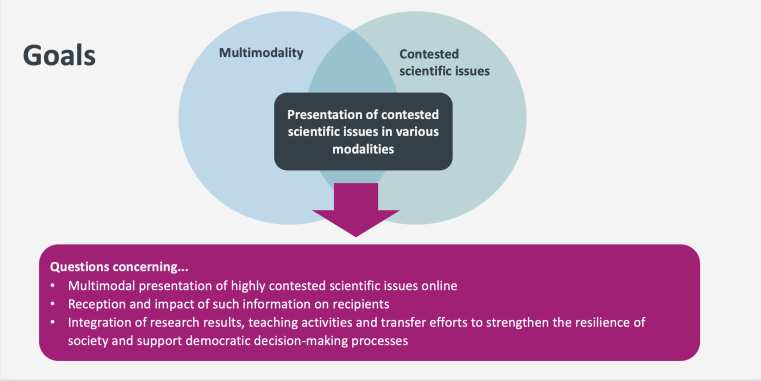
The "Hot Science Communication Lab" deals with scientific topics that are highly controversial. The particular challenge of such ‘hot’ science communication lies in its multimodal character, which includes text, images, sound and interactive elements. Social media, generative AI, deep fakes and memes create an information environment in which multimodality ‘heats up’ science communication. The lab therefore focuses on the interface between multimodality and controversy in science communication.

The research conducted in the lab will entail (computational) analyses of multimodal content, as well as experiments and surveys. Integral to this endeavor are research visits abroad, along with a fellowship program enabling researchers to visit the Hot SciComm Lab. In teaching, the lab will be closely integrated in the master’s program “Knowledge & Communication”. Embracing an innovative “think-and-do tank model” as a transfer strategy, the lab will identify trusted messengers and organize workshops to empower them to effectively communicate about multimodal controversial scientific topics.

Duration: 01.10.2025-30.09.2029

Funding: Volkswagen Foundation
Goals
© IfK

News

  • Launch of the lab

    The Hot Science Communication Lab was launched on 1 October 2025. 

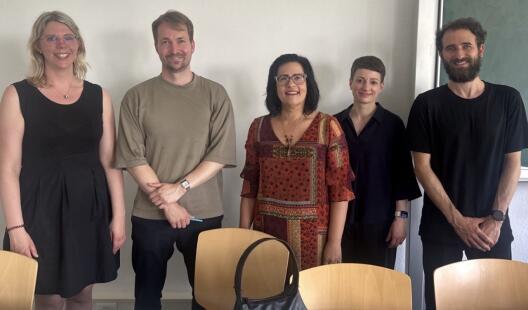
    Team of the Hot SciComm Lab
    © IfK
  • New Essay: Multimodality in Science Communication on Contested Issues

    On April 22, 2026, Julia Metag and Florian Wintterlin published an essay in the Journal of
    Science Communication (JCom). The work was produced as part of the “Hot Science
    Communication Lab” project, funded by the VolkswagenStiftung.
    In “Why multimodality matters when science is contested”, we argue that the combination
    of different communication modes – text, images, videos, and audio – has significantly
    increased in science communication through digital platforms. Multimodality plays a
    particularly crucial role in contested scientific issues such as climate change or vaccination,
    because it enables viral spread, emotional persuasiveness and personalization. The essay
    demonstrates that multimodal content offers both opportunities for accessible and
    engaging science communication and risks through disinformation, deepfakes, and AI-
    generated content.
    We advocate for a stronger engagement with the interplay of different modalities and for
    the further development of computational methods to analyze multimodal science
    communication. The essay is available open access at:
    https://jcom.sissa.it/article/pubid/JCOM_2503_2026_Y01/.

  • Research Visit at the Centre for Climate Communication and Data Science in Exteter

    From May 4th to 8th, the Hot Science Communication Lab went on a research trip. Julia Metag
    and Florian Wintterlin visited the Centre for Climate Communication and Data Science (C3DS)
    at the University of Exeter. Their host is Prof. Saffron O’Neill, Co-Director of C3DS and Professor
    in Climate & Society. The visit focused on exchange around computational analysis of
    multimodal science communication.


    C3DS coalesces social and computational social science to explore climate change
    visualizations. At the intersection of AI, social science, and climate communication, the centre
    examines how strategic communication can contribute to effective climate action and how
    modern information environment promotes or hinders comprehensive climate action.
    On Wednesday, May 6th, Julia Metag and Florian Wintterlin presented their work in the C3DS
    lunch talk “Why Using More Than Words Matters When Science is Controversial”.