
Latest News from the CES

Farewell note by Mario Graña Taborelli and Hayley Roy

Mario Graña Taborelli and Hayley Roy were fellows at the CES from 1 October 2025 to 31 Mach 2026. They would like to take the opportunity to share with us the results of their work

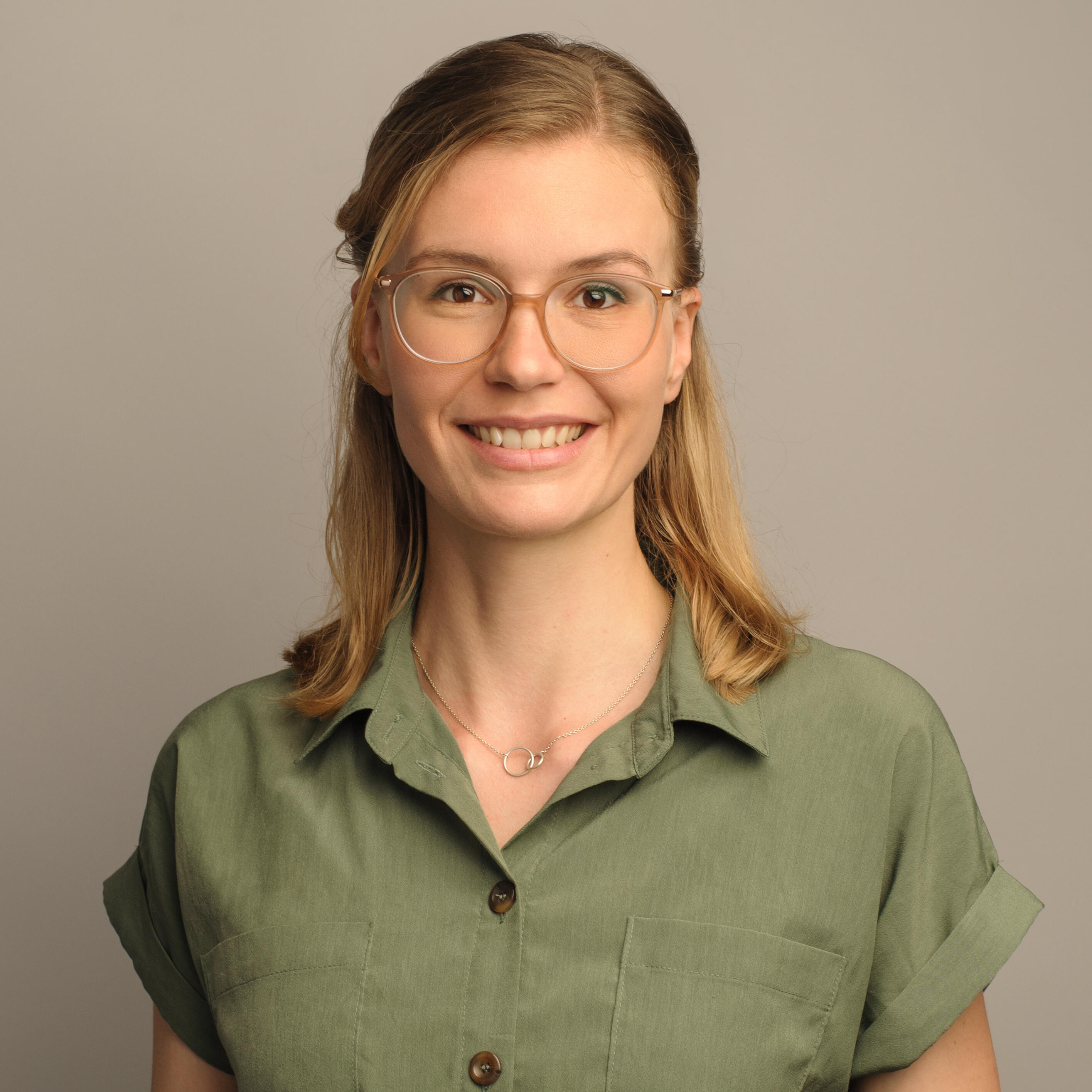
Hayley Roy: 

"As my fellowship at the Centre for Empire Studies concludes, I am pleased to share an overview of what I have accomplished during my time in Münster. 
As proposed, I finished two dissertation chapters during my tenure here, both concerned with empire, women’s mobility, and the global circulation of healthcare knowledge.  The first is a comparative study of six important nurses who travelled to work in German East Africa before 1890, which carefully examines the role of class and confession in interpersonal connections between nurses, authorities, and patients.  The second investigates the role of the colonial encounter in regulating and standardizing nursing in Germany by focusing on a meeting in the Foreign Office in March of 1890, which sets forth the argument that nursing professionalization was accelerated in the colonies compared to at home in Germany. 
Sections from both chapters formed the cores of the two presentations I made here.  Giving a talk at the Modern History Research Colloquium was a great way to kick off the fellowship and establish connections with professors and students in the Historical Seminar.  It was also meaningful to participate in the weekly colloquium as an audience member for the remainder of the semester.  
I am very thankful for the opportunities to help co-organize and present in the “Imperial Frontiers – Local and Global Entanglements” Workshop, which were immensely rewarding experiences.  The workshop itself provided an invaluable exchange with outstanding scholars from Europe, Asia, and Latin America.
I’d especially like to thank my friend and colleague Dr. Mario Graña Taborelli for helping me to think through imperial frontiers, as well as innumerable other questions and ideas across space and time, throughout our six-month stay in Office 126. 
In addition to my dissertation chapters, I wrote abstracts and drafted papers for the American Association for the History of Nursing/American Association for the History of Medicine Conference, as well as the German Historical Institute’s Transatlantic Doctoral Seminar, which have both been accepted for the upcoming summer.  
I also proposed a poster presentation for the American Historical Association’s 2027 Conference, which would be based on a digital mapping project that began to take shape here in Münster. The results have yet to be announced. 
Finally, I applied for and won a Dissertation Completion Fellowship at Emory University’s Fox Center for Humanistic Inquiry, where I will reside for the 2026 – 2027 academic year. 
I hope to keep in contact with my colleagues and friends at the CES and to find fruitful ways to continue our collaborations and exchanges going forward.  I thank the Centre for Empire Studies and the University of Münster for the chance to be here and share my work."

Mario Graña Taborelli

"Just wanted to share, as my fellowship with the Centre for Empire Studies (CES) at Universität Münster is coming to a close, that as part of my commitment, I drafted two articles that have been sent for publication to Autoctonía http://www.autoctonia.cl/index.php/autoc and Revista Complutense de Historia de América, https://revistas.ucm.es/index.php/rcha two academic journals rated as Q1 and Q2, from Latin America and Spain, respectively.

As planned, I explored through them the subject of “locality” in the construction of empires.

The first article, titled “Defending One’s Own. Yanaconas, Soldiers, and Citizens in the Construction of Locality in the Valleys of Tomina, Jurisdiction of the Royal Court of Justice of Charcas Early in the Seventeenth Century” identifies and explains three stages in this process “locality” construction, focused on the analysis of a petition that residents drafted in 1606, centred on a narrative of a “poverty-stricken and at war” region. The document’s cacophony is studied to make visible/widen our view of diverse social groups, including “soldiers” and “yanaconas”. Whereas the studies on these Indigenous peoples have been centred on their role as workforce; in this article, they are presented in a novel manner as carriers of local knowledges and active participants in the defence of their frontier, which broadens our view of the participation -voluntary or not- of conquered Indigenous peoples in empire construction.

The second article, titled, “Hombres pláticos [sic]. Territorialisation and Captains in the Frontier of Tomina in the district under Jurisdiction of the Royal Court of Justice of Charcas towards the end of the Sixteenth Century”, is focused on three Spanish/mestizo captains (Pedro de Segura Zavala, García Mosquera and Melchor de Rodas) and their role and that of their networks, including unconquered Indigenous chiefs, in the territorialisation of that space. It highlights the importance of these often overlooked “practical men” who had knowledges of normativities, languages and were frequently well integrated into mestizo and Indigenous societies, which facilitated and shaped the territorial expansion of the 16th Century Spanish empire. Through these characters, it is possible to outline such process as relational, cultural, and centred on conflict. This second article will be part of a dossier called “Actors, Negotiations and Resistance in the Iberian Monarchies’ Frontiers. 16th through 17th Centuries” edited by José Sovarzo, Hugo Contreras, and Patricio Vergara from Universidad de Chile and Universidad de Los Andes in Chile.

Furthermore, I have drafted two post-doctoral research projects -a DFG and an Early Career Leverhulme project- taking advantage of the university’s well-stocked libraries -of history, law, romance languages, and ethnic studies- and Germany’s fabulous inter-library lending scheme. I also wrote four book reviews, in English and Spanish, that are under publication with Boletín del Instituto de Historia Argentino y Americano “Dr. Emilio Ravignani”, The Sixteenth Century Journal, Bulletin of Latin American Research, and Renaissance Quarterly.

It was also a great pleasure to support the university’s PhD and BA students with comments, literature and insights into their theses and work.

It was also amazing to participate in three CES-Workshops -including one that I helped to organise- on “Hostages in the Wide Eurasian World”, “Imperial Frontiers- Local and Global Entanglements” and “the Latin American PhD Students Workshop”. I cherished these opportunities and learned a lot from colleagues.

Finally, I would like to thank everyone at the Centre and the University and Libraries, and my colleague Hayley Roy, that made me feel so welcome during my six-months stay. I am missing you all already."

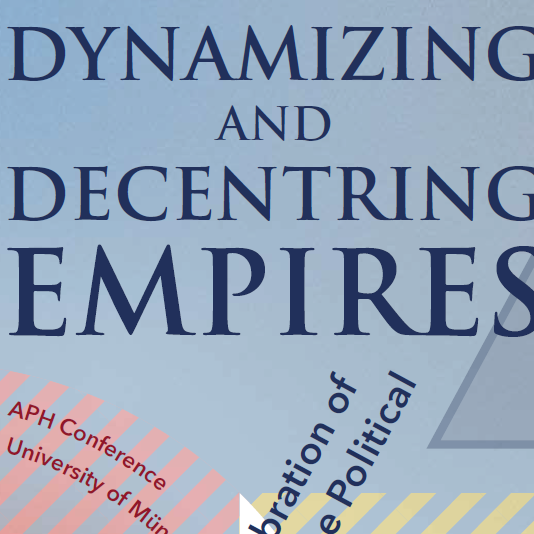
APH-Conference: Call for Papers Panels and Posters 

The organisers of the Association for Political History (APH) and their partners are calling for papers, panels and posters. From 11 to 13 June, the topic "Dynamising and Decentring Empires: A Recalibration of the History of the Political" will be explored in depth at a three-day conference. The venue is the University of Münster.

Further information can be found in the CfP.
© Stefan Klatt

Announcement on our own behalf:
On 26 June 2026, an CES internal workshop will be held in room F072 from 9 a.m. to 2 p.m. in the Fürstenberghaus.
If you have any questions or are interested, please contact sarah.albiez-wieck(at)uni-muenster.de by email.

Centre for Empire - Conference announcement
© Centre for Empire Studies

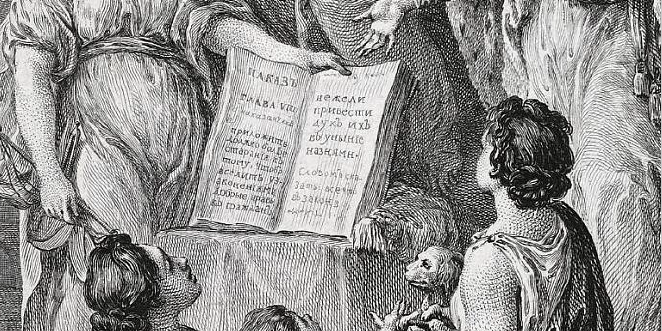
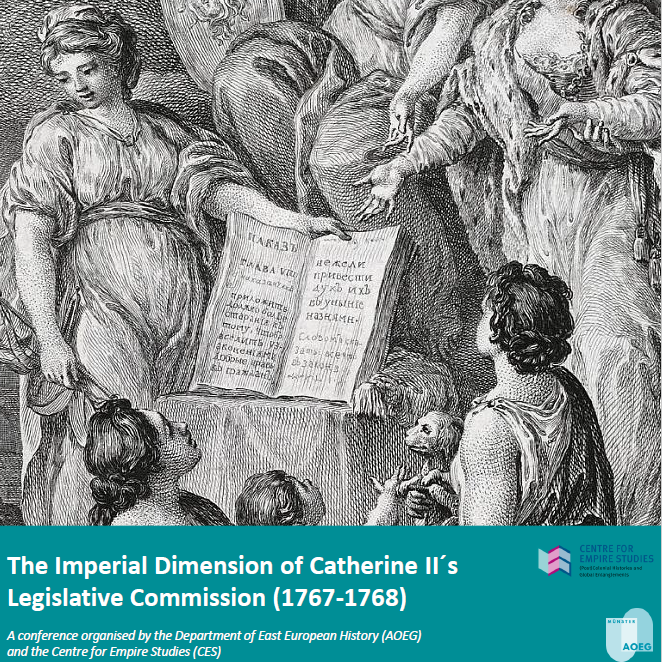
Announcement Tagung: The Imperial Dimension of Catherine II's Legislative Commission (1767–1768)

The conference "The Imperial Dimension of Catherine II's Legislative Commission (1767–1768)" will be hosted by Prof. Dr. Ricarda Vulpius and Prof. Dr. Lena Marasinova from the Department of Eastern European History at the University of Münster's History Seminar in collaboration with the Centre for Empire Studies (CES) on March 12–13, 2026.

Those interested in participating in the conference can register by writing to Irina Rempel (irina.rempel(at)uni-muenster.de).

The program can be found here: Program

Centre for Empire Studies
© CES

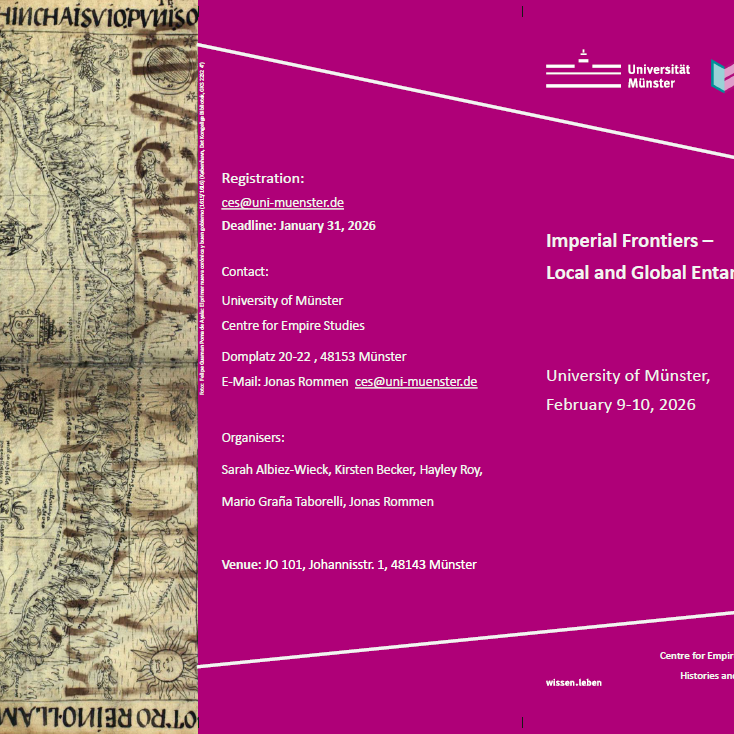
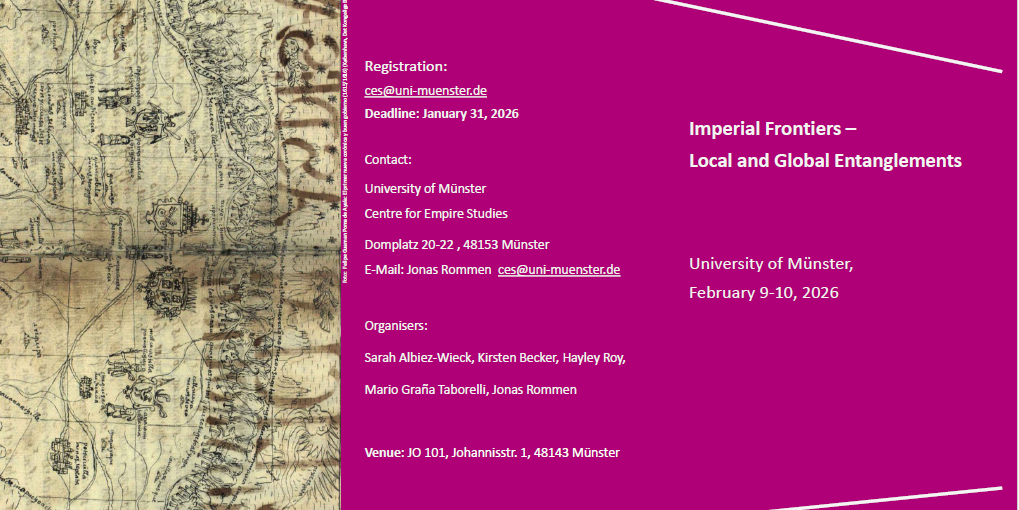
Announcement: CES workshop on Imperial Frontiers. Global and local entanglements

On 9 and 10 February 2026, the CES will hold a workshop on the topic:  ‘Imperial Frontiers. Global and local entanglements’.

Those interested can register to participate in the workshop by 31 January 2026 at ces(at)uni-muenster.de.


The detailed programme for this conference can be found here: CES Workshop Programme

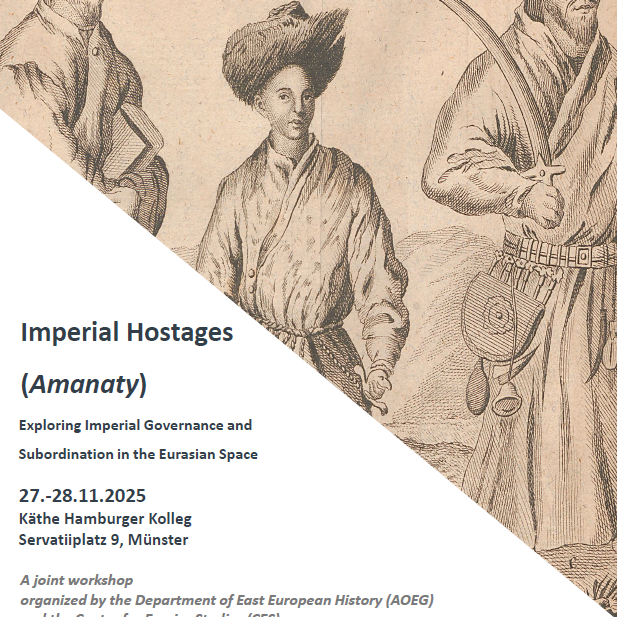
Imperial Hostages (Amanaty) Exploring Imperial Governance and Subordination in the Eurasian Space
© Ricarda Vulpius

On 27–28 November 2025, a workshop on the topic of ‘Imperial Hostages (Amanaty) Exploring Imperial Governance and Subordination in the Eurasian Space’ will take place at the Käthe Hamburger Kolleg in Münster. This workshop is being organised by the Institute for Eastern European History at the University of Münster in cooperation with the Centre for Empire Studies (CES).

You can find the detailed programme for this conference here: Programme

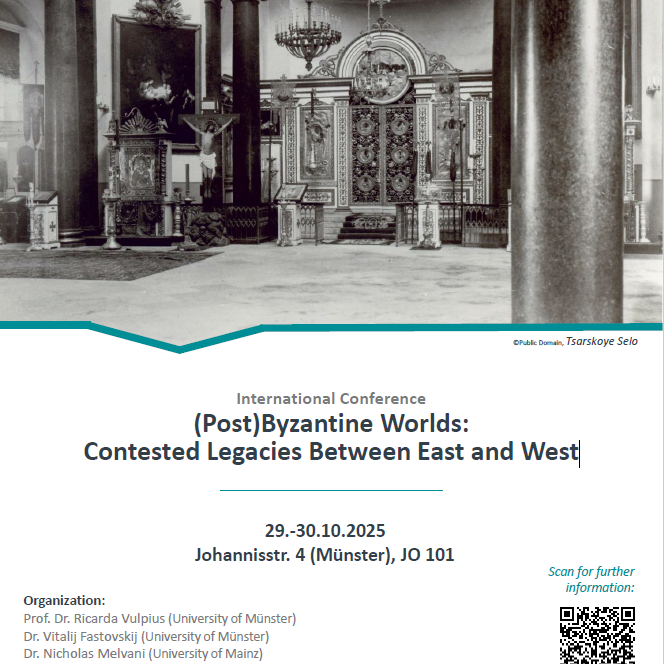
Conference (Post)Byzantine Worlds: Contested Legacies between East and West
© Ricarda Vulpius

On October 29-30.2025, an international conference will be held in Münster on the topic of “(Post)Byzantine Worlds: The (Eastern) Roman Heritage between East and West.” The conference is a collaboration between several institutes from various universities.

The participating institutions are the Department of East European History, University of Münster (Prof. Dr. Ricarda Vulpius), Chair of Eastern European History, University of Mainz (Prof. Dr. Jan Kusber), Institute for Byzantine and Modern Greek Studies, University of Münster (Prof. Dr. Michael Grünbart), Chair of Byzantine Studies, University of Mainz (Prof. Dr. Johannes Pahlitzsch), Cluster of Excellence “Religion and Politics” and the Centre for Empire Studies: (Post)colonial Histories and Global Entanglements (CES)

Conference Programme (Post)Byzantine Worlds: Contested Legacies between East and West
© Ricarda Vulpius
Centre for Empire informes:
© Stefan Klatt

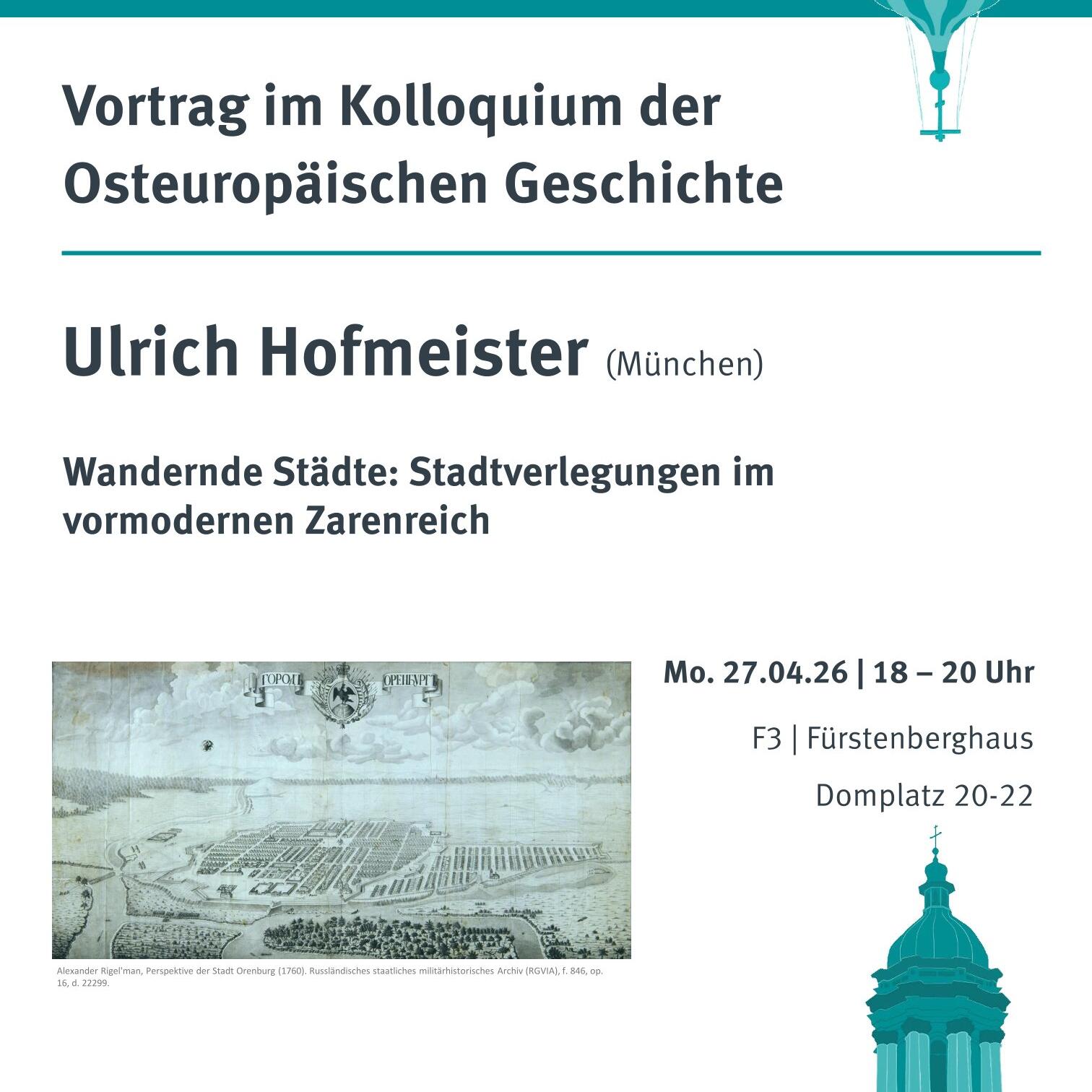
This Wednesday, October 29, 2025, the two new fellows at the Centre for Empire Studies, Hayley Roy and Mario Graña Taborelli, will give a lecture on their current research project as part of the Modern and Contemporary History Colloquium. The lectures will begin at 6:15 p.m. in Room F3 (Fürstenberghaus, Domplatz 20-22). Both speakers will present in English.

The two lectures are briefly presented below:


Hayley Roy (Emory University (USA))
"Networks of Nurses: Debating Nursing Practice in the German Overseas Empire, 1890 - 1907"

What is the role of nursing in German colonialism, and what is the role of colonialism in the development of the nursing occupation in Germany? This presentation sets the groundwork for answering these questions by outlining the activities of nurses working in German overseas territories around 1900. It begins with a brief history and overview of the historiography of nursing in German history, then discusses how the colonial project made secular nursing not only possible, but encouraged, which marks a significant and understudied departure from this tradition. Women’s presence in overseas territories did not go uncontested. The talk will explain tensions and debates about the role of the nurse that resulted in a more professionalized version of nursing in the colonies than would have been possible in Germany proper at that time.


Mario Graña Taborelli (UCL (London))
"Building Political Density, "Equipping the Land": Entangled Jurisdictions, Political Cultures, and Law in the Construction of a Frontier in the Early Modern Iberian Worlds"

Mario Graña Taborelli’s presentation is a review of his ongoing research on the political construction of a frontier space of the Early Modern Iberian Worlds. It suggests a periodisation for the process of territorialisation of the borderlands of the east of Charcas (colonial Bolivia) in the sixteenth century, exploring key concepts, and the vocabulary that reflects such process. It also informs of the findings in this research so far and of potential directions of this research moving forward. Finally, it discusses the idea of frontiers.

Semester Lecture Centre for Studies - Winter Term 2025/26
© Jonas Rommen

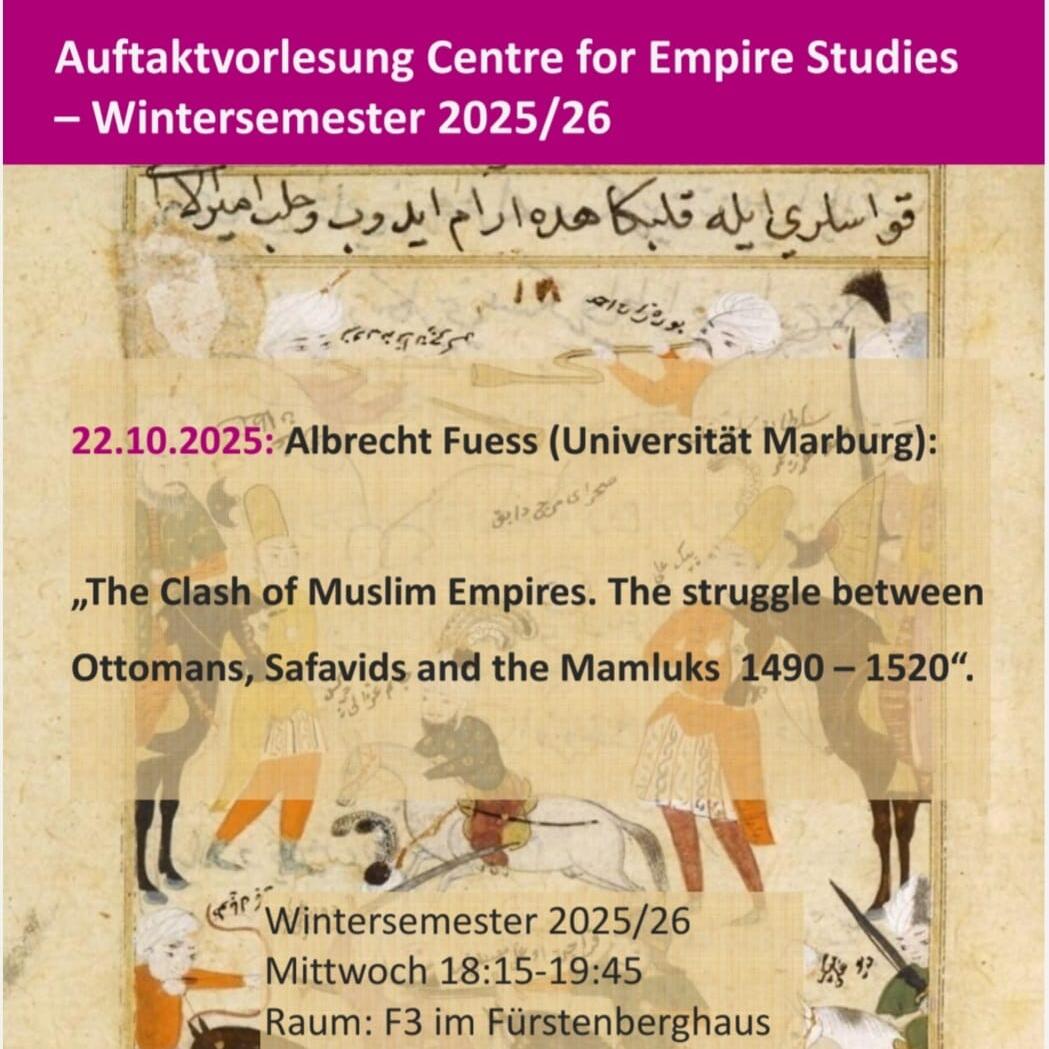
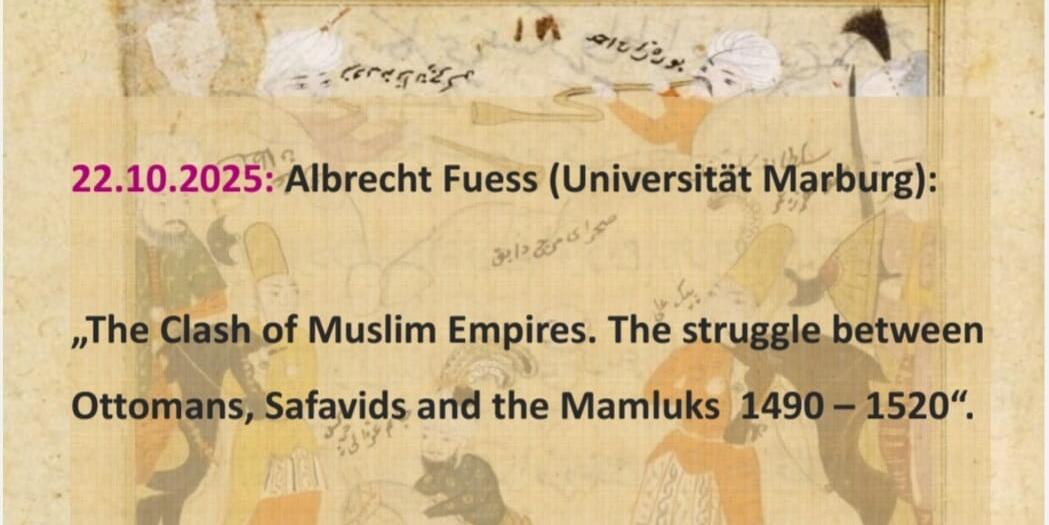
The CES is organising a semester lecture in the coming winter semester. On 22 October Prof. Dr. Albrecht Fuess from the University of Marbirg will speak at the colloquium about "The Clash of Muslim Empires. The struggle between Ottomans, Safavids and the Mamluks 1490 - 1520".

The speaker, Albrecht Fuess, is a professor of Islamic Studies at the University of Marburg.  


Tip: Colonialism theme room

At the Münster City Museum, visitors can follow in the footsteps of German colonialism in Münster.

Since 22 August, the Colonialism themed room has been open to visitors at Münster City Museum. The exhibition was developed in collaboration with the University of Münster and several partner institutions and can be visited until 15 February 2026.

Announcement: Semester Lecture CES

The CES is organising a semester lecture in the coming winter semester. On 22 October Prof. Dr. Albrecht Fuess from the University of Marbirg will speak at the colloquium about "The Clash of Muslim Empires. The struggle between Ottomans, Safavids and the Mamluks 1490 - 1520". 

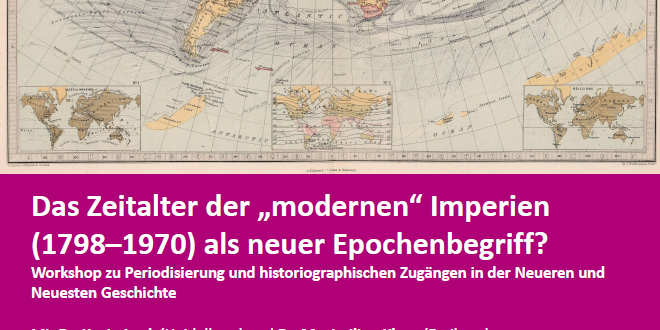
Workshop Standardisierung und Empire (19./20. Jh.)

On 15 and 16 May 2025, PD Dr Caroline Rothauge (Münster) and PD Dr Nina Mackert (Leipzig) are organising the workshop "Standardisierung und Empire (19./20. Jh.)" together with the Centre for Empire Studies Interested parties are welcome to register by 5 May 2025 at the latest.

FELLOWSHIPS at the Centre for Empire Studies

The Centre for Empire Studies: (Post)Colonial Histories and Global Entanglements (CES) at the University of Münster welcomes applications for fellowships for a period of up to six months starting 1 October 2025
© Neele Teneyken

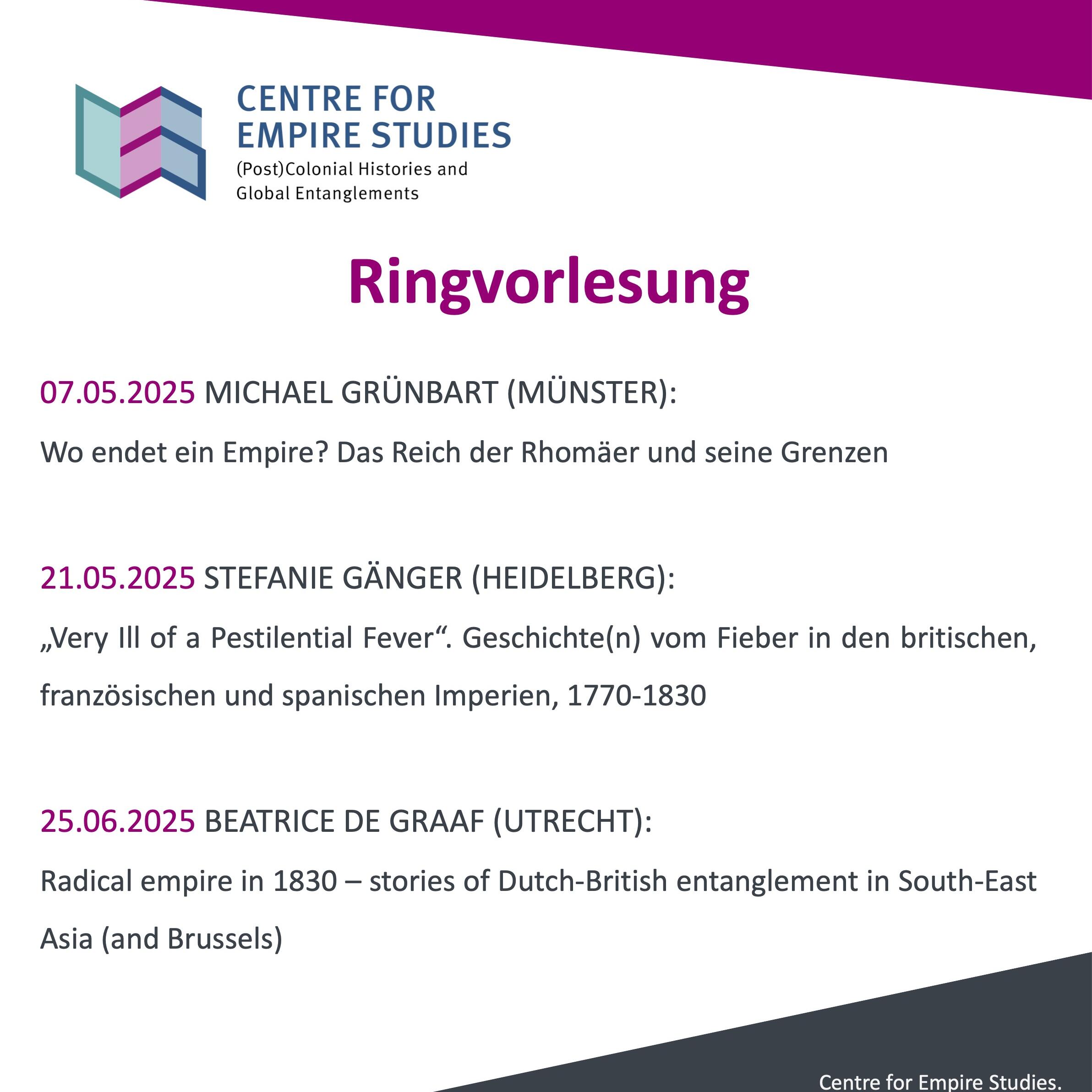
Announcement: lecture series CES

The Center for Empire Studies. (Post)Colonial Histories and Global Entanglements will continue last summer's successful lecture series in the coming year: a lecture from the field of Empire Studies will take place on three dates in the summer semester 2025.

See the full programme here

© Uni MS – Stefan Klatt

Successful opening conference of the Centre for Empire Studies

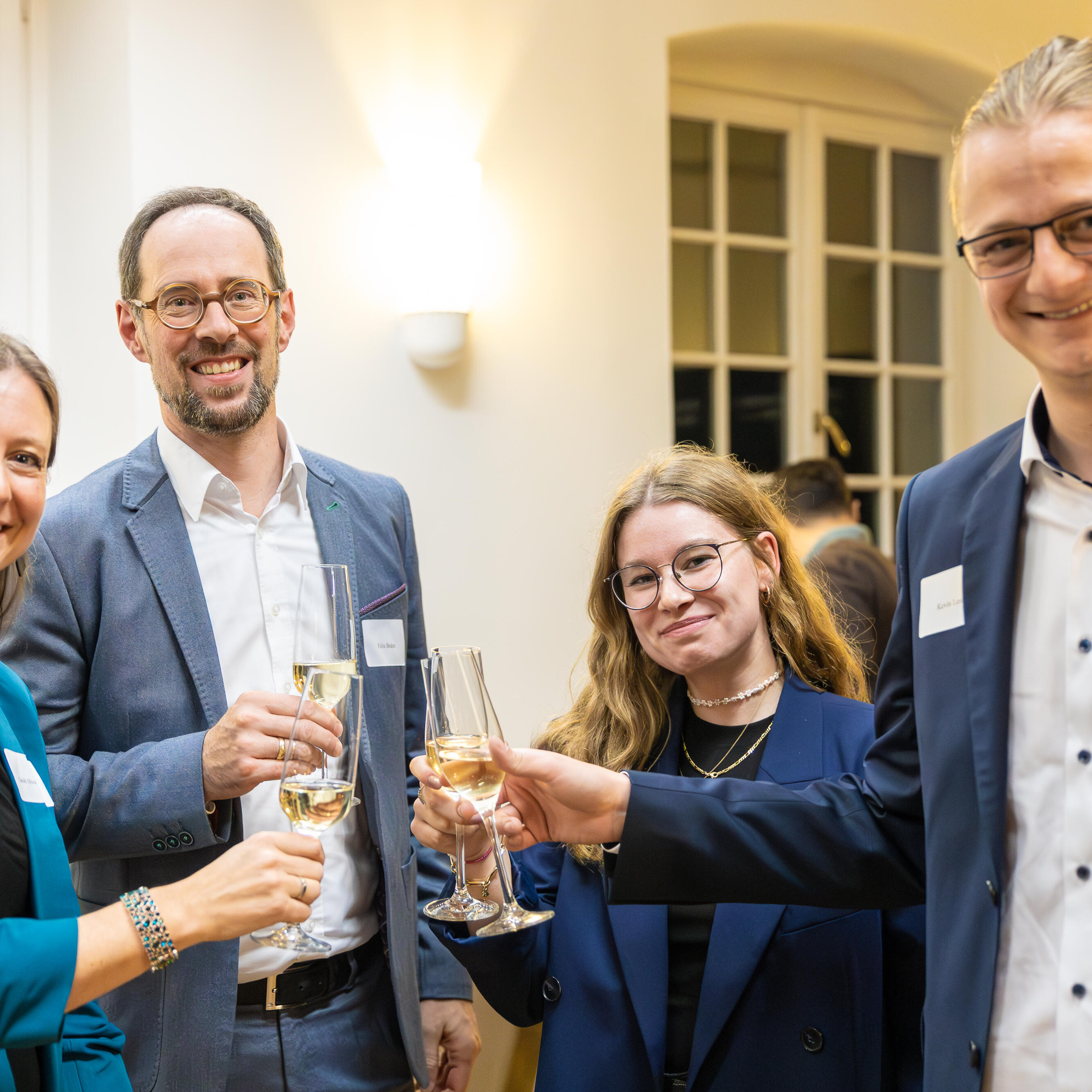
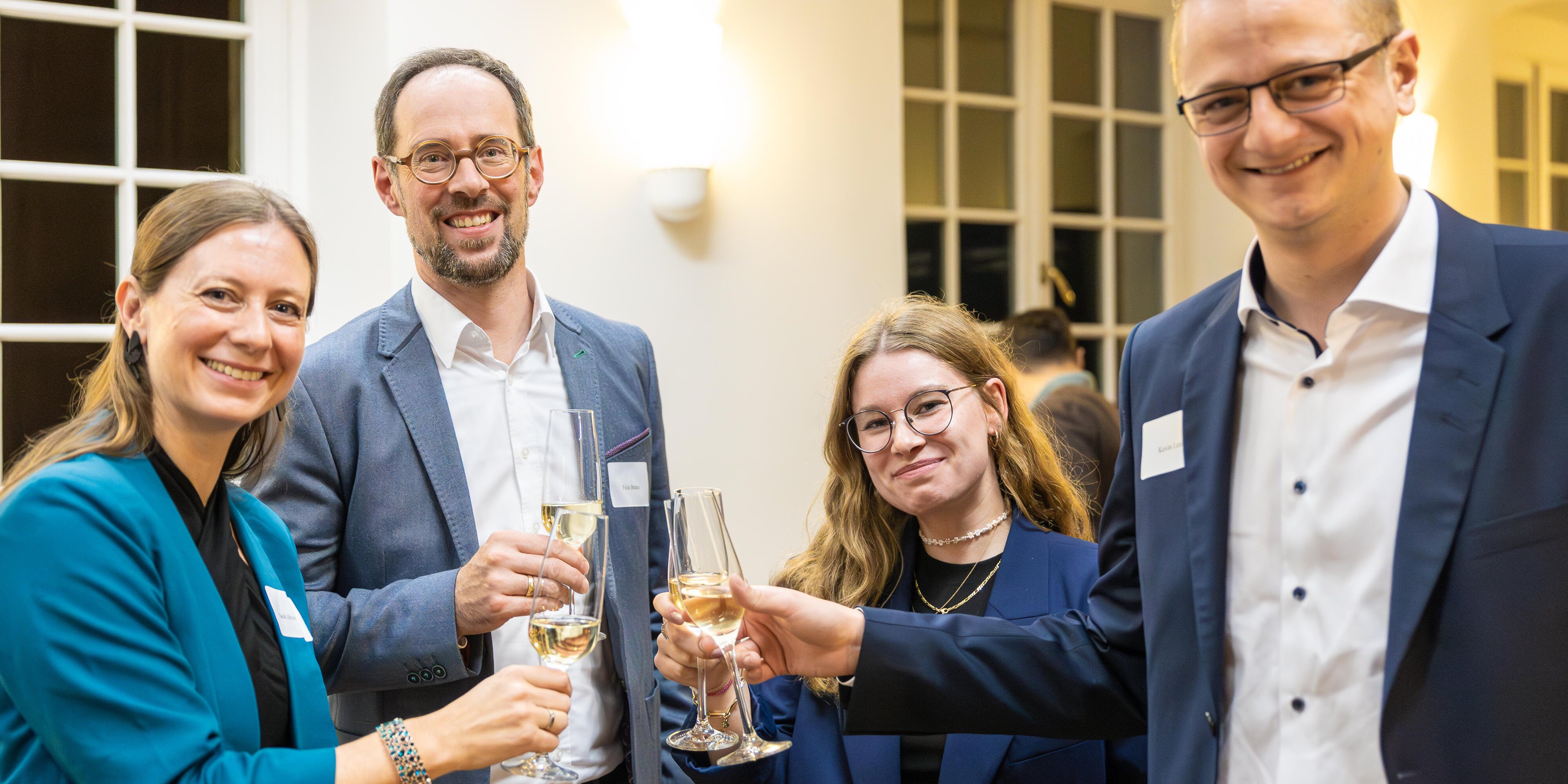
Following the official founding of the CES in June of this year, the opening conference took place on 10 and 11 October 2024. The two days of the conference attracted many internal and external guests to the interesting lectures and, not least, the evening keynote speech by Frederick Cooper and Jane Burbank, which led to a stimulating exchange between all guests.